Two years ago, on a rainy Tuesday in November, I watched a grown man cry over a mechanical pencil.
Not a fragile man. Not a sentimental collector of antiques. He was a thirty-eight-year-old software architect named Marcus—a hypothetical composite of three different friends I have watched burn out over the last decade—who spent sixty hours a week inside Slack threads, Jira boards, and glowing terminals. I had handed him a heavy, hexagonal brass Rotring 600 for his birthday, wrapped in brown butcher paper with a notebook made of cream-colored Japanese Tomoe River paper. He clicked the knock mechanism once. The tiny metallic snick echoed in the quiet kitchen. He turned the barrel in his fingers, feeling the cold, knurled metal bite slightly into his thumb, and his eyes went bright with sudden, overwhelming relief.
"Nothing on this," he whispered, staring down at the brass cylinder, "is going to ask me to verify my identity."
We laugh when we hear lines like that, mostly because the alternative is admitting how exhausted we really are. Every December, gift guides churn out predictable roundups of the best analog gifts that outrank any phone app, treating physical objects like novelty retro toys for hipsters who drink pour-over coffee. They miss the point entirely. Choosing an analog gift today isn't about nostalgia, and it certainly isn't about rejecting progress. It is an act of self-defense.
When you hand someone a physical object that does one thing well, without a screen, a battery, or a terms-of-service agreement, you aren't just giving them a thing. You are giving them an exit ramp.
The Architecture of Infinite Friction
To understand why a simple brass pen or a wooden chess set carries so much emotional weight right now, look at what happened to our pockets over the last fifteen years.
My own breaking point arrived during a winter trip to the coast. I wanted to track the morning tides so I could walk the cliffs before breakfast. Naturally, I downloaded a tide app. Before I could see a single wave height, the software demanded an email address, asked permission to track my location across other companies' apps, offered a seven-day free trial for a $49.99 annual subscription, and flashed three banner ads for waterproof Bluetooth speakers. By the time the tide chart finally loaded, the sun had already risen, my coffee was cold, and my heart rate was up. I hadn't looked at the ocean once.
Psychologists call this continuous partial attention, though that clinical phrase barely captures the low-grade nausea of modern digital life. Every app on your phone—even the benevolent ones meant to help you sleep, meditate, read, or write—is built inside an economy that survives on your distraction. You open a meditation app to quiet your mind, and a red notification badge from your bank catches your eye on the home screen. You open a digital Kindle to read a novel, and a pop-up asks if you want to share your highlight to social media.
Digital tools are frictionless to start and endless to escape. Analog tools invert that equation completely.
Think of a physical object like a cast-iron skillet, whereas a smartphone app is a fast-food drive-thru. The drive-thru is effortless until you realize you're eating lukewarm food in a parking lot while engines idle around you. The skillet is heavy. You have to heat it slowly, oil it, and wash it by hand. Yet that very weight—that physical resistance—anchors you to the room you are standing in. Behavioral researchers have documented this phenomenon for decades under the banner of embodied cognition: the human brain literally processes information, retains memories, and regulates stress differently when the hands engage with textured, three-dimensional matter.
When we buy someone a subscription to a mindfulness app or a smart mug that connects to Wi-Fi, we are unintentionally handing them another tiny supervisor. Another thing to charge. Another firmware update waiting in the dark.
Paper That Remembers What Screens Forget
Consider what happens when you replace a digital note-taking app with a fountain pen and heavy cotton paper.
In 2014, psychological scientists Pam Mueller and Daniel Oppenheimer published a landmark study comparing students who took notes on laptops with those who wrote longhand. The laptop typists captured far more words, transcribing lectures almost verbatim, yet they performed significantly worse on conceptual questions afterward. Because typing is so fast, the brain bypasses deep processing and acts like a stenographer. Writing by hand is slow. You cannot write down every word, so your brain is forced to listen, synthesize, filter, and translate ideas into your own architecture before the ink ever hits the page.
I started keeping a pocket notebook three years ago after realizing I couldn't remember a single thought I had typed into my phone's Notes app the previous month. Those digital notes sat in an invisible cloud, unvisited and weightless.
Now, when I want to give someone the gift of clear thinking, I skip the iPad stylus and go straight to the tools that make writing feel tactile and deliberate. A Leuchtturm1917 hardcover notebook or a Japanese Midori MD journal paired with a Lamy Safari fountain pen changes the physical posture of the person using it. You cannot doomscroll on paper. A blank page does not refresh with breaking news while you are mid-sentence. When you close the cover, the thoughts stay safely inside the room until you choose to open them again.
There is an intimacy to ink that pixels never replicate. Six months later, you can flip back through a paper notebook and see where your handwriting hurried during an argument, where a drop of rain smudged a margin on a train platform, or where the ink pooled slightly while you paused to choose the right word. Apps store data; paper stores time.
The Sound of Music You Have to Stand Up to Play
Walk into almost any living room today and look at how people listen to music. Someone murmurs a command to a smart speaker, or taps a glass rectangle, and an algorithm begins feeding an invisible, infinite stream of tracks chosen by a machine learning model in Stockholm or California. Music has become wallpaper—effortless, ubiquitous, and strangely disposable.
Now watch what happens when you give someone a manual belt-drive turntable—something honest and repairable like a Pro-Ject Debut Carbon or an entry-level Audio-Technica LP120X—along with two or three records that shaped their twenties.
Everything slows down.
You have to pull the vinyl sleeve from the shelf. You slide the heavy black disc out by its edges, careful not to leave fingerprints on the grooves. You place it on the platter, brush away the dust with a carbon-fiber brush, cue the tonearm, and gently drop the needle. Then comes that unmistakable, warm hiss right before the first bassline drops.
Because you cannot skip a track with a flick of your thumb from across the room, you listen to the album the way the artist actually sequenced it. You hear the quiet bridge between song three and song four. Twenty minutes later, the needle reaches the run-out groove, making that rhythmic shhh-thunk, shhh-thunk sound that forces you to stand up, walk across the rug, and flip the record over.
I gave a refurbished turntable and a secondhand copy of Miles Davis’s Kind of Blue to my younger sister during a brutal winter when she was working night shifts at a hospital. She told me months later that flipping that record became the boundary line between her job and her life. While the record spun, she wasn't allowed to look at her phone. Those twenty minutes belonged strictly to the horns, the upright bass, and the steam rising off her tea.
The Silent Tyranny of the Wrist
We have turned our own bodies into dashboards.
Millions of people wake up every morning and immediately check an app to find out how well they slept. Instead of asking themselves how they feel—whether their shoulders are tight, whether their mind feels clear, whether the morning air smells crisp—they consult a readiness score generated by an accelerometer strapped to their wrist. We have outsourced our own intuition to sensors.
Giving someone a mechanical wristwatch—a Seiko 5 Sports, a Hamilton Khaki Field, or a simple hand-wound Timex Marlin—is a quiet revolution against that surveillance.
Inside a mechanical watch, there is no microchip, no Bluetooth antenna, and no lithium-ion battery waiting to die in four years. Instead, there is a coiled metal mainspring, a balance wheel oscillating back and forth several times a second, and dozens of microscopic brass gears meshing together in pure physical harmony. When you wind the crown in the morning, you are literally transferring kinetic energy from your thumb and index finger into a tiny machine that will carry that energy through your day.
A mechanical watch loses or gains a few seconds a day. It is slightly imperfect, just like the person wearing it. Yet when you glance down at your wrist during a dinner party to check the hour, you see the sweep of a second hand—and nothing else. No Slack message from your boss. No breaking news alert. No reminder that you only closed two of your activity rings. You get the time, and you get to stay present with the people sitting across the table.
Games Without Patch Notes
Think about the last time you played a game on your phone. Even a good one. Beneath the colorful graphics, modern mobile games are engineered by behavioral economists using variable-ratio reinforcement schedules—the exact same psychological mechanism that powers slot machines in Las Vegas. They use artificial timers, daily login streaks, and microtransactions to manufacture anxiety when you aren't playing.
Now place a solid wooden chess set, a walnut backgammon board, or a set of heavy clay poker chips on a coffee table.
There are no updates to download. The rules of Go haven't needed a balance patch in over two thousand years. When you sit across from another human being over a physical board, the technology disappears entirely, leaving only eye contact, posture, bluffing, and the tactile satisfaction of sliding a weighted wooden knight across a square.
Last winter, during a three-day power outage caused by an ice storm, my neighbors and I pulled out a worn wooden Cribbage board and a deck of Bicycle playing cards by candlelight. None of us had cell service. For the first time in years, nobody reached instinctively into their pocket during a lull in conversation. We shuffled cards, argued over scoring rules, laughed until our ribs ached, and watched the hours pass without once checking a clock. When the electricity finally hummed back to life at midnight, none of us felt relief. We felt a strange, sudden grief that the spell had broken.
Morning Rituals Without a Wi-Fi Password
Even our mornings have been colonized by screens. We wake up to phone alarms, check weather apps before looking out the window, and brew coffee with programmable machines that blink blue LED error codes at us before we are fully awake.
Replacing a single morning habit with a purely mechanical tool changes the emotional temperature of an entire day.
Consider the Bialetti Moka Express, the octagonal aluminum stovetop espresso maker invented in Italy in 1933, or a manual Comandante hand coffee grinder paired with a Chemex glass pour-over carafe. Using a hand grinder takes roughly forty-five seconds of steady cranking. You feel the resistance of the roasted beans cracking between the steel burrs; you smell the volatile oils blooming right under your nose before the hot water even touches the grounds.
Or look at a simple Braun analog travel alarm clock—the classic matte-black cube designed by Dieter Rams—sitting on a nightstand. When you give someone an analog alarm clock, you give them permission to leave their smartphone charging in the kitchen overnight. That single boundary eliminates midnight doomscrolling and stops the first waking seconds of every morning from being hijacked by emails, headlines, and notifications. You wake up to a gentle mechanical beep in a quiet bedroom, not a glowing rectangle demanding your attention before your feet even touch the floor.
Capturing Light Instead of Data
We take more photographs every single day than humanity took during the entire nineteenth century, yet almost nobody looks at them. They vanish into camera rolls of forty thousand unedited files, buried beneath screenshots of parking receipts and recipes we never cooked.
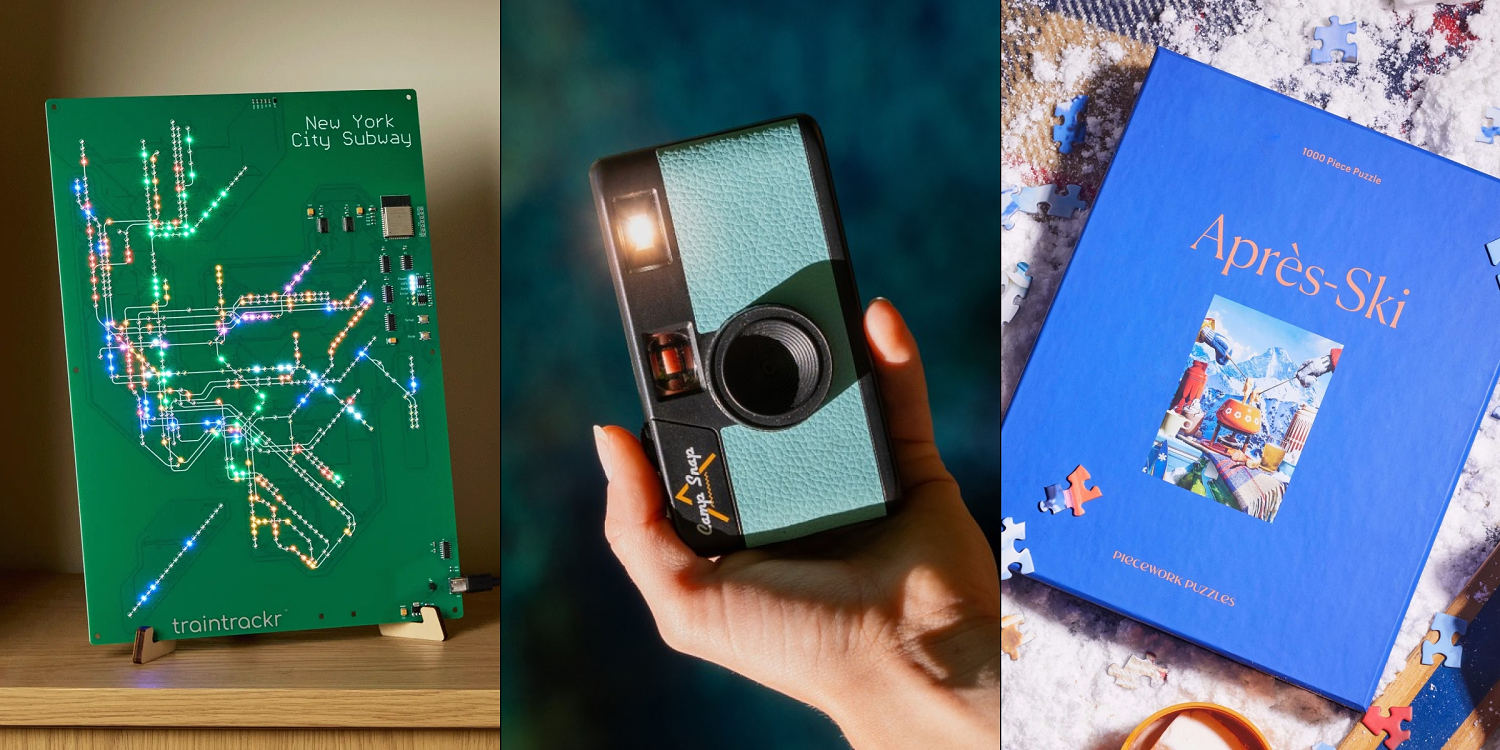
Handing someone an analog film camera—whether a refurbished Pentax K1000, a weatherproof Nikonos, or even a compact reusable 35mm point-and-shoot with three rolls of Kodak Portra 400—restores gravity to the act of looking.
When you only have thirty-six frames on a roll of film, and each click of the shutter costs real money to develop, you stop spraying photos blindly at your brunch. You wait for the light to hit your friend's face properly. You compose the frame through an optical viewfinder that doesn't show you a histogram or an instant preview. You press the shutter button, feel the mechanical mirror slap upward, wind the film advance lever with your thumb, and walk away without knowing for certain if you got the shot.
Weeks later, when the envelope of prints arrives from the lab, opening it feels like uncovering buried treasure. Even the imperfect shots—the ones with slight motion blur or warm light leaks—carry an emotional truth that AI-sharpened smartphone photos sanitize right out of existence.
The Courage to Give Something Heavy
I will admit something I rarely say out loud when people ask me for gift advice: buying an analog gift takes nerve.
It is scary to hand someone a physical object in an era where everyone claims they want less clutter and more convenience. You worry they will think a paper notebook is antiquated, or that a hand-cranked coffee grinder is too much work, or that a physical board game will gather dust on a closet shelf. Digital gifts feel safe because they vanish into the ether; they don't take up space on someone's dresser, and they don't ask the recipient to change their habits.
Yet that risk is precisely why these gifts matter.
Every app on a smartphone whispers the same seductive lie: that life should be frictionless, instant, and infinitely optimized. But human beings aren't built to live inside frictionless environments. We are creatures of weight, texture, resistance, and rhythm. We need tools that push back slightly against our hands so we remember we are actually here, inhabiting physical bodies in a real room, spending finite hours that cannot be backed up to the cloud.
Last month, I stopped by Marcus's apartment for dinner. His laptop was closed on the dining table, pushed off to the side beneath a stack of mail. Next to his coffee cup sat that heavy brass Rotring pencil, worn smooth along the hexagonal edges where his fingers rested every day, resting atop a thick Tomoe River notebook whose pages were swollen and wavy with months of dark blue fountain pen ink.
He didn't mention the pencil, and neither did I. He simply picked it up, clicked the knock mechanism once with a crisp metallic snick, and drew a quick, confident line across the paper while we talked.