Cold marble echoes differently in December.
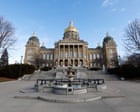
Walk into the Iowa State Capitol during the holidays, and the air smells faintly of floor wax, damp wool coats, and evergreen. Sunlight filters down from the soaring 275-foot golden dome, catching the brass railings and illuminating a quiet, annual ritual of civic pride. School choirs sing. Legislators pose beside towering spruce trees. Families from Des Moines and Cedar Rapids snap photos in front of traditional nativity scenes.
It feels warm. It feels settled. It feels like home.
Until someone brings a goat-headed statue into the rotunda.
That is the precise moment the warmth evaporates, replaced by a fierce, high-stakes collision over what the First Amendment actually demands when polite society gets uncomfortable. Recently, a federal judge stepped into this exact firestorm, ordering the state of Iowa to permit The Satanic Temple to host its holiday event inside the Capitol building.
To read a standard news brief on the ruling is to absorb dry legal mechanics: a motion for a preliminary injunction, state administrative rules, public forum doctrine, and a victory for religious pluralism. You read it, nod, and scroll past.
You miss the tremor beneath the floorboards.
Because this legal battle is not really about horns, heavy metal aesthetics, or holiday trolling. It is about an invisible tripwire woven into the fabric of American democracy. When a government opens its doors to celebrate one faith, it quietly signs a binding contract to welcome every other faith—including the ones that make the neighbors flinch.
The Architecture of a Public Square
To understand why a federal judge had to intervene in Des Moines, picture a hypothetical town square—let us call it Maplewood—where the mayor decides to build a massive, gleaming bulletin board right outside City Hall.
At first, the mayor invites local churches to pin up flyers for their Christmas pageants and Easter egg hunts. Everyone smiles. The community feels cohesive. Then, one Tuesday morning, a small group of non-theistic activists walks up with a hammer, a nail, and a poster celebrating the winter solstice through the lens of literary Satanism. Suddenly, the mayor realizes the bulletin board is full. He invents a new rule on the spot: no posters that might "disrupt the peaceful atmosphere" of the plaza.
In constitutional law, that mayor just walked straight into a buzzsaw.
Once the government creates what courts call a "designated public forum"—a space opened up for expressive activity by private citizens—it surrenders its right to act as an ideological bouncer. It can enforce neutral rules about time, place, and manner. It can say, "No posters larger than three feet," or "Everyone must take their flyers down by five o'clock." What it cannot do is read the message on the flyer and decide whether the viewpoint is wholesome enough for public consumption.
This is the exact trap Iowa officials stepped into.
For years, the Iowa Department of Administrative Services allowed a wide array of religious and civic groups to reserve space in the Capitol rotunda during the holiday season. Christian groups routinely held prayer rallies, displayed nativities, and sang carols under the rotunda's grand arches. The state welcomed them, viewing the Capitol as a vibrant hub for citizen expression.
Then came The Satanic Temple.
When the organization applied to hold a holiday event at the Capitol—following their previous, deeply controversial Baphomet display in the same building that sparked national outrage and eventually led to vandalism—state officials tightened the screws. They denied the permit, citing revised event guidelines aimed at curbing activities deemed incompatible with the decorum and family-friendly nature of the Capitol's holiday programming.
State lawyers argued they were merely maintaining order and protecting the integrity of a historic government building. The Satanic Temple argued something far simpler: they were being singled out because state officials hated their message.
The Weight of the Unwelcome Guest
I still remember the first time I watched a similar free-speech battle unfold in a small midwestern county courthouse, years before I ever studied constitutional law.
The hallway was cramped, smelling of stale coffee and wet umbrellas. On one side stood a crowd of lifelong residents holding laminated Bibles, their faces tight with genuine, aching sincerity. To them, the courthouse lawn was sacred ground, a reflection of the moral bedrock that held their town together through droughts and factory closures. On the other side stood three outsiders holding signs demanding the removal of a Ten Commandments monument, or else the installation of their own atheist plaque beside it.
Standing between them, I felt a profound sense of vertigo. Both sides looked terrified. The townspeople felt their heritage was being mocked and erased by cynical provocateurs. The outsiders felt like second-class citizens in their own country, forced to walk past a government-endorsed theology every time they went to pay a traffic ticket or register a deed.
That memory always surfaces when headlines about The Satanic Temple hit the news cycle. It is easy to dismiss the group as mere performance artists or shock jocks in clerical collars. Indeed, the organization openly states that it does not believe in a literal, horned devil; instead, it uses Satan as a literary symbol of rebellion against arbitrary authority, championing bodily autonomy, rational inquiry, and strict separation of church and state.
Yet dismissing their legal challenge as a prank misses the deadly serious mechanics of the law.
In the eyes of the First Amendment, sincerity is not measured by how mainstream your theology looks. Whether a group gathers to pray to Jesus of Nazareth, light a menorah, celebrate the winter solstice, or read poetry praising Lucifer as a symbol of enlightenment, the state must wear a blindfold.
When Iowa officials denied The Satanic Temple's permit while continuing to approve traditional Christian holiday events, they took the blindfold off. They peeked at the content of the speech. And in federal court, peeking is fatal.
Inside the Judge’s Chambers
When the dispute landed before the federal court, the legal questions stripped away all the cultural outrage and boiled down to a ruthless test of consistency.
Did the state of Iowa apply its event rules neutrally, or did it weaponize administrative red tape to silence an unpopular viewpoint?
The evidence pointed overwhelmingly toward the latter. Under established Supreme Court precedent—stretching back decades through landmark cases involving religious student groups, street preachers, and controversial parades—viewpoint discrimination is considered an egregious violation of the First Amendment. Even in a "limited public forum," where the government can restrict the subject of discussion (for instance, limiting a school board meeting strictly to school business), it still cannot discriminate based on viewpoint within that subject.
If the subject is "holiday celebrations in the Capitol," the state cannot say, "Christian holiday celebrations are welcome, but Satanic holiday celebrations are banned."
The federal judge’s ruling was a sharp reminder of this constitutional bedrock. By ordering Iowa to allow The Satanic Temple’s event to proceed, the court affirmed that the First Amendment does not come with a popularity clause. The Constitution was not written to protect speech that everyone applauds; speech that everyone applauds needs no protection. It was written specifically to shield the jarring, the unpopular, and the deeply offensive from the heavy hand of state censorship.
Consider what happens next if the ruling had gone the other way.
Imagine a progressive state government in California or New York deciding that traditional evangelical Christian views on marriage or abortion are "disruptive" to the inclusive atmosphere of its state capitol. Using the exact same logic Iowa attempted to deploy, officials in Sacramento or Albany could quietly rewrite administrative guidelines to bar conservative prayer groups from holding rallies on public steps.
The sword of censorship never cuts in only one direction. Today, it strikes down a Satanic holiday gathering in Des Moines. Tomorrow, held by different hands, it strikes down a pro-life vigil in Denver or an interfaith peace rally in Boston.
The Exhaustion of Pluralism
Still, acknowledging the legal brilliance of the ruling does not erase the human friction it leaves behind. We should be honest about that. Living in a genuinely pluralistic society is exhausting.
It asks an extraordinary amount of emotional restraint from ordinary people. If you are a devout Christian walking through the Iowa Capitol with your children in December, seeing a display or an event hosted by The Satanic Temple feels visceral. It feels like a deliberate poke in the eye during a season meant for peace and reverence. Your frustration is real. Your desire for a shared, harmonious public culture is entirely human.
At the same time, if you are a non-religious taxpayer, a Jew, a Muslim, or a member of a minority faith walking into that same Capitol, seeing the state government exclusively elevate Christian symbols while slamming the door on everyone else sends an unmistakable message: This building belongs to them, not you.
The federal judge’s order forces both groups into the same room, beneath the same golden dome, under the exact same set of rules.
It is messy. It is loud. It strips away the illusion that we all believe the same things or celebrate the same miracles. And for state officials, it leaves only two constitutionally valid paths forward for future Decembers.
Either the state of Iowa keeps the doors of the Capitol rotunda wide open—welcoming the choirs, the nativities, the menorahs, the solstice gatherings, and the Satanic Temple alike—or it closes the forum entirely, banning all private religious displays and events from the building so the government remains strictly neutral.
What the state cannot do is play favorites.
The Echo Under the Dome
History shows us that societies rarely lose their freedoms in a single, dramatic collapse. More often, liberty erodes through quiet administrative adjustments—a permit quietly denied here, a rule selectively enforced there, all in the name of keeping the peace and avoiding offense.
In Des Moines, a federal judge slammed the brakes on that quiet erosion.
This December, when the doors of the Iowa State Capitol swing open, the air will still smell of floor wax and winter wool. The light will still pour down through the grand rotunda onto the polished stone floors. And right alongside the carols and the evergreen wreaths, a small group of citizens holding deeply unpopular beliefs will stand in the exact same light, protected by the exact same ink on a two-hundred-year-old piece of parchment.
Freedom rarely looks like a polished holiday postcard. Sometimes, it looks like a crowded hallway where nobody agrees, standing beneath a roof that belongs to everyone.