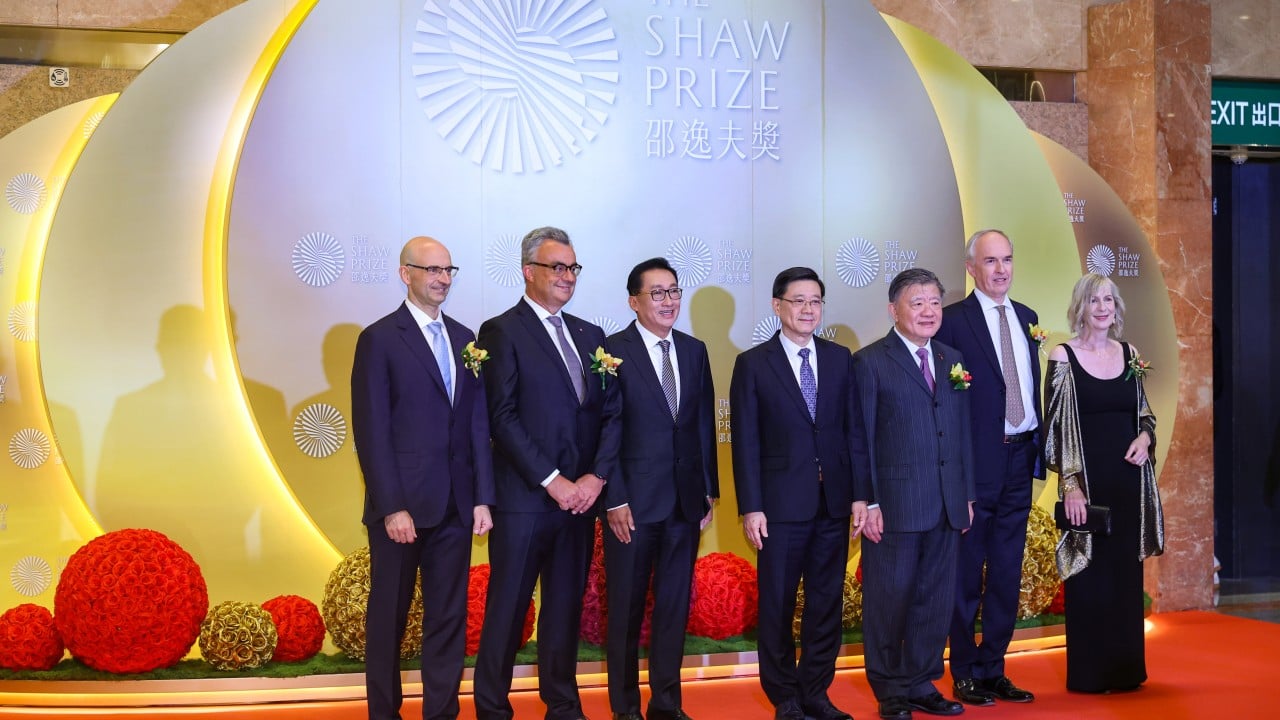
Rain streaks the floor-to-ceiling windows overlooking Victoria Harbour, blurring the neon towers of Kowloon into smears of amber and electric blue. Inside the Grand Hall of the Hong Kong Convention and Exhibition Centre, the air smells faintly of damp wool, white lilies, and hot stage lights. A string quartet finishes a final, lingering note. Then, two researchers—one trained in the stone-walled laboratories of Paris, the other in the glass-and-steel institutes of China—walk onto the stage together to accept the Shaw Prize.
Applause. If you enjoyed this piece, you might want to check out: this related article.
It is polite at first, the measured clapping of diplomats, university chancellors, and tuxedoed donors, before swelling into something warmer and slightly defiant as the laureates speak of "borderless connections" in science. The next morning, wire services and regional newspapers compress the entire evening into a neat, forgettable headline about a Chinese-French team celebrating international cooperation at the annual Hong Kong ceremony. Readers skim the paragraph over coffee, nod at the pleasant sentiment, and flip to the stock tables or the sports scores.
They miss the real story entirely. For another look on this story, check out the latest update from NPR.
When you strip away the banquet hall floral arrangements and the formal citations, that handshake on stage was not a routine academic photo opportunity. It was an act of quiet resistance against a world that is rapidly forgetting how human knowledge actually grows.
The Anatomy of a Headline We Almost Ignored
Standard news coverage has a peculiar talent for draining the blood out of human obsession. A dry summary tells you who won, names the institution, mentions the prize purse—currently 1.2 million US dollars for each of the three Shaw Prize categories in Astronomy, Life Science and Medicine, and Mathematical Sciences—and quotes a few lines about cross-border friendship. It reads like a corporate merger announcement.
What it leaves out are the years of 2:00 a.m. video calls across a seven-hour time difference, the customs forms stalled on desks in two hemispheres, and the sheer stubbornness required to keep a joint research project alive when geopolitics turns every shared dataset into a subject of suspicion.
I have spent enough years reporting from the edges of research campuses and sitting in fluorescent-lit corridors outside grant review panels to recognize the look on a scientist's face when a collaboration is forced to justify its own existence. It is a mixture of exhaustion and disbelief. Scientists rarely enter their professions to become diplomats. They enter because an equation refuses to balance, or because a cluster of cells behaves strangely under a microscope, or because a faint signal from deep space refuses to match the textbook model.
When Sir Run Run Shaw established the Shaw Prize in Hong Kong in November 2002, with the first awards presented in 2004, he built it around a deceptively simple premise: to honor individuals who have achieved breakthroughs in academic and scientific research that further societal progress, enhance quality of life, and enrich humanity's spiritual civilization, regardless of race, nationality, gender, or religious belief. Twenty-two years after that inaugural ceremony, those words read less like ceremonial boilerplate and more like a challenge thrown down at the feet of modern politics.
Two Labs, Seven Time Zones, and a Wall of Paperwork
To understand what "borderless connections" actually look like away from the cameras, consider a hypothetical scenario modeled directly on the daily realities facing Sino-European research teams today.
Picture two scientists. Call the first Dr. Claire Moreau, a structural biologist working out of a cramped, fourth-floor laboratory in Paris where the radiators hiss through November and the espresso machine is older than the doctoral students. Call the second Dr. Chen Wei, a computational geneticist in Shanghai whose team runs sequencing models on high-density servers humming behind triple-glazed glass.
In our hypothetical scenario, Claire has spent six years isolating a stubborn protein folding anomaly linked to a rare neurodegenerative disorder, but her lab lacks the longitudinal patient dataset needed to confirm whether the mutation behaves identically across diverse populations. Chen has spent those same six years analyzing genomic patterns across tens of thousands of clinical records in East Asia, yet his algorithms keep hitting a wall because he cannot visualize the three-dimensional atomic structure of the protein in motion.
Individually, both are brilliant. Individually, both are stuck.
When they finally connect at an international symposium and realize their halves of the puzzle lock together, the science moves at breakneck speed. The friction comes from everything surrounding the science. To ship a biological reagent from Paris to Shanghai, or to route encrypted clinical metadata from Shanghai to Paris, triggers months of overlapping compliance reviews, export-control screenings, and legal audits. A postdoctoral fellow waiting for a research visa watches an entire academic semester evaporate while security clearances bounce between ministries.
This is not an exaggeration cooked up for dramatic effect. According to the UNESCO Science Report, roughly one in four scientific research papers published worldwide now involves international co-authorship—a dramatic rise from the late twentieth century that powered breakthroughs from the Human Genome Project to the detection of gravitational waves. Yet tracking by Nature Index and major university consortia over the past several years shows a sobering reversal in bilateral ties between Western institutions and Chinese partners, as national security reviews, funding restrictions, and political skepticism have chilled routine exchanges.
Wait.
Think about what happens when a researcher in Paris hesitates before hitting "send" on an email to a colleague in Beijing or Shanghai, wondering whether sharing preliminary calibration data will invite an institutional audit six months later. Nobody passes a law banning curiosity. Instead, discovery dies by a thousand administrative paper cuts.
Why Nature Refuses to Read a Passport
To grasp why choking off those channels is so dangerous, it helps to use an explicit metaphor. Imagine two astronomers standing on opposite sides of the Earth, each looking through a powerful telescope at the night sky. Because the planet is a sphere, neither observer can ever see the entire celestial vault at once; the horizon always hides half the universe. Only by linking their observations across time zones—passing a fading star from one lens to the next as the Earth turns—can they track a transient cosmic event from birth to collapse.
Nature operates with complete indifference to border checkpoints. A pathogen mutating in a wet wetland ecosystem does not pause at customs. Atmospheric carbon drifting over the Pacific carries no nationality. Even pure mathematics, the most abstract of human pursuits, relies on a fragile relay race of ideas passed between minds shaped by entirely different educational traditions.
History offers hard, verified proof of what happens when Chinese and French scientific traditions collide in the best possible way.
Consider the landmark medical breakthrough in acute promyelocytic leukemia, known as APL, once one of the deadliest forms of blood cancer. Beginning in the late 1980s and accelerating through the 1990s and 2000s, Chinese clinicians and researchers in Shanghai—including Wang Zhenyi and Chen Zhu—worked alongside French molecular biologists in Paris, such as Hugues de Thé and Anne Dejean. By combining all-trans retinoic acid with arsenic trioxide, therapies rooted in Chinese clinical observation and decoded at the molecular level through transatlantic and Sino-French laboratory rigor, the teams transformed APL from a rapid death sentence into a disease with cure rates exceeding ninety percent.
That achievement was not born in isolation. It emerged because researchers crossed linguistic, cultural, and political divides, testing each other's assumptions until the underlying biology yielded its secrets. More recently, joint Sino-French astrophysics missions like the Space-based multi-band astronomical Variable Objects Monitor—SVOM, launched in 2024 to hunt gamma-ray bursts from the early universe—demonstrated the same principle in orbit: French gamma-ray cameras paired with Chinese optical and X-ray telescopes, scanning the heavens as a single instrument.
When a Chinese-French team stands on the Shaw Prize stage in Hong Kong, they are standing on the shoulders of that exact lineage. They are living evidence that different intellectual habits—the rigorous theoretical formalism long prized in French academies, paired with the massive experimental scale and rapid clinical translation seen in modern Chinese institutes—produce results neither system could generate on its own.
The Invisible Tax on Closed Doors
Still, let us be honest about the skepticism in the room. It is easy to feel cynical when reading lofty phrases about "borderless connections" in an official ceremony brochure.
If you follow global news, you know the counterarguments by heart. Governments worry—sometimes with legitimate reason—about intellectual property theft, dual-use technologies with military applications, and asymmetric access to research ecosystems. Ordinary citizens, watching industries shift and geopolitical rivalries harden, understandably ask why public tax dollars in Europe or Asia should subsidize joint ventures with strategic competitors. Even inside universities, administrators speak privately of the anxiety of navigating conflicting rules from Brussels, Washington, and Beijing.
It is confusing. Sometimes it is intimidating.
Yet when fear dictates the boundaries of basic science, we pay an invisible tax that never shows up on a government ledger. We pay for it in duplicated clinical trials that waste hundreds of millions of dollars testing compounds another lab already proved toxic. We pay for it in climate models missing regional atmospheric measurements, and in clean-energy battery chemistries delayed by five or ten years because materials scientists could not compare notes in real time.
Knowledge is not a finite pie where one nation's slice shrinks whenever another nation learns something new. In fundamental science, insight compounds. When a mathematician in Paris cracks a lemma and a colleague in Hong Kong or Beijing uses it to solve a fifty-year-old conjecture, the theorem belongs to everyone who ever picks up a pencil after them.
Hong Kong itself occupies a poignant geography in this story. Sitting at the maritime crossroads where southern China meets the wider world, the city has long served as a translator between systems. Holding the Shaw Prize ceremony there—under the quiet gaze of an international selection committee composed of some of the world's most respected scientists—sends a deliberate signal. It insists that excellence still has an objective standard, and that human curiosity remains larger than the flags sewn onto our sleeves.
What Remains After the Applause Fades
Late in the evening, after the photographers pack their tripods and the banquet tables are cleared of crystal glasses, the ceremonial speeches dissolve into the humid Hong Kong night. A medal made of gold-plated silver—stamped on one side with the profile of Run Run Shaw and on the other with a classical Chinese inscription reminding us that the laws of nature endure—tucks neatly into a velvet presentation box.
Tomorrow, the laureates will fly back to their respective cities. They will clear immigration queues, answer backlogged emails, and return to the unglamorous grind of grant applications and peer reviews.
Somewhere between Paris and Shanghai, as night falls over one laboratory and dawn breaks over the other, a shared server will blink quietly in the dark, carrying a stream of raw numbers from one set of human hands to another.