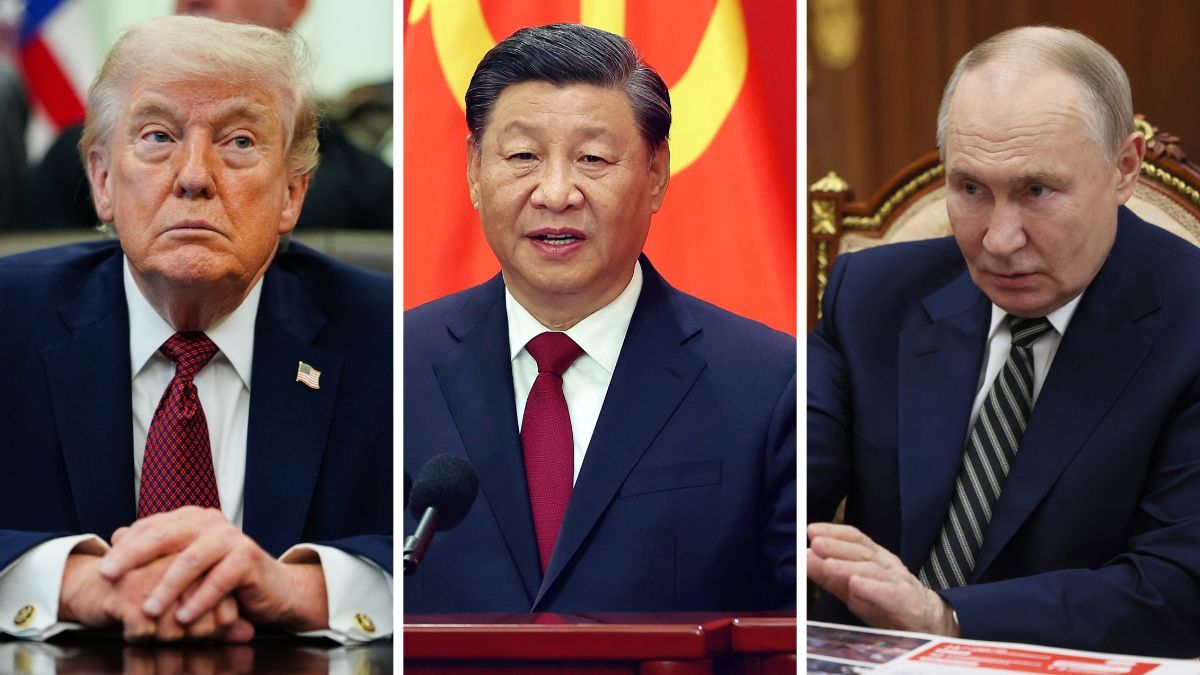
Picture a hypothetical room in Geneva, or maybe Astana, where the air conditioning hums too loud and three heavy leather chairs are spaced with mathematical precision around a polished walnut table. At one side sits Donald Trump, leaning forward, reading the room like a high-stakes real estate auction. Across from him sits Vladimir Putin, posture rigid, calculating leverage in decades rather than news cycles. And in the third chair—the one that makes seasoned diplomats across Asia and Europe stare twice—sits Xi Jinping.
Wait.
Look closely at that third chair. In traditional statecraft, a three-way summit between the leaders of the United States, Russia, and China sounds like basic common sense, the ultimate board meeting of global heavyweights. Yet foreign policy analysts, intelligence veterans, and Beijing watchers repeatedly describe a Trump-Putin-Xi trilateral summit as an "unusual step" for China. To understand why, you have to step out of the marble hallways of Washington and Moscow and look at the world through the eyes of someone who has spent their life navigating the quiet, deliberate rhythms of Chinese diplomacy.
For decades, Beijing has treated multilateral summits among rival superpowers the way a seasoned chess player treats a three-player board. In a two-player game, you know who your opponent is, you know what every piece is worth, and you control the tempo. Add a third player, and suddenly two people can quietly nod at each other across the table while you are left holding the bill.
The Architecture of Control
Consider a hypothetical veteran diplomat—let’s call him Ambassador Lin—who spent thirty years drafting talking points in Beijing’s Ministry of Foreign Affairs before retiring to a quiet apartment overlooking the Houhai lakes. If you ask Lin why China prefers bilateral meetings—one leader sitting across from one leader—he wouldn't start with grand ideological theory. He would talk about logistics, choreography, and the terror of the unscripted moment.
In Chinese diplomatic tradition, a leader’s appearance is never casual. Every handshake is timed to the second; every camera angle is vetted; every joint communiqué is negotiated word by comma weeks before the plane even touches the tarmac. When Xi Jinping meets Vladimir Putin one-on-one, Beijing controls half the script, and Moscow—deeply reliant on Chinese trade, energy purchases, and diplomatic cover—rarely surprises its partner. When Xi meets Donald Trump one-on-one, the unpredictability is higher, certainly, yet the variables remain contained within a single bilateral relationship: tariffs, technology controls, Taiwan, fentanyl precursors.
Put all three men in the same room, and that carefully engineered predictability evaporates.
Think of it like this: imagine you are negotiating a sensitive business buyout with a volatile competitor, and you decide to bring your closest supplier into the room at the exact same time. Suddenly, your competitor isn't just talking to you; he is winking at your supplier, offering side deals, and testing whether your partnership is actually as solid as you claim. You lose the ability to compartmentalize. You can no longer tell one partner what they want to hear without the other listening in real time.
The Ghost of the Cold War Triangle
To feel the weight of Beijing’s hesitation, you have to remember that China has been burned by triangular diplomacy before. History doesn't just sit in textbooks in Zhongnanhai; it sits in the room during every strategy session.
In the early 1970s, Richard Nixon and Henry Kissinger famously flew to Beijing to exploit the bitter ideological and border split between Mao Zedong’s China and the Soviet Union. Washington used one communist giant to balance the other, reshaping the Cold War in its favor. Beijing benefited enormously from that opening, of course, gaining access to Western markets and technology. Yet the deeper lesson etched into China’s institutional memory was clear: in any triangle of great powers, the two sides that talk best to each other hold the whip hand over the third.
For the past ten years, Beijing has enjoyed sitting at the pivot of the modern triangle. While relations between Washington and Moscow cratered over Ukraine, election interference, and sanctions, China maintained open—if often tense—channels with the United States while deepening its "no limits" partnership with Russia. Beijing could talk trade with American CEOs on Tuesday and conduct joint naval patrols with Russian warships on Thursday.
A Trump-Putin-Xi trilateral meeting flips that geometry upside down.
Why? Because Donald Trump has never hidden his desire to reset relations with Moscow, nor his belief that personal chemistry between strongmen can cut through decades of bureaucratic deadlock. From Beijing’s perspective, sitting in a three-way room creates an immediate optical and strategic hazard: what if Washington and Moscow find common ground faster than expected? What if the summit becomes a stage where Trump and Putin trade concessions over European security or energy markets, leaving Xi looking less like the indispensable mediator and more like a bystander watching a rapprochement he cannot control?
The Burden of Expectations
There is another, quieter reason Beijing treats a three-way summit as an extraordinary departure from its playbook. When China enters a room with the United States and Russia, the world doesn't just watch; it demands results.
Let’s step back into the shoes of an ordinary family in Warsaw, Taipei, or Seoul watching the evening news if such a summit were announced. To a mother in Warsaw worried about war spilling across her border, three leaders at one table means only one thing: a grand bargain on Ukraine. To a semiconductor engineer in Hsinchu, Taiwan, it sparks an immediate, cold anxiety that her island’s future might be traded away like a poker chip in a late-night session. To a factory owner in Guangdong already squeezed by tariffs and sluggish domestic demand, it looks like a high-wire act where one wrong word could trigger a new wave of export bans.
Beijing hates being cornered by global expectations it hasn't pre-approved.
China’s foreign policy under Xi Jinping has worked tirelessly to build an image of steady, measured authority—a rising power that champions "multipolarity" and leads the Global South through sprawling, consensus-driven forums like BRICS and the Shanghai Cooperation Organization. Notice how those forums work: dozens of flags, long speeches about shared development, zero pressure for Xi to make snap concessions on camera.
A trilateral summit with Trump and Putin is the exact opposite. It strips away the buffer of fifty other nations. It forces China into an exclusive, three-chair club of superpowers—an image that thrills hawks in Washington who want to frame the world as a clash of empires, while complicating Beijing’s carefully cultivated identity as a champion of developing nations rather than a co-manager of a global directory.
Why Step Into the Room at All?
If the risks are so obvious, why would China ever agree to pull up that third chair? That is the question that keeps analysts awake at night, because when Beijing breaks a decades-old habit, it never does so on a whim.
Imagine a hypothetical senior strategist in Beijing looking at a map of the world as 2026 unfolds. On one screen, economic indicators flash amber: export growth faces steep tariff walls, foreign direct investment is cautious, and domestic consumption needs breathing room. On another screen, military deployments in the Indo-Pacific grow denser by the month, while the war in Ukraine drags on, draining Russia and locking Europe into tight alignment with Washington.
In that scenario, staying outside the room carries its own dangers.
First, if Trump and Putin are determined to meet bilaterally to hash out a framework for Ukraine, arms control, or energy prices, Beijing faces a classic diplomatic dilemma: if you aren't at the table, you might be on the menu. Being in the room ensures that no agreement between Washington and Moscow touches on Russian Far East infrastructure, Arctic shipping routes, or strategic nuclear stability without Xi Jinping’s direct input.
Second, there is the sheer gravitational pull of nuclear arms control. Traditional treaties between the United States and Russia—like New START, which expired in February 2026—were built for a two-superpower world. Washington has argued for years that any new framework limiting strategic warheads is meaningless if it leaves out China’s rapidly expanding arsenal. Beijing has consistently refused to join bilateral U.S.-Russia arms talks, insisting its nuclear forces are far smaller and built purely for minimum deterrence. Yet a leader-level trilateral setting allows Xi to address strategic stability on his own terms—framing it around global security principles rather than letting lower-level negotiators get trapped in technical warhead counts.
Third, and perhaps most human of all, is the currency of prestige. In domestic politics, optics matter everywhere, and Beijing is no exception. Seeing Xi Jinping sit as an equal architect of global order alongside the leaders of the United States and Russia sends an unmistakable message to a domestic audience: China is no longer knocking on the door of great-power politics; it owns a third of the building.
The Weight of the Unscripted
Still, uncertainty hangs over any gathering of these three men like static electricity before a storm. Anyone who claims to know exactly how a Trump-Putin-Xi summit would play out is guessing.
Diplomacy, at its core, is carried out by human beings with distinct instincts, egos, and blind spots. Donald Trump thrives on disruption, unpredictability, and the art of the visible deal. Vladimir Putin thrives on patience, historical grievance, and exploiting daylight between his adversaries. Xi Jinping thrives on discipline, hierarchy, and eliminating surprises before they happen.
Put those three temperaments in one room, and you don't get a smooth symphony. You get a collision of operating systems.
For Beijing, stepping into a trilateral summit is like a master watchmaker agreeing to repair a timepiece on a moving train. Every instinct trained into China’s diplomatic corps says: slow down, control the environment, keep the conversations separate, never let two rivals compare notes in front of you. Choosing to sit down anyway signals that the stakes—economic survival, war and peace in Eurasia, and the rules of the next nuclear era—have grown too large to manage from behind separate closed doors.
And somewhere in a quiet courtyard in Beijing, an old diplomat watches the news ticker scroll across his television screen, sets down his teacup, and wonders whether the table will hold all three chairs without tipping.



