The shipping container smells like diesel, damp cardboard, and warm rain.
If you stand on the edge of the Port of Busan at four in the morning, watching giant yellow gantry cranes pluck steel boxes from the bellies of vessels longer than three football fields, global trade stops looking like a chart in a financial newspaper. It becomes loud. It becomes physical. Every single box swinging through the salt air holds a piece of somebody’s livelihood—a batch of microchips soldered in Penang, crates of mangoes harvested in Mindanao, bolts of technical fabric woven outside Ho Chi Minh City, or lithium battery cells packed in Shenzhen.
For decades, that rhythmic clatter of steel on steel was the heartbeat of modern prosperity. We took it for granted. You tapped a screen in Chicago or London or Tokyo, and three days later, a cardboard box landed on your porch. Behind that quiet miracle stood an invisible handshake across the Pacific—a messy, imperfect, yet astonishingly effective agreement that borders should stay porous enough for goods, ideas, and capital to move freely.
Now, that handshake is trembling.
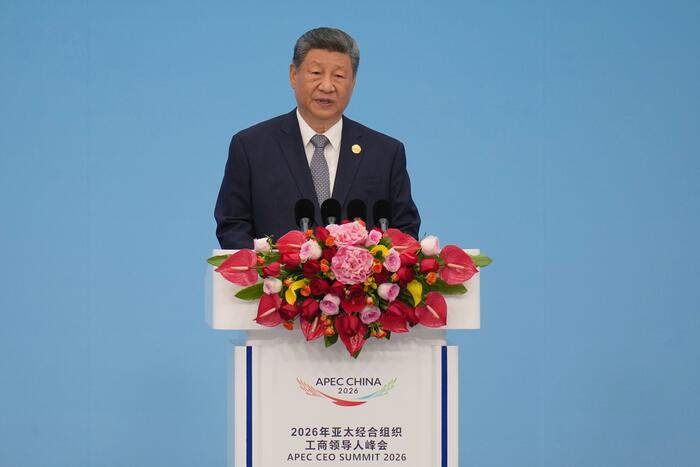
When Chinese President Xi Jinping and fellow Asia-Pacific leaders stood together at recent regional summits to urge the world to embrace open trade and fair, inclusive growth, the headlines read like standard diplomatic wallpaper. Dry. Predictable. The kind of phrasing policy analysts skim over while sipping lukewarm coffee.
Look closer, though, and you hear something else entirely. You hear urgency. You hear a warning shot fired across the bow of a global economy drifting dangerously toward fragmentation.
The Invisible Thread Connecting Two Kitchens
To understand why a room full of suits in Lima or Gyeongju or Beijing suddenly sounds so insistent about "open trade," step away from the podiums and imagine a hypothetical family—let’s call them the Tanakas—running a mid-sized precision-tooling workshop on the outskirts of Osaka.
Mr. Tanaka doesn't care about macroeconomic theory. He cares about steel alloys from South Korea, optical sensors shipped from Taiwan, and assembly contracts with factories in Vietnam that ultimately supply electric vehicle makers in Europe and North America. For thirty years, his business survived because the Asia-Pacific operated like a single, breathing workshop. Parts crossed borders four or five times before becoming a finished product, accumulating value at every stop without getting strangled by punitive tariffs.
Now picture a second hypothetical character: Maya, a twenty-nine-year-old software engineer in Jakarta building supply-chain logistics tools for small agricultural exporters. Her clients are coffee growers in Sumatra and spice farmers in Sulawesi trying to reach buyers in Shanghai, Seoul, and Sydney.
When politicians in distant capitals start talking about "decoupling," "reshoring," or slapping sweeping tariffs on imports, they talk as if they are performing neat, surgical strikes on rival nations.
They aren't.
They are taking a pair of rusty scissors to the thread connecting Mr. Tanaka’s lathe in Osaka to Maya’s server in Jakarta, and straight through to the price you pay for groceries, electronics, and medicine at your local store.
How We Forgot What Closed Borders Actually Cost
I still remember the first time I watched a supply chain freeze in real time. During the height of the pandemic port bottlenecks a few years back, I spent weeks talking to freight forwarders in Singapore and small importers in California. Grown men who had spent forty years moving cargo calmly across the Pacific were staring at spreadsheets with hollow eyes. A single missing semiconductor worth less than two dollars was holding up forty-thousand-dollar tractors. Container rates jumped tenfold in a matter of months. Inflation didn't arrive as an abstract policy failure; it arrived as a gut punch at the supermarket checkout counter.
That crisis was caused by a virus. Today, leaders across the Asia-Pacific are warning that we are about to manufacture the exact same kind of chokehold on purpose.
Consider what the Asia-Pacific actually represents in hard numbers. The twenty-one member economies of the Asia-Pacific Economic Cooperation—APEC—account for roughly sixty percent of global gross domestic product and nearly half of all world trade. Over the past three decades, since APEC leaders first set their sights on dismantling trade barriers in the 1990s, average tariffs across the region plummeted from around seventeen percent down to roughly five percent.
That drop wasn't just an accounting victory. It lifted hundreds of millions of people out of crushing poverty. It built the Asian middle class. It turned quiet fishing villages into gleaming logistics hubs and kept consumer prices remarkably low across Western economies for an entire generation.
Yet human memory is notoriously short when prosperity becomes routine. When factories close in one town or a strategic industry feels threatened, the political temptation to throw up walls becomes almost irresistible. Tariffs feel decisive. Protectionism feels like armor.
Until you have to wear that armor while trying to run a marathon.
The Anatomy of a Trade Trap
Think of global trade like a circulatory system. Protectionism acts like a tourniquet. If a limb is bleeding, a tourniquet saves a life for twenty minutes. Leave it tied for six hours, and the limb dies.
When Xi Jinping addressed business and political leaders across the Pacific Rim, calling for nations to "tear down walls that impede the flow of trade, investment, technology, and services," skeptics naturally looked for geopolitical subtext. And they weren't wrong to look. China is the world’s largest manufacturing powerhouse and the top trading partner for more than a hundred countries. When export markets tighten in the United States or Europe, Beijing has an obvious, vital interest in keeping Asian and global trade lanes wide open.
Dismissing the message solely because of the messenger, however, misses the larger chorus.
Listen to the leaders of Singapore, Vietnam, South Korea, Malaysia, Peru, and Chile. Small and medium-sized economies don't have the luxury of hiding behind massive domestic markets. Their survival depends entirely on predictable rules, open sea lanes, and the freedom to trade with everyone without being forced into a binary geopolitical corner.
If you ask a Southeast Asian trade minister what keeps them awake at night, it isn't just competition from China or interest rates in Washington. It is the terrifying prospect of a split world—one where countries are forced to choose between two rival technological and commercial blocs, duplicating supply chains at astronomical cost while leaving poorer nations stranded on the outside.
Economists at the International Monetary Fund have modeled what severe trade fragmentation looks like. Depending on how deeply the world fractures into competing blocs, global economic output could shrink by anywhere from two percent to seven percent over the long term. Seven percent of the global economy isn't a rounding error. That is the equivalent of wiping out the combined annual economic output of France and Germany.
Gone. Evaporated into higher compliance costs, redundant factories, and slower innovation.
Why "Fair Growth" Is the Hardest Promise in the Room
Of course, if open trade were purely magical, nobody would be protesting it.
We have to be honest about why protectionism gained so much traction in the first place. For years, the cheerleaders of hyper-globalization sold a fairy tale: open the floodgates, let capital flow wherever labor is cheapest, and everybody wins.
Except everybody didn't win equally.
While corporate margins soared and consumers enjoyed cheap flat-screen televisions, entire manufacturing communities from the American Midwest to northern England watched their main streets hollow out. Even inside rapidly growing Asian economies, the rewards of breakneck export growth often pooled at the top, widening the gulf between gleaming coastal megacities and neglected rural provinces. Meanwhile, unchecked industrial expansion scarred rivers, choked skies with coal smoke, and accelerated climate pressures that now threaten the very coastal ports where ships dock.
That is why the second half of the Asia-Pacific leaders' message matters just as much as the first. Notice they didn't just call for free trade. They repeatedly emphasized fair and inclusive growth.
What does fair growth actually look like when you strip away the diplomatic polish?
It means recognizing that trade agreements can no longer be written solely for multinational conglomerates. If a digital trade pact helps tech giants move data across borders effortlessly, it also needs rules that let Maya’s coffee farmers in Sumatra access digital payment systems and cross-border e-commerce without getting crushed by hidden fees.
It means greening the supply chain—investing in clean energy transitions so that emerging economies aren't penalized by carbon border taxes they lack the capital to meet.
And it means building resilience without building fortresses. There is a massive difference between diversifying your suppliers—what companies call "China Plus One," spreading factories across Vietnam, India, Indonesia, and Mexico so a single typhoon or lockdown doesn't paralyze production—and outright economic warfare designed to sever ties completely. Diversification strengthens the web. Severance tears it apart.
The Quiet Battles Happening Beneath the Headlines
While television news anchors focus on dramatic tariff threats and naval standoffs, a quieter, far more constructive battle is unfolding in the unglamorous trenches of regional trade agreements.
Look at the Regional Comprehensive Economic Partnership—RCEP—which links fifteen Asia-Pacific nations, including China, Japan, South Korea, Australia, New Zealand, and the ten ASEAN countries, into the largest free-trade bloc on Earth. Look at the Comprehensive and Progressive Agreement for Trans-Pacific Partnership—CPTPP—which sets high standards for labor, environmental protection, and digital commerce across the Pacific.
These frameworks aren't perfect. Negotiations drag on for years over rules of origin, agricultural subsidies, and intellectual property protections. I’ve read through hundreds of pages of tariff schedules, and I can tell you firsthand: trade law is enough to test anyone’s sanity. It is tedious, technical, and full of compromises that leave nobody completely satisfied.
Yet that tediousness is precisely the point.
Every time two countries agree on a shared customs standard, a mutual recognition of safety certificates, or a dispute-settlement mechanism, they are choosing rules over raw power. They are building shock absorbers into the global economy. They are giving Mr. Tanaka in Osaka the confidence to invest in a new CNC machine because he knows the tariff rate on his exports won't double overnight on a politician’s whim.
What Happens When the Tide Goes Out
There is an old saying among sailors in the South China Sea: you don't learn how well a hull is built when the water is glass; you find out when the monsoon hits.
Right now, the global economy is sailing straight into rough weather. Aging populations across East Asia and Europe are shrinking the workforce. High debt levels are constraining government budgets. Artificial intelligence is rewriting the rules of white-collar and blue-collar labor simultaneously. Climate shocks are disrupting harvests and shipping lanes from the Panama Canal to the Mekong Delta.
In a world facing that many shared storms, retreating behind national walls is like passengers on a ship deciding to saw their own cabins free so they can float alone.
It feels like independence for about five seconds. Then the water rushes in.
The leaders gathering across the Asia-Pacific understand something fundamental about survival in the twenty-first century. Geography cannot be rewritten. China, Japan, South Korea, Southeast Asia, Australia, and the Americas share the same ocean, the same atmosphere, and the same deeply entangled economic destiny. You cannot build a prosperous, stable future in the Pacific by pretending your neighbors don't exist—or by trying to engineer their collapse.
Back on the dock in Busan, dawn is finally breaking over the harbor. The sky shifts from bruised purple to pale orange, catching the wet steel of a departing container ship loaded twenty tiers high. Tugboats ease away from her hull, churning white foam into the dark water as she turns toward the open sea, bound for Yokohama, Long Beach, and beyond.
Thousands of miles away, someone will open one of those boxes next month and find exactly what they needed to build a home, run a clinic, or keep a small business alive—never knowing the names of the dockworkers, engineers, or diplomats who kept the path clear.
The ship slips past the breakwater, engines humming steadily against the swell, carrying a fragile promise across the water.