Midnight in Tel Aviv does not sound like a political rally. It sounds like the hum of a refrigerator in a cramped apartment, the clink of a teaspoon against a glass of black coffee, and the low, persistent murmur of a television broadcast turned down just enough so the neighbors cannot hear the anchors argue over exit polls.
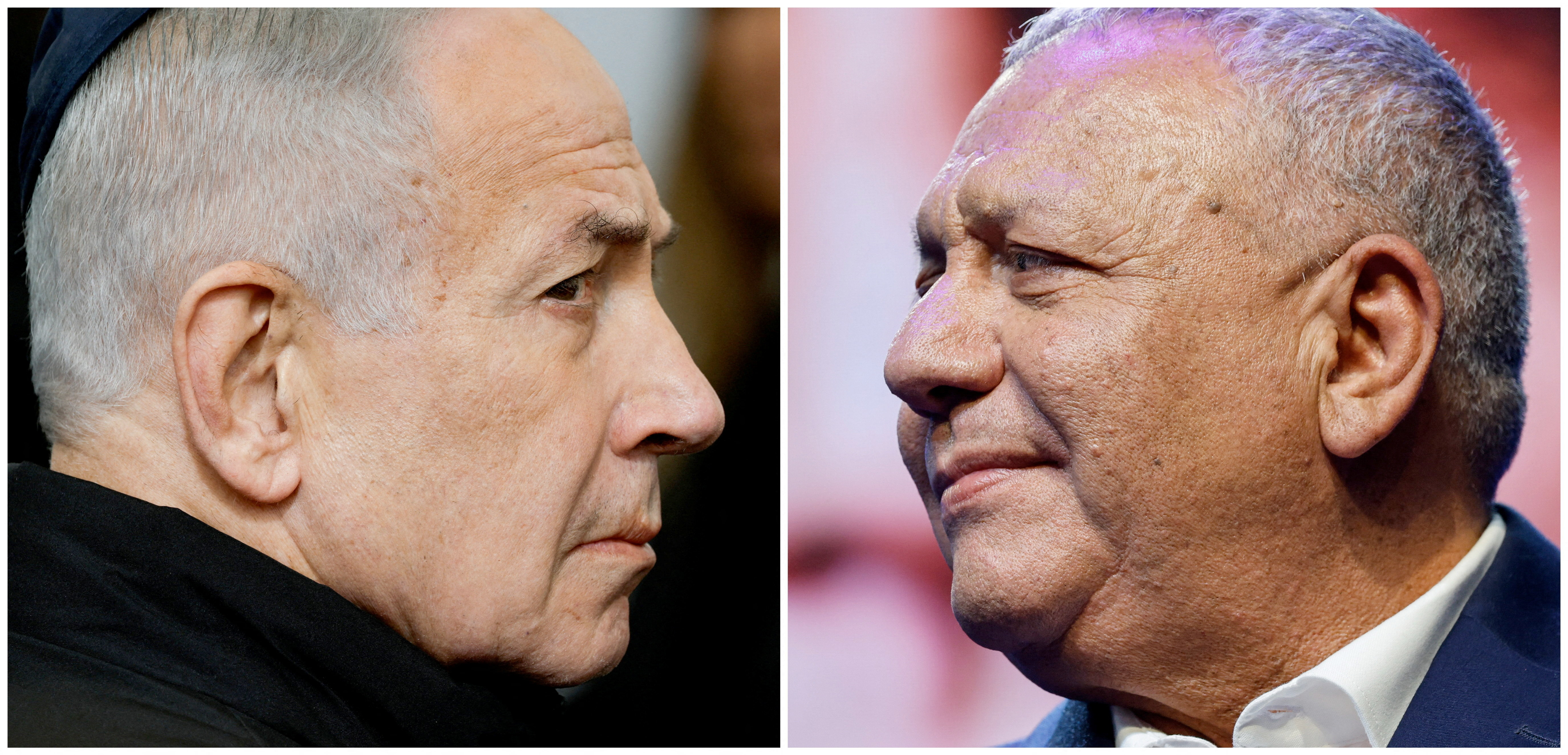
If you refresh a standard election tracker on a night like this, you get a clean, geometric grid. You see two names—Benjamin Netanyahu and Gadi Eisenkot—facing off across a digital map painted in shades of blue, white, and red. You see raw vote counts updating every few minutes from the Central Elections Committee, percentages ticking up by tenths of a point, and bar graphs measuring the distance to a single magic number: 61.
Sixty-one seats in a 120-member Knesset. On a spreadsheet, it is simple addition. In real life, it is the difference between two fundamentally incompatible visions of what a country is supposed to feel like when you wake up in the morning.
Consider a hypothetical family—let us call them the Mizrahis, living in a third-floor walk-up in Beersheba—watching the live map shift as ballot boxes from the northern periphery and the coastal plain begin to report. For them, the party-wise results scrolling across the bottom of the screen are not abstract data points. The eldest son has spent the better part of the past two years cycling in and out of reserve duty. The daughter is trying to figure out whether she can afford rent in central Israel on a starting teacher’s salary. When the anchors dissect whether Netanyahu’s right-wing bloc is holding steady or whether Eisenkot’s centrist coalition is peeling away decisive mandates, the Mizrahis are not watching a horse race. They are watching a referendum on who gets to write the rules of their daily lives for the next four years.
The Architecture of a Deadlock
To understand why an Israeli election night feels less like a verdict and more like an opening bid, you have to understand the peculiar mechanics of the system itself. Unlike winner-take-all elections where a single district flips and the story ends, Israel votes as one nationwide constituency using proportional representation. Every ballot cast in a kibbutz near the Lebanese border carries the exact same mathematical weight as a ballot dropped into a cardboard box in downtown Jerusalem.
Think of the Knesset not as a two-party duel, but as a 120-piece mosaic where no single party ever owns enough tiles to complete the picture alone. Since the founding of the state in 1948, no party has ever won an outright majority of 61 seats on its own. Every government in Israeli history has been a coalition—a carefully negotiated marriage of convenience, ideology, and survival.
According to the rules set by Israel’s Central Elections Committee, a party must clear an electoral threshold of 3.25 percent of the total valid votes just to enter the parliament. That single rule turns election night into a high-wire act. If a smaller faction finishes at 3.26 percent, it walks into the Knesset with four seats and potentially holds the balance of power. If it lands at 3.24 percent, every single one of those tens of thousands of votes vanishes into thin air, redistributed mathematically among the survivors.
When commentators talk about "who is winning and who is losing" in the 2026 race between Netanyahu and Eisenkot, they are really watching two overlapping contests. First, there is the race between the two largest anchor parties—Netanyahu’s Likud and the centrist bloc led or anchored by former IDF Chief of Staff Gadi Eisenkot. Second, and often far more decisive, is the survival rate of the smaller satellite parties orbiting each camp. A leader can watch his own party surge in the vote count and still lose the premiership before dawn if two of his coalition partners slip just beneath that 3.25 percent floor.
Two Men, Two Temperaments
Part of the magnetic tension around a Netanyahu-versus-Eisenkot matchup comes from the stark contrast in how both men occupy space in the Israeli imagination.
Benjamin Netanyahu, Israel’s longest-serving prime minister, is a figure whose political biography is woven into decades of the country’s modern history. To his supporters, particularly in Likud’s traditional strongholds across the south and in working-class towns, he remains the seasoned statesman—a leader who speaks the language of deterrence, economic liberalization, and unapologetic national sovereignty, and who refuses to yield to pressure from foreign capitals or domestic elites. To his critics, he represents a polarizing era of institutional strain, protracted legal battles, and deep social division that came to a head during the judicial overhaul protests and the trauma following October 7, 2023.
Gadi Eisenkot offers almost the exact opposite aesthetic. A retired lieutenant general who served as the 21st Chief of Staff of the Israel Defense Forces before entering politics and serving in the war cabinet, Eisenkot built his public persona on quiet, methodical restraint rather than theatrical oratory. His appeal to centrist and center-right voters rests on a promise of institutional repair, national unity, and pragmatic security management—a figure who speaks softly, carries the personal grief of losing his son and nephew in combat, and frames leadership as a solemn obligation rather than a permanent crusade.
Yet on election night, charisma and biography are quickly reduced to cold arithmetic. Neither man wins by charming the entire country. Each wins by assembling a block of allies that can reach 61 without fracturing over the three fault lines that have defined Israeli politics for a generation: security strategy, the balance between religion and state—including ultra-Orthodox military conscription—and the independence of the judiciary.
How to Read the Live Map Without Losing Your Mind
Anyone who has stayed up past two in the morning watching Israeli election coverage knows how deceptive the early numbers can be.
At 10:00 PM sharp, when the polls close, the major television networks release their exit polls. In the living rooms of Haifa and Ashdod, phones immediately start buzzing with group chat messages. One side celebrates; the other braces for impact. Seasoned political analysts, however, treat exit polls like a rough charcoal sketch rather than a photograph. Because the electoral threshold is so razor-thin, a margin of error of just one or two percent can swing four or five seats from one bloc to the other.
Then come the real ballots, counted by hand in thousands of local polling stations and transmitted to the Central Elections Committee. Here, geography creates an optical illusion that traps casual observers every single cycle.
Smaller polling stations—often located in rural communities, kibbutzim, and affluent suburban neighborhoods—tend to finish counting and reporting first. Larger urban centers, ultra-Orthodox neighborhoods, and working-class districts with high voter turnout take longer to tally. As a result, the live map often tilts sharply toward the center-left in the early hours after midnight, only to shift steadily rightward as the night wears on and the major cities report their totals.
And even when the civilian ballot boxes are 99 percent counted, the story is still not over. In the final stage, election workers tally the "double envelopes"—ballots cast by soldiers serving on bases, diplomats stationed abroad, hospital patients, and prison inmates. Because active-duty soldiers represent a younger demographic whose political leanings often differ from the national average, those final envelopes have historically shifted two or three seats at the very eleventh hour, turning a narrow 61-seat majority into a 60-60 deadlock.
The Invisible Stakes Behind the Bar Graphs
Step back from the television screen for a moment and look at what the bar graphs leave out.
A chart showing seat distributions cannot measure the exhaustion of a reserve soldier’s spouse who has spent months managing a household and a full-time job alone. It cannot capture the quiet anxiety of an Arab citizen in Nazareth wondering whether a new coalition will invest in municipal infrastructure and crime prevention or treat his community as a political foil. It cannot register the frustration of a secular tech worker in Herzliya or a religious shopkeeper in Netanya, both of whom feel that the country’s social contract is fraying at the edges.
This is the emotional core that dry election summaries miss. In many democracies, an election changes tax rates, regulatory priorities, or the tone of public debate. In Israel, because there is no formal written constitution and the legislature operates as a single chamber, a coalition of 61 seats holds immense structural power. It determines who sits on the committee that selects Supreme Court judges, how state budgets are allocated between public schools and religious institutions, who is drafted into the military, and how the state approaches diplomacy, hostages, ceasefires, and borders.
When you watch a bar graph inch from 59 to 61, you are watching the lever of the entire state tilt in one direction.
The Morning After the Count
It is 4:30 AM. The coffee is cold. On the television screen, the anchors have loosened their ties or swapped heels for flats, their voices hoarse from six hours of continuous speculation. The Central Elections Committee dashboard now shows 96 percent of the votes counted.
Suppose—again as an illustrative scenario—that the tally settles into a razor-thin stalemate: 60 seats for the bloc aligned with Netanyahu, 56 for the coalition anchored by Eisenkot, and four seats held by an independent faction that refused to commit to either camp before the vote.
In that moment, the voters’ work ends and the real politics begins.
Under Israeli Basic Law, the President of Israel consults with the leaders of every party that cleared the threshold, asking each whom they recommend to form the next government. The candidate who secures the highest number of recommendations—usually, though not always, the leader of the largest bloc—receives a formal mandate of 28 days, with a possible 14-day extension, to negotiate a coalition agreement and present a cabinet to the Knesset for a vote of confidence.
Back in our hypothetical apartment in Beersheba, the Mizrahis turn off the television before sunrise. Nothing in their daily routine has visibly changed yet. The buses still run down Rager Boulevard; the corner bakery still opens at six; the morning news radio still plays the familiar chime on the hour.
Yet everyone waking up across the country knows that the numbers locked into the Central Elections Committee’s servers overnight have already redrawn the boundaries of what is possible. Every promise made on a campaign stage in Tel Aviv or Jerusalem is now about to collide with the unforgiving arithmetic of 61—and in the quiet weeks of coalition bargaining ahead, the fate of millions of ordinary lives will rest on which party leader blinks first in a closed room.