The containment of ionized particles within the Chernobyl Exclusion Zone (CEZ) relies on a brittle equilibrium between structural integrity and environmental isolation. Recent kinetic impacts and shell damage to the site’s peripheral infrastructure do not merely represent localized destruction; they threaten to decouple the radioactive inventory from its current state of managed stasis. To evaluate the true risk of these events, one must move beyond the hyperbolic rhetoric of "catastrophe" and analyze the specific physical mechanisms through which radionuclide migration occurs.
The Hierarchy of Containment Vulnerability
The risk profile of the Chernobyl site is best understood through a tiered hierarchy of containment. When shell damage occurs, it disrupts these layers with varying degrees of severity.
- Primary Waste Storage Facilities: These are the most critical nodes. Any breach here provides a direct path for high-level waste (HLW) to interact with the atmosphere.
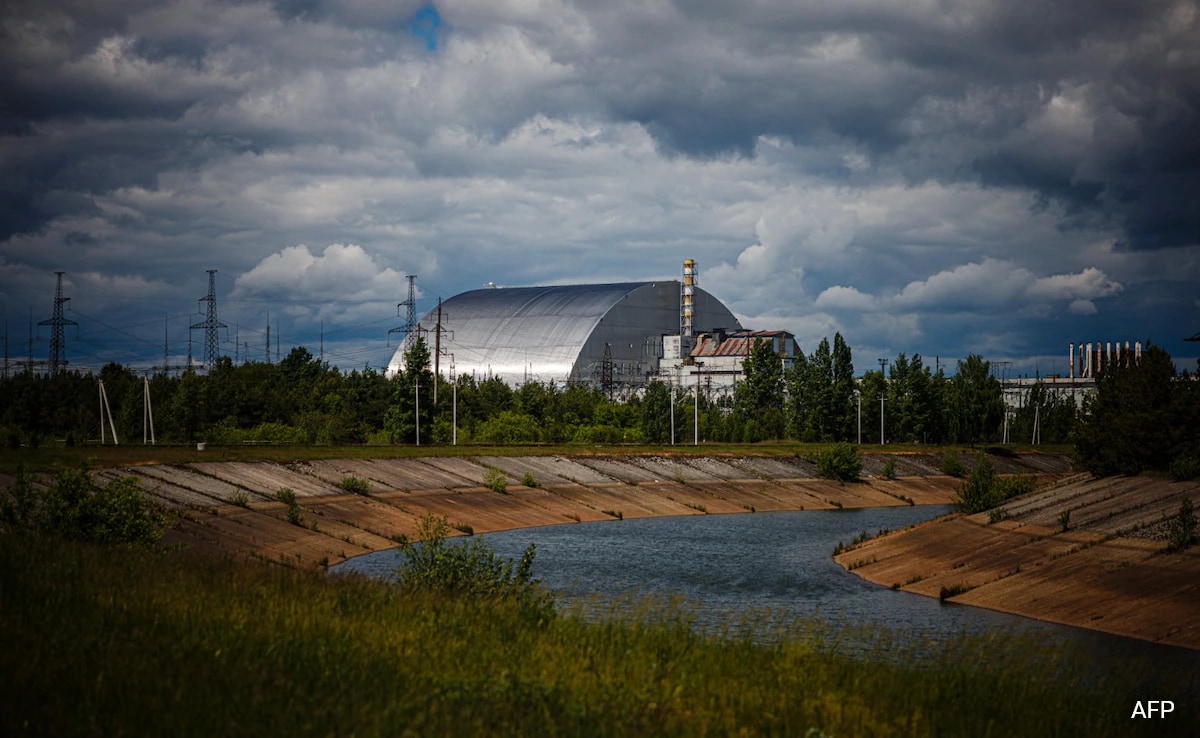
- The New Safe Confinement (NSC): This structure serves as a massive environmental shield over Reactor 4. Its primary function is to prevent moisture ingress and the subsequent migration of radioactive dust.
- Ancillary Infrastructure: Power lines, water pumping stations, and cooling systems. While not containing waste themselves, their failure triggers a degradation of the active management systems required to maintain the site.
Shelling damage creates a forced transition from controlled isolation to uncontrolled environmental exposure. The primary concern is not a "nuclear explosion"—which is physically impossible given the current state of the fuel—but the aerosolization of transuranic elements.
The Aerosolization Mechanism and Particle Dispersion
The most immediate threat posed by structural damage is the mechanical liberation of radioactive dust. Over decades, the internal surfaces of the reactor ruins and the surrounding facilities have accumulated a fine layer of dust containing isotopes such as Cesium-137, Strontium-90, and various isotopes of Plutonium.
Kinetic Energy and Particle Lift
When a projectile strikes a contaminated structure, the resulting kinetic energy performs work on the resting dust particles. This process, known as resuspension, is governed by the force of the impact and the aerodynamic diameter of the particles. Fine particles (less than 10 micrometers) are particularly dangerous as they can remain suspended in the air for extended periods and are easily inhaled, leading to internal radiation exposure.
Thermal Convection Loops
If shell damage leads to fire—either through the ignition of localized materials or forest fires in the surrounding exclusion zone—the risk shifts from mechanical resuspension to thermal lift. Fires create vertical convection currents that can carry radioactive particles into the upper troposphere. This bypasses localized containment and allows for long-range transport, making the risk a transboundary issue rather than a local one.
The Three Pillars of Site Stability
Maintaining the CEZ in a non-critical state requires the continuous operation of three specific technical pillars. Shelling damage threatens each of these systems independently.
Pillar I: Hydrological Control
The groundwater levels beneath the CEZ must be meticulously managed. If the pumping stations lose power due to infrastructure damage, water levels can rise. This leads to two critical failure points:
- Leaching: Water interacting with "lava-like" fuel-containing materials (FCMs) dissolves radionuclides, carrying them into the Pripyat River system.
- Criticality Risk: While unlikely, water acts as a neutron moderator. In specific geometries where degraded fuel remains, a sudden influx of water could theoretically increase neutron multiplication factors, though not to the level of a self-sustaining chain reaction in the current configuration.
Pillar II: Atmospheric Filtration and Pressure Management
The NSC operates under negative pressure to ensure that any air escaping the structure passes through HEPA (High-Efficiency Particulate Air) filters. Structural breaches via shelling compromise this pressure differential. Once the seal is broken, "passive venting" occurs, where natural wind patterns pull unfiltered air out of the structure, distributing radioactive particulates into the surrounding environment.
Pillar III: Monitoring and Sensor Telemetry
Real-time data is the only tool preventing a reactive management posture. Shelling often severs fiber optic cables or destroys sensor arrays that monitor gamma radiation levels, temperature, and humidity. Without this telemetry, responders are "blind," unable to distinguish between a minor localized leak and a major structural failure.
The Cost Function of Environmental Remediation
The economic and logistical burden of a structural breach at Chernobyl is non-linear. A 10% increase in the area of radioactive contamination does not result in a 10% increase in cleanup costs; it triggers an exponential surge in required resources due to the complexity of decontamination in an active conflict zone.
The "Cost of Inaction" can be calculated by the projected loss of agricultural land value across Europe and the healthcare expenditures associated with long-term low-dose radiation exposure. Even if radiation levels remain below "acute" thresholds, the psychological and economic disruption to global food supply chains—particularly for grain originating from the Black Sea region—is a quantifiable byproduct of any perceived contamination event.
Operational Limitations of Current Defense Strategies
Current protocols for protecting the CEZ are designed for industrial accidents, not active kinetic warfare. This creates several bottlenecks in risk mitigation:
- Personnel Access: Active shelling prevents technicians from conducting routine maintenance on the NSC’s ventilation systems.
- Supply Chain Fragility: Specialized parts for the filtration systems are not readily available in a combat environment.
- Emergency Response Latency: In a standard scenario, the "Slavutych-to-Chernobyl" transit for workers is a controlled logistical loop. In a conflict scenario, this loop is severed, meaning structural damage remains unaddressed for days or weeks.
The second limitation is the degradation of the "Red Forest" and surrounding biomass. These areas act as a natural biological filter, trapping dust. However, shelling often triggers wildfires. When this biomass burns, it releases the "banked" radiation stored in the trees and soil from the 1986 event, effectively re-contaminating the region with legacy isotopes.
The Criticality of the "Dust Management System"
Inside the NSC, a dedicated dust management system sprays chemicals to "fix" radioactive dust to the floor, preventing it from becoming airborne. This system requires power, chemical refills, and regular maintenance. If shell damage disables the power grid or the plumbing for this system, the internal environment of the NSC becomes a high-density aerosol chamber. A subsequent structural breach would then release a concentrated plume of particulates that has not been "fixed" by the suppression system.
Strategic Realignment for Zone Protection
The traditional view of Chernobyl as a static museum of past errors must be discarded. It is an active industrial site that requires constant energy input to maintain its state of entropy. The logic of "protection" must shift from passive containment to active resilience.
- Decentralization of Power: The site requires redundant, off-grid power sources (e.g., localized solar arrays with hardened battery storage) to ensure that the negative pressure systems and groundwater pumps remain functional regardless of the state of the national grid.
- Hardened Telemetry: Replacing vulnerable fiber optics with hardened, satellite-linked radiation sensors would ensure that data flow remains intact even if physical infrastructure is destroyed.
- Automated Dust Suppression: Upgrading fixative application systems to operate autonomously or via remote triggers would mitigate the risk posed by the inability of human operators to access the site during active shelling.
The immediate strategic priority is the establishment of a demilitarized technical corridor around the CEZ. Failure to treat the site as a neutral technical entity leads to a scenario where localized tactical gains are offset by long-term regional ecological insolvency. The risk is not a single "event," but a cumulative degradation of the containment systems that have, until now, successfully sequestered the 1986 inventory. Any structural breach must be viewed as a catalyst for a multi-vector environmental release involving aerosolization, hydrological migration, and thermal transport.