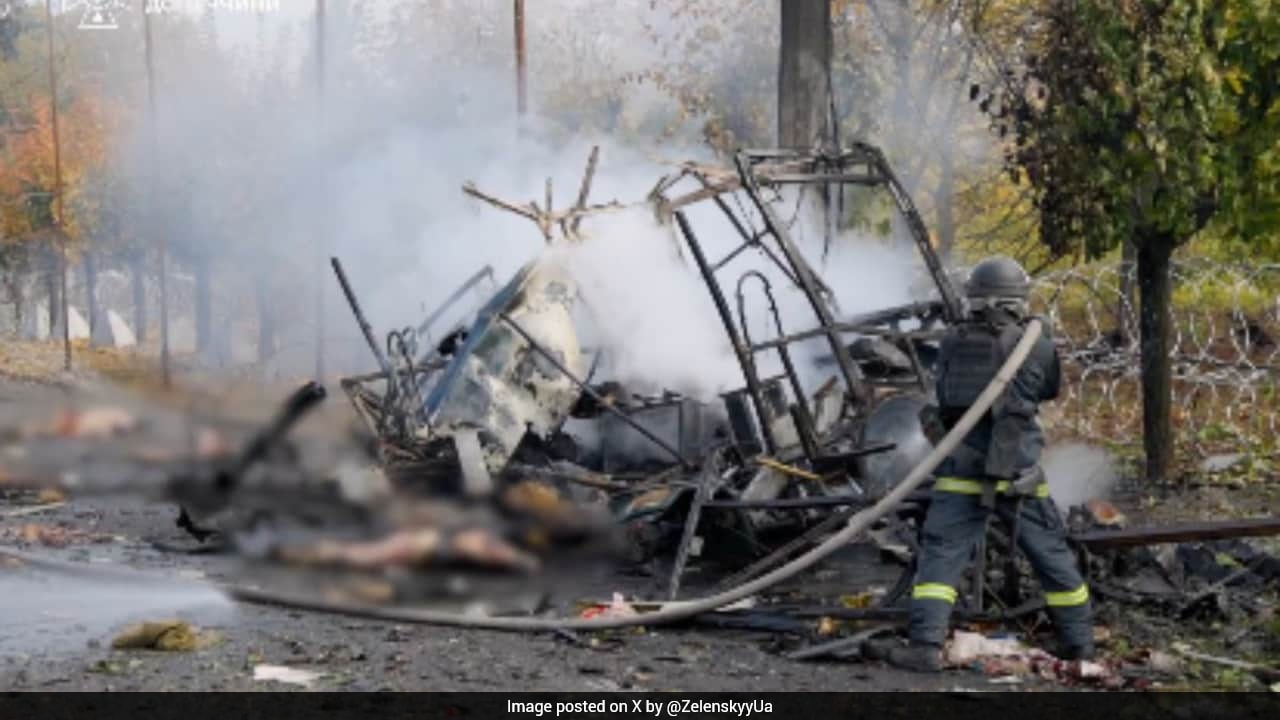
War has a way of reducing human lives to cold statistics, but every single number represents a shattered family, an abrupt end, and a community left reeling. When a Russian guided aerial bomb slammed into a busy street near two packed city buses in Kramatorsk, eastern Ukraine, the grim toll immediately climbed to at least 30 dead, leaving dozens more wounded.
This wasn't some remote military installation or an active trench line. It was an ordinary public transport stop on Yuvileina Street, right next to a local dental clinic. Civilians going about their daily routines, trying to maintain some semblance of normalcy near the front lines, became targets in an instant.
The Reality of Frontline Urban Survival
Living in a frontline city means navigating constant danger. In Kramatorsk and neighboring Sloviansk, roads have increasingly been draped with protective mesh netting trying to shield civilian traffic from marauding drones. Yet, these makeshift defenses offer zero protection against heavy guided aerial bombs dropped by warplanes.
When the strike hit, it incinerated passenger vehicles and left rescue workers sifting through mangled metal and ash. Local officials pointed out the obvious cruelty of the attack, noting that targeting public transport stops is a deliberate strategy to terrorize the civilian population rather than achieve any tactical military victory.
A Week of Relentless Escalation
The devastation in Kramatorsk didn't happen in a vacuum. It marked part of a brutal escalation across multiple regions. Just a day prior, a separate missile strike crushed a five-story apartment building in Pryluky, located in the northern Chernihiv region. That single blast killed at least 22 people, including five young children ranging from one to eight years old, burying residents beneath tons of concrete.
Simultaneously, infrastructure attacks have intensified. Cities like Kyiv faced emergency power blackouts as energy grids took direct hits, signaling a grim strategy by Moscow to freeze out the civilian population as winter approaches.
Why These Strikes Matter for the Wider Conflict
The strategy behind these bombardments is transparent. Analysts and international observers note that failing to secure sweeping battlefield victories, opposing forces have leaned heavily into systemic civilian terror. By hitting public transit hubs, residential blocks, and power stations, the objective is to crush morale and make daily life in Ukrainian-controlled cities completely untenable.
Local authorities and emergency services remain stretched to their absolute limits. First responders continue to work around the clock, pulling survivors from rubble while dealing with the constant threat of secondary strikes. As diplomatic efforts and high-level talks crawl forward in places like Abu Dhabi, the reality on the ground remains brutally simple: ordinary people bear the heaviest cost of an unresolved war.
Public transport in eastern Ukraine has been temporarily suspended in heavily impacted areas, forcing remaining residents to face an even more isolated existence as air raid sirens wail across the freezing landscape.
Watch coverage of the Kramatorsk bus strike on YouTube
This video provides on-the-ground news coverage and visual context regarding the devastating strike on civilian buses in Kramatorsk.
