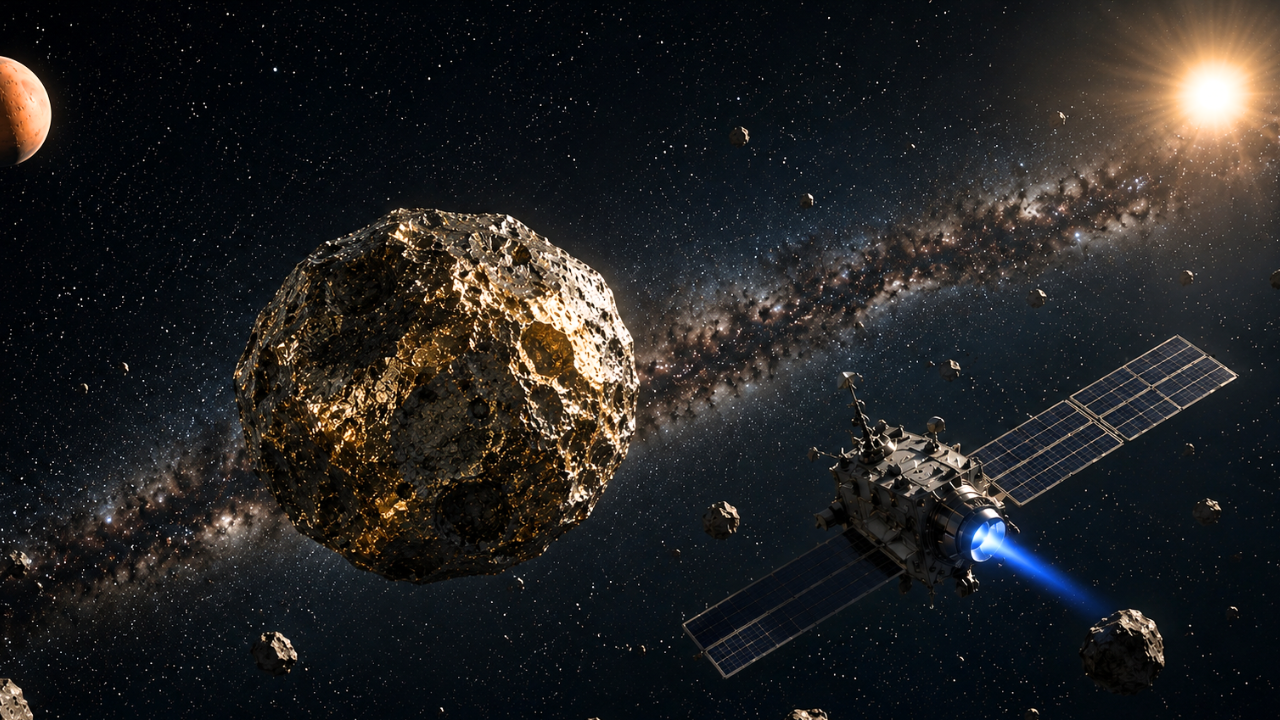
Stop looking at 16 Psyche as a celestial lottery ticket. Every mainstream outlet is currently regurgitating the same tired narrative: NASA is chasing a "quadrillion-dollar" rock made of gold and platinum that could make everyone on Earth a billionaire. It is a fairy tale. It’s the kind of math that only works if you ignore the most basic laws of economics and the brutal reality of orbital mechanics.
NASA’s Psyche mission is currently screaming past Mars, using a gravity assist to slingshot toward the outer belt. But the agency isn't going there to find a fortune. They are going there to look at a corpse. If you liked this article, you should read: this related article.
16 Psyche isn't a treasure chest; it is the exposed iron core of a planetesimal that failed to be born $4.5$ billion years ago. The value isn't in the metal. The value is in the forensic data of how planets die before they even start. If you’re waiting for a space-mining revolution to crash the price of gold, you’ve been sold a bill of goods by people who don't understand the difference between "abundance" and "accessibility."
The Quadrillion Dollar Lie
The "10,000 quadrillion dollar" figure you see in headlines is an insult to your intelligence. To arrive at that number, journalists take the estimated mass of the asteroid—roughly $2.2 \times 10^{19}$ kg—and multiply it by the current spot price of nickel, iron, and cobalt on the London Metal Exchange. For another perspective on this event, refer to the latest coverage from Engadget.
This is the equivalent of finding a mountain on Earth and claiming it’s worth billions because of the minerals inside, without accounting for the fact that you have no shovel, no road, and the mountain is currently moving at 15 miles per second.
Even if you could somehow drag 16 Psyche into Earth’s orbit—which would require more energy than humanity has produced in its entire history—the moment you introduced that much supply to the market, the price would collapse to near zero. You can’t be a billionaire if the "precious" metal you’re selling is as common as gravel.
The real story isn't the money. It's the differentiation. In planetary science, differentiation is the process where a molten body separates into layers: the heavy stuff (iron and nickel) sinks to the center to form a core, while the lighter silicates float to the top to form a mantle and crust.
We can't see Earth's core. It's $3,000$ kilometers beneath our feet, protected by crushing pressure and searing heat. Psyche is a fluke of cosmic violence. Some massive impact likely stripped away its mantle, leaving the "heart" of a planet exposed in the vacuum of space. We aren't visiting a mine. We are performing an autopsy on a world that never was.
Solar Electric Propulsion is the Real Protagonist
While the public gawks at the "golden" asteroid, they are missing the actual technological feat happening right now. The Psyche spacecraft is powered by Hall-effect thrusters. This isn't your grandfather’s chemical rocket.
Chemical rockets are high-thrust but low-efficiency. They are a massive explosion directed through a nozzle. They run out of gas in minutes. Psyche uses Solar Electric Propulsion (SEP). It takes xenon gas—the stuff in some high-end car headlights—and uses electricity from those massive solar panels to strip electrons off the atoms, creating ions. These ions are then accelerated out of the thruster by an electric field.
The force it produces is pathetic. It’s roughly the weight of a single AA battery sitting in your hand. But here is the nuance: it can stay on for years.
I’ve watched engineers sweat over the efficiency of these systems because, in deep space, specific impulse ($I_{sp}$) is the only metric that matters. Chemical rockets have an $I_{sp}$ of about $300$ to $450$ seconds. Psyche’s Hall thrusters are hitting roughly $3,000$ seconds. It is the difference between a dragster that burns its fuel in seconds and a hyper-efficient EV that can drive across a continent on a single charge.
If we ever actually mine the belt, it won't be with "cool" rockets. It will be with these slow, buzzing blue glows that move cargo across the solar system with the patience of a glacier.
The "Metal World" Might Be a Dust Bunny
Here is the contrarian take that the mission scientists are quietly terrified of: Psyche might not even be solid metal.
Recent radar observations and thermal inertia studies have started to poke holes in the "exposed core" theory. The density measurements are coming back lower than they should be for a solid hunk of iron-nickel. There are two possibilities here, and both of them ruin the "space mining" fantasy:
- High Porosity: The asteroid might be a "rubble pile." Instead of a solid ingot, it’s a loose collection of metallic gravel and boulders held together by weak gravity. Trying to mine that would be like trying to drill into a bag of ball bearings in zero-G.
- Ferrovolcanism: The asteroid might have a high concentration of silicate (rock) mixed in, but its surface was covered in metallic lava flows billions of years ago. It might just be a rocky asteroid wearing a thin metallic coat.
If Psyche turns out to be a pile of space-dust and common rock with a metallic sheen, the "quadrillion-dollar" narrative doesn't just die—it becomes a case study in why we shouldn't let PR departments dictate scientific expectations.
The Mars Flyby Isn't Just for Speed
NASA is currently bragging about the Mars flyby. They frame it as a "gravity assist." It sounds simple—swing around the planet, gain speed, and head out.
But a gravity assist is a high-stakes theft of momentum. The spacecraft isn't just "falling" toward Mars; it is stealing a microscopic fraction of Mars's orbital energy. We are literally slowing down the Red Planet to speed up our probe.
The precision required is staggering. If the entry angle is off by a fraction of a degree, the spacecraft either burns up in the Martian atmosphere or misses its trajectory toward the belt entirely, drifting into a useless orbit around the sun.
Why We Are Asking the Wrong Questions
People keep asking, "When will we bring back the metal?"
That is the wrong question. The right question is: "What does Psyche tell us about the magnetic shield that keeps us alive?"
Earth has a magnetic field because our iron core is liquid and swirling. This dynamo protects our atmosphere from being stripped away by the solar wind. Psyche is a frozen, dead version of that engine. By studying its magnetic remnants—if they exist—we learn the "off switch" for a planet's habitability.
We aren't going to Psyche to get rich. We are going to Psyche to see what Earth will look like in a few billion years when our own core finally freezes solid.
Stop Rooting for the Gold, Start Rooting for the Xenon
The obsession with the asteroid's composition is a distraction. The real "game" is the Deep Space Optical Communications (DSOC) experiment riding along with the probe.
For decades, we’ve used radio waves to talk to spacecraft. Radio is slow. It’s the dial-up internet of the cosmos. DSOC uses near-infrared lasers to beam data back to Earth. During the journey to Psyche, NASA has already demonstrated data transmission rates from millions of miles away that dwarf anything we've done before.
We are moving from "bleep-bloop" telegrams to high-definition streaming across the solar system. You can't build a spacefaring civilization on radio waves. You build it on lasers.
The Brutal Truth About Space Exploration
Space is not a place for "innovation" in the way Silicon Valley understands it. It is a place of brutal, unforgiving physics where "disruption" usually means something exploded.
The Psyche mission was delayed for a year due to software integration issues and "institutional challenges" at JPL. That’s a polite way of saying the project was a mess. They had to rebuild the team and the testing protocols from the ground up.
This is the reality of the frontier. It’s not a seamless upward curve of progress. It’s a slog through bureaucracy, math errors, and the vacuum of space trying to kill your electronics.
The mission is a triumph not because the asteroid is "valuable," but because we managed to build a machine that can survive a six-year trek into a radiation-soaked void to look at a 140-mile-wide rock that hasn't changed since the dawn of time.
Forget the gold. Forget the quadrillions. Watch the ion engines. Study the lasers. Respect the physics.
The asteroid is just a destination; the technology we’re forced to build to get there is the actual prize. If you're still looking for a payday in the asteroid belt, you're not a futurist. You're just a 19th-century prospector with a telescope.