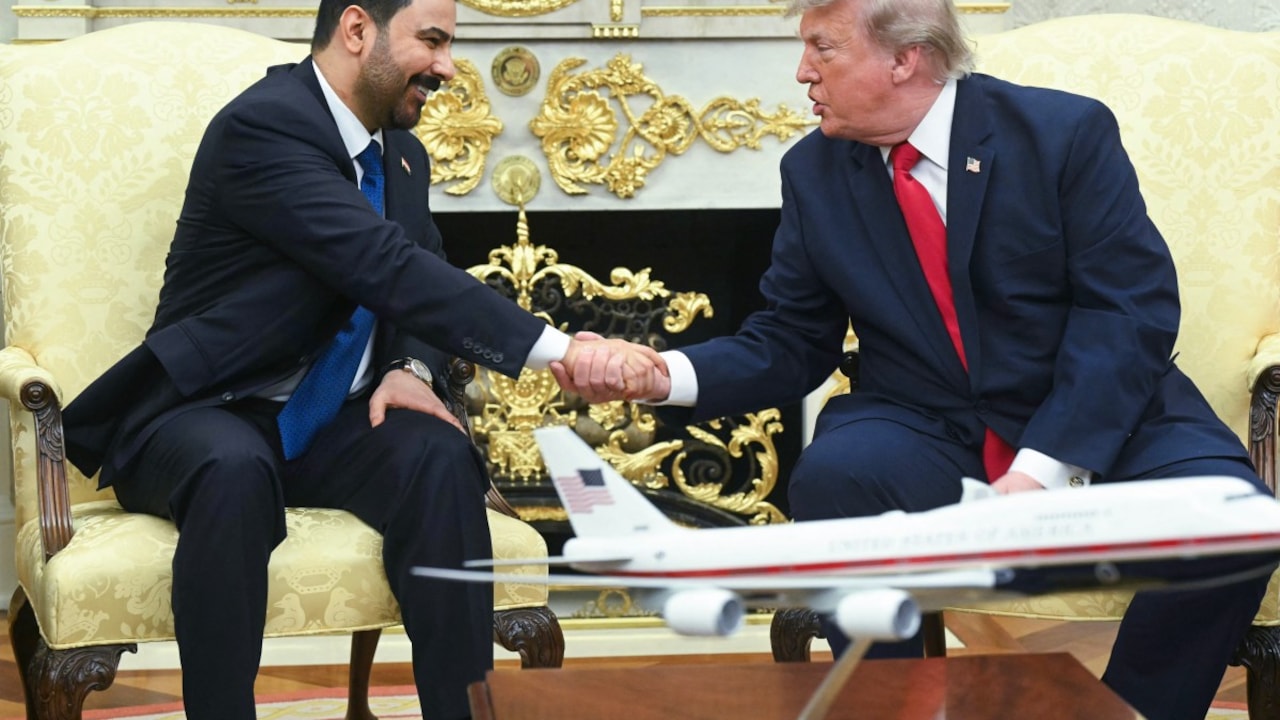
The carefully choreographed diplomacy of a White House lawn rarely reflects the gritty reality of geopolitical leverage. When Donald Trump welcomed the Iraqi Prime Minister, proclaiming a relationship built on "tremendous chemistry," the cameras captured a warm, optimistic alliance. Yet behind the firm handshakes and mutual praise lies a complex web of military pressure, economic dependence, and a desperate balancing act that Iraq must maintain between Washington and Tehran. The public display of friendship masks a high-stakes negotiation where Iraq’s economic survival is constantly traded for American security demands.
At the heart of this diplomatic theater is a fundamental tension. The United States wants to curb Iranian influence and ensure the safety of its remaining troops in the region. Iraq, conversely, wants to assert its sovereignty, stabilize its fragile economy, and avoid becoming the primary battleground for a proxy war. Understanding how these conflicting goals coexist requires looking past the scripted talking points of bilateral meetings to examine the raw leverage points that truly dictate the relationship.
The Financial Hand on Iraq's Throttle
The United States holds a literal chokehold over the Iraqi economy. It is a stark reality that few officials openly discuss, but it dictates every move Baghdad makes.
Under an arrangement dating back to the 2003 invasion, Iraq’s oil revenues are deposited directly into an account at the Federal Reserve Bank of New York. The Iraqi central bank must request physical shipments of US dollars from this account to fund its domestic economy and stabilize the Iraqi dinar. This gives Washington unprecedented oversight and direct control over Iraq's liquid capital.
+--------------------------------------------------------------+
|                THE FLOW OF IRAQI OIL WEALTH                  |
+--------------------------------------------------------------+
|                                                              |
|   [ Iraqi Oil Sales ] ---> Global Markets                    |
|                                |                             |
|                                v                             |
|   [ Federal Reserve Bank of New York ] (US Controlled)       |
|                                |                             |
|                                v  (Subject to OFAC vetting)  |
|   [ Physical Dollar Shipments ]                              |
|                                |                             |
|                                v                             |
|   [ Central Bank of Iraq ] ---> Domestic Economy             |
|                                                              |
+--------------------------------------------------------------+
When Washington suspects that Iraqi banks are smuggling US dollars into sanctioned neighboring countries, the Treasury Department simply tightens the valve.
By blacklisting dozens of Iraqi private banks from accessing the weekly dollar auctions, the US has previously sent the Iraqi dinar into a tailspin. This financial leverage is far more potent than any military threat. The Iraqi prime minister knows that any serious move to expel US forces or align too closely with regional adversaries could result in the economic collapse of his government within weeks. The "chemistry" praised in public is, in truth, the polite compliance of a leader who knows exactly where his money is kept.
The Security Illusion and the Fight for Sovereignty
For years, Iraqi politicians have faced intense domestic pressure from nationalist and pro-Iran factions to expel foreign troops. Publicly, Baghdad frequently signals its intent to transition the US-led coalition's mission to bilateral security agreements. Privately, the calculation is far more cautious.
- Intelligence Sharing: Iraqi forces remain heavily reliant on Western satellite imagery, signal intelligence, and high-altitude surveillance to track insurgent remnants.
- Air Support and Logistics: While the Iraqi military has grown in capability, its logistics networks, maintenance pipelines, and advanced air support still depend on foreign contractors and US backing.
- The Kurdish Factor: The semi-autonomous Kurdistan region in the north views the US military presence as a vital guarantee against aggression from both Baghdad and neighboring regional powers.
Expelling US forces entirely would not only risk a resurgence of extremist networks but would also likely trigger a swift withdrawal of Western investments. The political rhetoric of troop withdrawal is a domestic necessity; the reality of troop retention is a survival strategy.
Balancing on the Regional Knife Edge
Iraq's geography is its destiny. Sandwiched between a hostile, heavily sanctioned neighbor and a dominant global superpower, Baghdad has attempted to position itself as a regional mediator rather than a combatant.
This balancing act is becoming increasingly untenable. Iran wields deep-seated cultural, political, and paramilitary influence inside Iraq, utilizing local militias to project power and bypass international sanctions. When these militias launch attacks against US assets, Washington retaliates with airstrikes on Iraqi soil, violating the sovereignty Baghdad desperately tries to project.
The Iraqi leadership must convince Washington that it is actively working to restrain these paramilitary factions, while simultaneously convincing those very factions that it is working to usher the US military out the door. It is a double game played with an incredibly thin margin for error.
                       [ IRAQ ]
                      /        \
                     /          \
                    v            v
         [ United States ]    [ Iran ]
         - Controls Currency   - Controls Militias
         - Military Support   - Shared Border/Trade
If the prime minister leans too far toward Washington, he faces domestic destabilization and potential assassination threats from local militias. If he leans too far toward Tehran, the US can cripple the Iraqi banking sector and isolate the country internationally.
The Mirage of Economic Independence
To break free from this cycle of dependence, Iraq has embarked on ambitious infrastructure projects aimed at connecting regional trade routes and securing energy independence. The "Development Road" project, designed to link the Persian Gulf to Europe via Turkish rail and highway networks, is heralded as Iraq’s ticket to becoming a global logistics hub.
Yet, infrastructure requires immense capital, and capital requires stability. International investors are hesitant to pour billions into a country where militia groups operate with impunity and the threat of regional escalation is always present.
Even Iraq's efforts to stop importing natural gas from Iran for its power grids have met with constant delays. Despite American pressure to sign contracts with Western energy giants to capture flared gas, Iraq remains dependent on Iranian energy imports to keep its lights on during the blistering summer months. Washington routinely issues temporary sanctions waivers to allow these energy transactions, keeping Iraq on a short leash that can be yanked at any moment.
The "tremendous chemistry" on display during high-profile visits is a diplomatic necessity, not a geopolitical shift. Behind the smiles and mutual assurances is a transactional relationship defined by financial leverage, military dependence, and a fragile nation trying to survive in the shadow of giants.