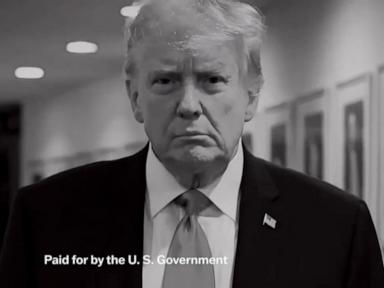
The modern American presidency has long mastered the art of self-promotion, but a recent escalation has crossed a critical threshold. When federal agencies begin cutting multi-million-dollar checks for broadcast advertisements that focus heavily on praising a sitting commander-in-chief, the boundary separating official public communication from partisan campaigning evaporates entirely. This is not merely a political squabble over optics; it represents a fundamental stress test for federal anti-propaganda statutes and the responsible stewardship of public funds.
At the heart of this controversy lies an aggressive deployment of federal capital. Reports revealed that millions in taxpayer funds—with commitments stretching into staggering figures across departments like Homeland Security—were channeled into high-profile television spots. These commercial spots hit major networks during high-viewership programming, including NFL and college football broadcasts, inserting executive self-praise directly into American living rooms.
The Mechanics of Public-Funded Messaging
How does an administration justify using the federal treasury to broadcast imagery that critics characterize as a personal homage? The playbook relies on historical precedent, albeit stretched to its absolute breaking point.
Every modern administration has utilized public service announcements. Past White Houses purchased airtime to educate citizens on critical public health shifts, such as Medicare expansions or vaccination rollouts. Those campaigns, while politically beneficial, maintained a functional core centered on a specific statutory benefit or public health directive.
The defense mounted for recent spots pivots on that exact historical defense. Officials label the broadcasts as educational, patriotic messaging intended to instill national pride. Yet, media analysis and ethics watchdogs point out a glaring structural divergence. Instead of detailing an accessible government program or a practical service, the spots feature heavy biographical framing, prominent third-party political endorsements, and direct audio echoes of campaign rallies.
Legal Gray Areas and Accountability Gaps
Federal law strictly prohibits the use of appropriated funds for publicity or propaganda purposes designed to support or defeat legislation or candidates. However, enforcing these statutes is notoriously difficult.
The agencies tasked with oversight often find themselves caught in a jurisdictional labyrinth. Ethics lawyers argue that branding executive achievements with a "Paid for by the U.S. Government" disclaimer does not magically sanitize what is functionally a campaign commercial. When public money subsidizes media that burnishes an individual's political brand ahead of midterm elections, the structural advantage over political opponents becomes profound. Incumbents possess a megaphone built from the public treasury, one that private challengers cannot hope to match dollar-for-dollar.
Consider a hypothetical scenario to understand the administrative distortion: if a corporate CEO used corporate capital and employee pension funds exclusively to run prime-time advertisements celebrating their own leadership style rather than corporate products, shareholder derivative lawsuits would materialize almost instantly. In the public sector, however, the "shareholders"—the tax-paying public—rely on congressional watchdogs and fragmented oversight committees to contest the expenditure after the fact.
The Bipartisan Discomfort
Significantly, the backlash has not been confined strictly to opposition lines. While Democratic lawmakers have penned scathing letters condemning the spots as illegal ego trips, a handful of prominent Republicans have also broken ranks, expressing open discomfort with the strategy. When seasoned legislative leaders admit that a message might resonate personally but still reject the use of public coffers to pay for it, the practice reveals a rare vulnerability across party lines.
The pressure eventually forces tactical retreats. Public statements hinting that executive leadership might personally reimburse the treasury for the controversial broadcasts or hints at altering funding streams underscore how acute the political fallout became. Yet, reimbursing a fraction of the cost after the ad buy has already saturated key media markets does little to repair the underlying institutional erosion.
Transparency in government communication is a fragile ecosystem. Once the precedent is established that executive staff can tap public accounts to project curated political narratives directly into living rooms, subsequent administrations inherit an expanded boundary of executive power. Without legislative tightening of anti-propaganda restrictions, the line between informing the citizenry and marketing the leader will continue to blur until accountability is entirely lost.
White House airs Trump ad 'Paid for by the U.S. government'
This video provides an authentic look at the controversial government-funded advertisement and the immediate public broadcasting reaction to its airing.


