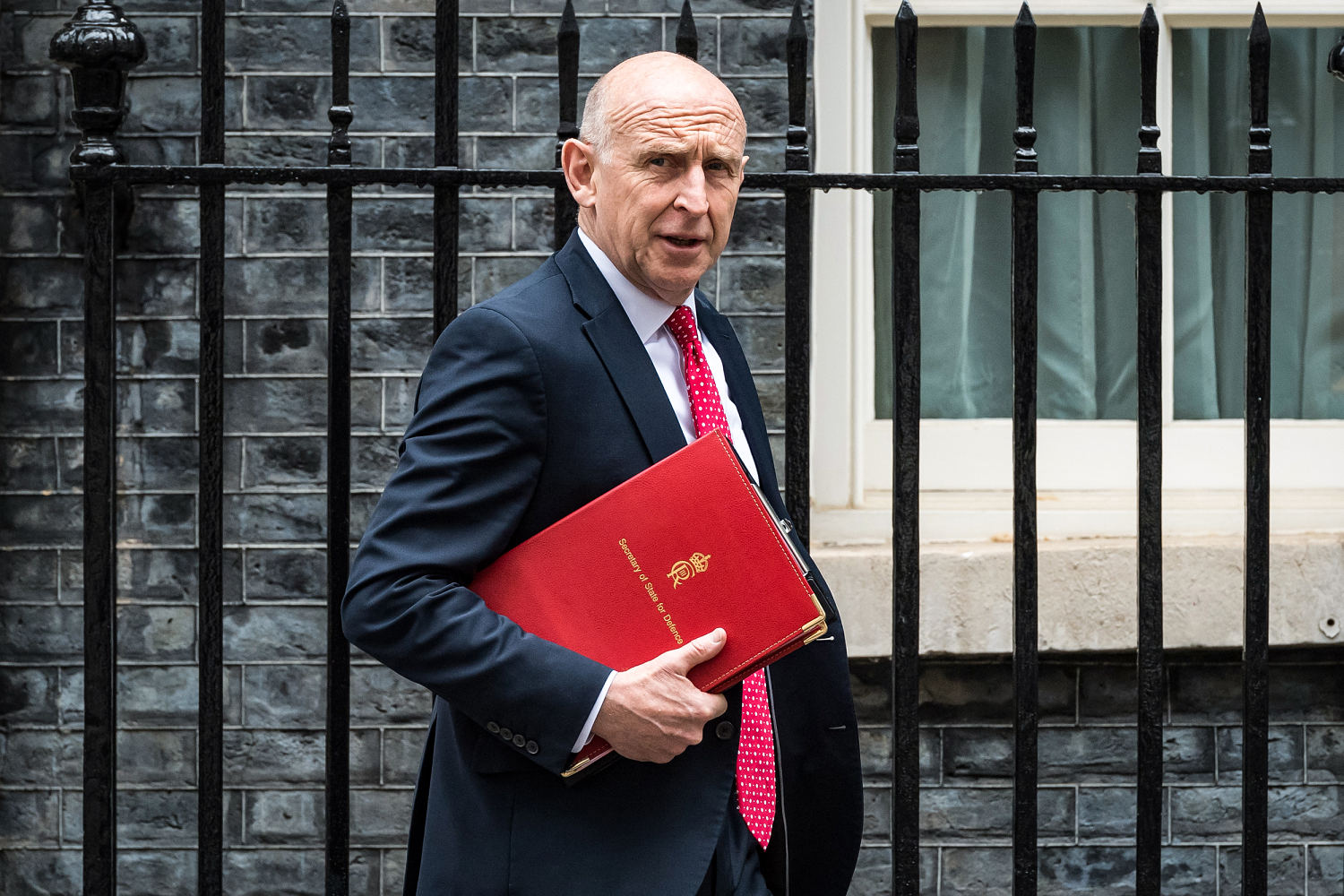
The door to the Ministry of Defence does not slam. It closes with a heavy, expensive thud, the kind of sound engineered to keep the noise of the street where it belongs—outside. But when the British Defense Secretary finally turned the handle and walked out into the gray London drizzle, the silence he left behind was deafening.
He didn't leave because of a scandal. He didn't leave because he lost the confidence of his party or stumbled into a media trap. He left because of a ledger.
On one side of that ledger was the shifting, violent reality of a world growing colder by the day. On the other side was a government budget that treated national defense like a line-item luxury, something to be trimmed, optimized, and delayed for a sunnier day.
Every leader reaches a point where the gap between what they are asked to do and what they are given to do becomes a canyon. For the man at the top of the UK’s military apparatus, that canyon had simply become too wide to cross. His resignation was not just a political exit. It was a whistleblown warning wrapped in a letter of departure.
The Mirage of the Safe Horizon
To understand why a cabinet minister would willingly derail his own career, you have to look at what he saw every morning on his desk.
For thirty years, Western nations lived under a comfortable illusion. We convinced ourselves that the major conflicts of the twentieth century were historical anomalies, relics of a less enlightened age. We drew down troop numbers. We mothballed tanks. We treated defense spending not as an investment in survival, but as a political bargaining chip.
Consider a hypothetical family living in an aging house. For decades, the roof holds. A few shingles fall off, but the sun is shining, so they decide to spend the repair budget on a new kitchen instead. It is a reasonable choice right up until the sky turns black and the hurricane hits.
The British military has been living in that house.
The reality of modern warfare requires an immense, exhausting amount of capital just to stand still. A single modern fighter jet is not just an airplane; it is a flying supercomputer surrounded by a web of global supply chains. A solitary naval frigate is a floating city that requires millions of dollars in maintenance just to keep the salt water from eating its hull.
When the money dries up, the degradation does not happen all at once. It happens in the shadows. It is the spare part cannibalized from one helicopter to keep another in the air for one more week. It is the training exercise canceled to save on fuel. It is the ammunition stockpile that could sustain a high-intensity conflict not for months, but for a matter of days.
The Defense Secretary knew the math. He had spent months arguing behind closed doors that the statutory target of spending two percent of Gross Domestic Product on defense was no longer a ceiling to aspire to, but a floor that was rapidly collapsing beneath their feet. He wanted a commitment to two and a half, perhaps three percent. He wanted the kind of money that makes adversaries pause.
He was met with polite nods, bureaucratic delays, and the ultimate weapon of the treasury: the promise of a future review.
The Arithmetic of Deterrence
We often think of military spending in terms of aggression. We picture columns of armor crossing borders or missiles cutting through the night sky. But the true purpose of a defense budget is entirely psychological. It is about buying the one thing you cannot price in a marketplace: deterrence.
Deterrence is a complex concept, but it rests on a remarkably simple human calculation. It is the art of ensuring that your opponent looks across the border, counts your strengths, assesses your readiness, and decides that today is not the day.
When a nation allows its armed forces to hollow out, that calculation changes. The adversary stops looking at what you say and starts looking at what you can actually do. They notice that your aircraft carriers lack a full complement of jets. They notice that your regiments are under-strength. They see that your political leadership is more concerned with short-term fiscal targets than long-term strategic readiness.
The real danger is not that a weakened military loses a war. The real danger is that a weakened military invites one.
The UK has long prided itself on punching above its weight on the global stage. It is a nuclear power, a permanent member of the UN Security Council, and the historic backbone of European maritime security. But pride cannot fuel a destroyer. It cannot intercept a hypersonic missile.
The Human Cost of the Spreadsheet
Behind every major political resignation are the people who will never see the inside of a cabinet room but will bear the ultimate weight of the decisions made there.
Think of a twenty-two-year-old infantry soldier station in a forward operating base. They do not care about GDP percentages. They do not read treasury white papers. They care about whether their body armor fits, whether their radio can communicate through interference, and whether, if the worst should happen, there is a helicopter with a functional engine ready to fly them to medical aid.
When a defense secretary resigns over funding, they are resigning on behalf of that soldier.
The decision to walk away is an admission of failure, but it is also an act of profound honesty. It is a statement that the current trajectory is unsustainable, that the promises being made to the public about their security are built on a foundation of sand. It forces a conversation that the political establishment would prefer to avoid, dragging the unglamorous, expensive reality of national survival into the harsh light of public scrutiny.
The debate that follows is always predictable. Critics will argue that every pound spent on a missile is a pound taken away from a school or a hospital. It is a powerful, emotional argument. It is also entirely flawed.
Hospitals and schools require a stable, secure, and sovereign society to exist at all. Defense is not a competitor to the welfare state; it is the shield that allows it to function without fear of interruption.
The Quiet Room
The afternoon after the resignation, the office at the Ministry of Defence would have been stripped of personal belongings. The framed photographs taken down from the walls, the desk cleared of the briefing papers that had occupied every waking hour for years.
A new secretary will take the seat. They will receive the same briefings. They will look at the same grim projections, the same aging equipment, and the same escalating threats across the globe. They will be handed the same ledger, still unbalanced, still demanding more than the treasury is willing to give.
The man who walked away did not solve the problem. His departure did not suddenly conjure billions of pounds out of thin air. But he did something else, something that might prove more valuable in the long run. He refused to be the polite face of a decline he knew to be dangerous.
The drizzle outside Westminster eventually cleared, leaving the streets damp and reflective under the streetlights. The government continues its business. The speeches will still be made, filled with grand assertions of national strength and unwavering commitments to global security.
But the empty chair in the cabinet room remains a monument to a cold, unyielding truth: you cannot defend a nation with rhetoric, and peace is only as strong as the price you are willing to pay for it.


