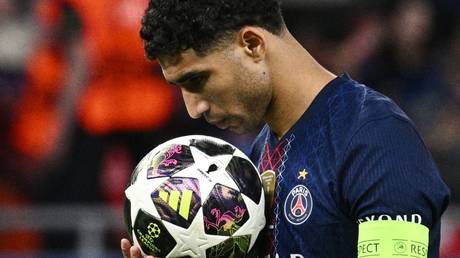
The timing was calculated to cause maximum disruption, or perhaps it was merely the unyielding wheel of judicial bureaucracy turning without regard for the international sports calendar. Just hours before Achraf Hakimi walked onto the grass to captain Morocco in their World Cup group fixture against Scotland, the Versailles appeals court handed down a decision that stripped away the remaining legal buffers between the defender and a public criminal trial. The court confirmed that the Paris Saint-Germain right-back must stand trial on charges of rape, dismissing his appeals and concluding that the multi-year investigation had produced sufficient evidence to present to a jury.
He played anyway. The modern sports complex possesses a remarkable capacity to separate performance from conduct, treating a criminal indictment as an off-field distraction rather than a foundational crisis. Hakimi played ninety minutes, executed seventy-eight accurate passes, and helped secure a one-zero victory for his national team while his legal representation issued furious press statements denouncing the decision. The contrast was stark, exposing the deep divide between athletic worship and legal accountability that characterizes modern elite sports.
The legal machinery has been grinding toward this point since March 2023. A twenty-four-year-old woman alleged that the football player assaulted her at his home in Fontenay-aux-Roses, a quiet suburb located just outside Paris. Hakimi has maintained his innocence from the moment the preliminary charges were filed, labeling the allegations a fabrication designed to target his wealth and standing. His defense team has consistently argued that the case lacks material foundation, pointing to what they term inconsistencies in the complainant's statements. The French judiciary, however, has decided that those inconsistencies are matters for a trial court to weigh, not for investigative judges to dismiss in private chambers.
The Strategy of Public Grievance
Elite athletes facing severe criminal accusations frequently turn to a familiar script. They position themselves as targets of a predatory system that seeks to exploit their visibility. Within hours of the appeals court ruling, Hakimi took to social media to broadcast a defense rooted in grievance, claiming that the case would have been dropped long ago had he been an ordinary citizen. He spoke of his silence over the past three years, framing his restraint as a dignified reliance on a justice system that he now implies has failed him due to his fame.
This rhetoric targets a specific audience. It appeals to a fanbase conditioned to view their heroes as bulletproof icons fighting against external, malicious forces. For a captain who led his country to historic heights during previous international tournaments, this capital is immense. His supporters do not see an indictment; they see a conspiracy designed to derail a national icon at the peak of his professional career.
The defense strategy relies on attacking the credibility of the accuser. Rachel-Flore Pardo, the lawyer representing the plaintiff, noted that her client had been systematically defamed and dragged through the mud by the player's legal team throughout the three-year investigation. The rhetoric from the defense has been unsparing, accusing the woman of concealing vital information, obstructing the search for truth, and showing psychological ambivalence. This aggressive approach is standard practice in high-profile sexual assault cases, where the objective is to shift the focus from the actions of the accused to the character of the accuser.
Football and the Shield of Wealth
The broader issue extends far beyond a single defender or a specific match in a tournament group stage. Football clubs and national federations have long struggled to manage serious off-field misconduct, almost always defaulting to a policy of preservation. If an asset retains market value, the institution will protect it until the legal realities make continuation impossible. Paris Saint-Germain kept Hakimi in the starting lineup through consecutive domestic campaigns and continental tournaments, refusing to suspend a player who remained essential to their tactical framework.
The commercial realities dictate this compliance. A world-class right-back represents tens of millions of euros in transfer value and millions more in global marketing reach. To bench such a asset prior to a formal conviction is viewed by executives as financial self-sabotage. They hide behind the principle of the presumption of innocence, using a valid legal doctrine as a shield against ethical responsibility.
This institutional inertia has created an environment where players operate under the assumption of protection. They are surrounded by handlers, lawyers, and public relations specialists whose sole job is to minimize friction and manage risks. When a serious criminal allegation breaches this perimeter, the shockwaves are profound. The protective bubble does not burst; it simply hardens, transforming into a defensive wall of legal motions and counter-accusations.
The Narrative of the Easy Target
The assertion that celebrity status turns an individual into an easy target is a double-edged sword. While wealth can attract fraudulent claims, it also buys a caliber of legal defense that ordinary citizens cannot comprehend. A team of elite attorneys can scrutinize an accuser’s life, employ private investigators, and prolong judicial proceedings for years, wearing down the resolve of anyone who challenges them. The narrative of the persecuted superstar ignores the vast structural advantages available to a multi-millionaire athlete facing the state’s judicial apparatus.
The plaintiff's legal team expressed relief that the case would finally be heard in an open court. They frame the upcoming trial as a necessary challenge to the culture of denial that protects prominent figures within men's football. The trial will not merely judge the events of a single night in a Paris suburb; it will test whether the French justice system can maintain its independence when processing an individual of global renown.
The upcoming trial will offer no easy answers, and the public discourse will remain polarized. For the accuser, the court's decision to move forward represents a rare breach in the legal fortress that usually insulates elite athletes from the consequences of their actions. For Hakimi, it is a confrontation he claims to welcome, an opportunity to clear his name after years of operating under a cloud of suspicion. The truth will be parsed in a courtroom, far away from the cheering stadiums and the protective embrace of corporate football. The sport will continue to play on, but the shield of invincibility has slipped, leaving its star to face the unblinking gaze of a criminal court.