At 4:14 AM in a windowless room outside Dallas, the future of commercial aviation sounds like a coffee grinder chewing on a credit card.
Click. Whir. Clack.
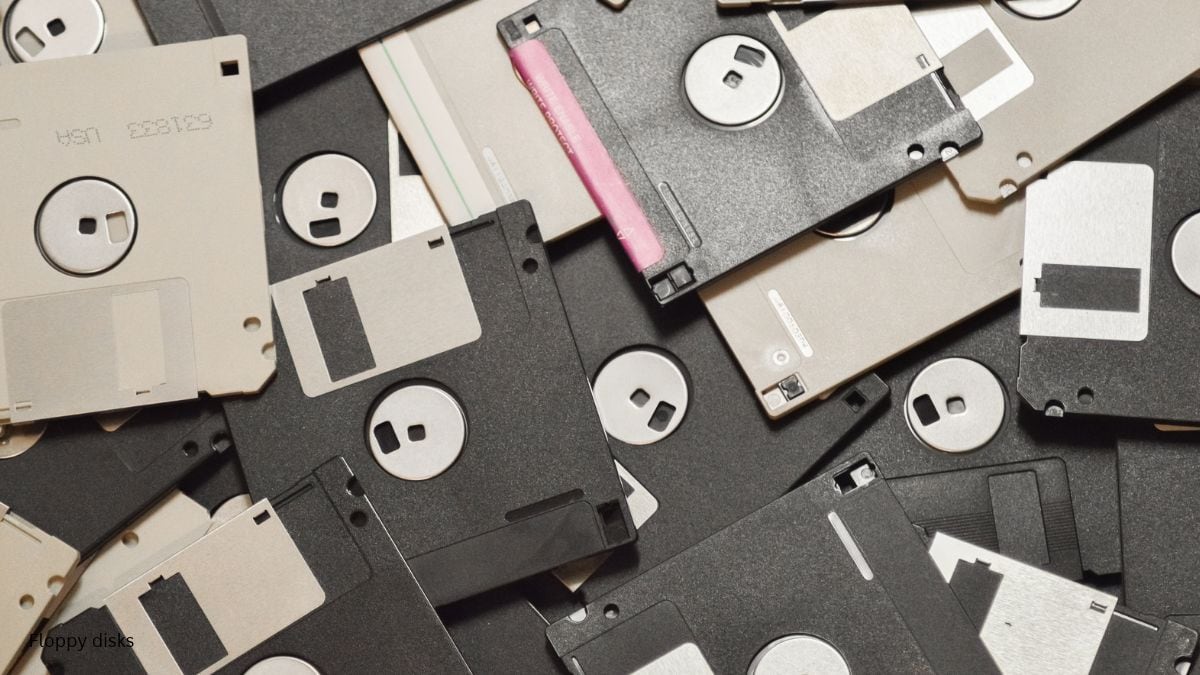
To understand what happened when American air travel ground to a halt—leaving thousands of exhausted passengers sleeping on terminal carpets beside crying toddlers and half-eaten airport pretzels—you have to look past the sleek titanium fuselages on the tarmac. You have to look at a technician's hands sliding a five-and-a-quarter-inch square of black magnetic plastic into a beige slot built before the Berlin Wall fell.
A floppy disk.
Let’s pause on that. Hold it in your mind for a second. While you book your boarding pass using facial recognition on a glass smartphone capable of billions of calculations per second, the invisible architecture keeping two hundred tons of aluminum and jet fuel from colliding over Kansas still relies on storage media invented during the Nixon administration.
When recent flight chaos rippled across the United States, rumors flew faster than a Boeing 787. People whispered about cyberattacks. They blamed bad weather, pilot shortages, or corporate greed. The reality, as Federal Aviation Administration briefings and congressional inquiries have gradually revealed, is far more unsettling—and strangely human. The FAA tried to update its aging Air Traffic Control infrastructure, and in doing so, accidentally pushed a fragile, decades-old nervous system past its breaking point.
The Ghost in the Terminal
Consider a hypothetical traveler—let’s call her Elena—sitting at Gate B12 in Chicago O’Hare. She is trying to make her father’s eightieth birthday in Phoenix. Her app says the flight is on time. The gate agent’s screen says the flight is on time. Outside the rain-streaked glass, the pilots are already in the cockpit, running their pre-flight checks.
Then, nothing happens.
The boarding door stays shut. Ten minutes pass. Thirty. An hour. When the announcement finally crackles over the loudspeaker, the gate agent sounds just as bewildered as the passengers. There is no thunderstorm in Phoenix. There is no mechanical failure on the plane. Instead, there is a vague mention of an "airspace flow program" and "automated system latency."
What Elena cannot see is the silent bottleneck happening hundreds of miles away inside an Air Route Traffic Control Center.
To picture how modern air traffic control actually works under the hood, use an analogy: think of the system not as a unified supercomputer, but as a Victorian mansion that has been renovated fifty times without ever tearing down the original walls. You have gleaming smart-home thermostats wired directly into cloth-wrapped copper cables from 1923. You have high-speed fiber-optic internet routed through a tin can and a piece of string.
For decades, the FAA has maintained safety through sheer, stubborn redundancy. The golden rule of aviation engineering is simple: if a machine hasn't crashed a plane since 1984, you do not touch it unless you have a gun to your head. Because of that philosophy, critical subsystems—including legacy radar processors, weather-reporting relays, and the notorious Notice to Air Missions (NOTAM) database—survived long after their creators retired, died, or forgot how to write the archaic programming languages that power them.
Yes, technicians really do still load software patches and terrain maps onto certain FAA terminals using floppy disks and paper strips. I remember the first time I walked through an active radar room and saw a controller scribbling flight altitudes onto a narrow strip of paper before sliding it across a wooden console. My stomach dropped. I had spent my life believing the sky was governed by wall-to-wall holographic touchscreens straight out of a science fiction movie. Seeing that paper strip—and hearing the unmistakable mechanical chatter of legacy disk drives—felt like discovering that a modern suspension bridge was being held together by twine and prayers.
It is terrifying to admit, especially when you are sitting in seat 14A at thirty-five thousand feet, that the safest transportation network in human history runs on digital antiques.
When an Upgrade Becomes an Overload
So why did everything suddenly choke? If the old machines worked for forty years, why did they fail now?
The culprit wasn't neglect. Ironically, it was progress.
In recent months, the FAA rolled out a series of necessary software updates designed to modernize data feeds, improve trajectory modeling, and synchronize flight plans across regional centers. On paper, these updates were smart, overdue, and completely logical. They were meant to handle higher post-pandemic flight volumes and give controllers sharper real-time visibility.
But here is what happens when you pour high-pressure water through a corroded lead pipe: the pipe bursts.
According to internal assessments and watchdog reports from the Government Accountability Office, nearly a third of the FAA’s 138 critical air traffic control systems are officially classified as unsustainable. Many run on operating systems like Windows 95, OS/2, or custom mainframe code written in Assembly and JOVIAL—a computer language born in the late 1950s that fewer and fewer living engineers know how to read.
When the FAA pushed modern, data-heavy updates onto networks tethered to those legacy bottlenecks, the old hardware simply couldn't swallow the meal. Memory buffers overflowed. Legacy data buses—some transferring information at speeds slower than a dial-up modem from 1996—hit 100 percent capacity.
Consider what happens next inside the machine. When a modern server encounters a traffic jam, it reroutes packets in microseconds. When a thirty-five-year-old terminal fed by magnetic disks hits a wall, it freezes. Alarms trigger. Fail-safes kick in. And because aviation safety is built on an uncompromising mandate—when in doubt, stop everything—controllers have no choice but to widen the spacing between aircraft, hold planes on the ground, and throttle the entire national airspace down to a crawl.
Nobody dies. That is the miracle of the system. The safety net holds.
Yet the human cost cascades outward in slow motion. Pilots time out of their federally mandated duty hours while sitting on taxiways. Flight attendants get stranded in cities where they have no hotel rooms. Surgeons miss transplants. Families miss weddings, funerals, and last goodbyes. The airlines lose hundreds of millions of dollars in a single afternoon, and every frustrated traveler screams at a gate agent who has zero control over a memory overflow in a basement server room three states away.
Why Can't We Just Buy New Computers?
Whenever this story hits the evening news, everyone asks the exact same question at the dinner table: The United States government spends trillions of dollars a year—why on earth don't they just go to Best Buy, buy new computers, and throw the floppy disks in the trash?
It is a fair question. It is also the exact trap that has paralyzed aviation modernization for twenty years.
Replacing the FAA’s infrastructure isn't like upgrading your office laptops over a long weekend. You cannot shut down the American sky for forty-eight hours while technicians unplug the cables and install a new operating system. Every single second of every single day, roughly five thousand commercial aircraft are airborne over the United States. The plane has to be rebuilt while it is flying at five hundred miles an hour.
Even worse is the tangled web of dependencies. Over the decades, thousands of custom patches were written to help old systems talk to slightly newer ones. If you rip out a mainframe from 1988, you might inadvertently sever the data link to a localized wind-shear sensor at a regional airport in Montana, or break the telemetry feed that tells an approach radar in Atlanta where a Cessna is flying.
The FAA’s flagship modernization effort, known as NextGen, has been underway since the mid-2000s. It has already consumed tens of billions of dollars and stretched across four presidential administrations. While NextGen has delivered genuine breakthroughs—like satellite-based GPS navigation that lets planes fly more direct, fuel-efficient routes—the core ground infrastructure remains stubbornly, maddeningly trapped between two eras. Every new software layer added on top of the old foundation increases complexity, creating hidden friction points that nobody notices until an update triggers a systemic overload.
We are living through the bill coming due for decades of "good enough."
The Quiet Heroism in the Dark
It is easy to mock the floppy disks. They make for great headlines and late-night punchlines. Watching an agency responsible for the world's busiest airspace wrestle with storage media from the era of cassette tapes feels absurd on its face.
Spend an hour talking to an active air traffic controller, though, and the laughter evaporates fast.
These men and women sit in darkened rooms staring at phosphor-green and amber displays, wearing headsets that crackle with dozens of voices per minute, carrying the literal lives of thousands of strangers in their short-term memory. When the automation glitches—when a data block lags, or a system reboot forces them back to manual spacing—they don't panic. They lean forward. They talk faster. They run mental geometry in three dimensions while compensating for hardware that should be sitting behind velvet ropes in the Smithsonian.
During the worst of the recent disruptions, while passengers vented their fury on social media, controllers and airway transportation systems specialists were working mandatory overtime, manually nursing temperamental terminals back online, nursing hardware whose replacement parts have to be scavenged from eBay or custom-machined because the original manufacturers went out of business thirty years ago.
That is the invisible truth behind every delayed flight you have ever cursed. The chaos isn't proof that the people running the sky are incompetent. It is proof that human beings are working miracles every single day to bridge the gap between twenty-first-century demand and twentieth-century steel.
The Reckoning Above Our Heads
Congress has finally begun sounding the alarm with a urgency that feels different this time. Recent oversight hearings have laid bare the stark reality: patching a crumbling foundation with modern software is no longer a viable strategy. The FAA has pledged to accelerate the decommissioning of legacy systems, phase out remaining magnetic disk dependencies, and untangle the archaic code bottlenecks that turned routine updates into nationwide gridlock.
Whether Washington has the sustained political will to fund a top-to-bottom overhaul—without cutting corners or starving the project halfway through—remains an open, uncomfortable question. Infrastructure is never glamorous until it breaks. Nobody wins an election by bragging about replacing a telecommunications switch in Albuquerque.
Until that long, unglamorous work is finished, the American sky will remain a paradox. Tomorrow morning, millions of people will step onto gleaming carbon-fiber jets equipped with satellite Wi-Fi, predictive turbulence radar, and engines that communicate terabytes of diagnostic data directly to manufacturers in real time. They will buckle their seatbelts, pull down the window shade, and trust completely in the miracle of modern flight.
And somewhere far below them, in a cool, humming room lit by the glow of aging monitors, a technician will reach into a drawer, pull out a square of black plastic, and push it into a drive until it clicks.