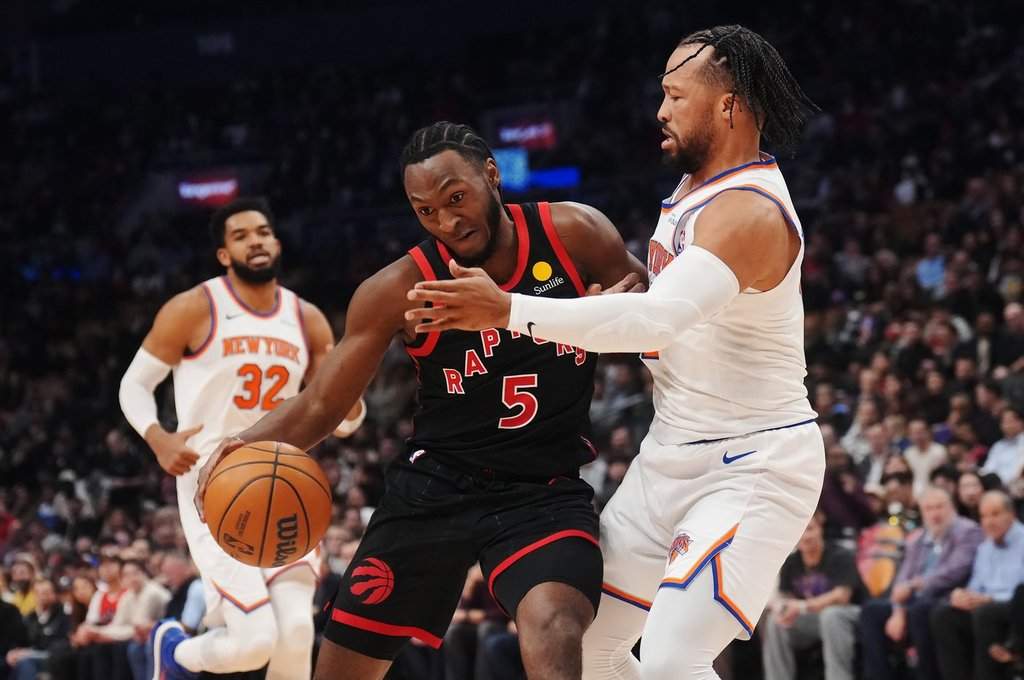
Five losses in a row hurt. When the Toronto Raptors fall to the New York Knicks for a fifth straight loss, the immediate reaction from casual fans and talk-radio callers is predictable. They blame effort, they demand trades, or they write off the entire roster before the calendar even flips.
That reaction misses what actually happens on the floor when Toronto runs into New York. In related developments, read about: What Most Darts Fans Miss When Humphries and Van Gerwen Reach the Grand Slam Knockouts.
Looking closely at how these two Atlantic Division rivals match up reveals a much clearer picture than a simple box score ever could. You don't lose five consecutive games to the same opponent by accident, and you definitely don't fix it by yelling about "heart" in postgame press conferences. The gap comes down to physicality on the glass, half-court shot creation when the game slows down, and how New York punishes every minor defensive rotation.
Why the Raptors Fall to the Knicks in Late-Game Situations
Most Raptors-Knicks matchups don't look like blowouts for the first thirty-six minutes. Toronto typically competes hard, generates transition opportunities, and keeps the score within striking distance entering the fourth quarter. Sky Sports has also covered this fascinating subject in great detail.
Then the game slows to a crawl.
In the NBA, half-court execution separates playoff contenders from rebuilding or fringe teams. New York thrives when possessions tighten up and officials swallow their whistles. Their offense is built around methodical spacing, physical screening, and attacking mismatches until a defender compromises their stance. Once Toronto helps one step too far off a shooter or fails to box out on a weak-side closeout, the Knicks capitalize immediately.
Toronto's offense often moves in the opposite direction during crunch time. Without multiple elite self-creators who can break down a set defense off the dribble without needing a screen, possessions stall out around the perimeter. Passes get deflected. Shot clocks tick down past six seconds, forcing contested mid-range jumpers or rushed threes against recovering length.
Watch the final five minutes of a tight Raptors loss and you'll notice the same sequence repeat itself:
- A stagnant half-court set ends in a low-percentage pull-up jumper.
- New York secures the defensive rebound cleanly without giving up a second-chance tip.
- The Knicks walk the ball up, run a high pick-and-roll, and either draw a foul or kick out to an open corner shooter.
- Toronto calls a timeout down six with under two minutes left, having lost control of the tempo entirely.
It's frustrating to watch because the effort is clearly there. Effort just doesn't replace half-court shot-making.
The Rebounding and Physicality Gap Nobody Talks About
Everyone loves highlighting three-point percentages after a loss. Shooting variance is easy to point at because you can glance at a stat sheet and say, "Well, if three more shots drop, we win."
That's lazy analysis.
The real damage in a losing streak against New York happens in the paint before a shot even goes up or right after it clanks off the rim. The Knicks treat offensive rebounding as an extension of their half-court offense. When you give a disciplined, physical team extra possessions in a tight fourth quarter, you're effectively spotting them six to ten points a game.
For Toronto, defensive rebounding requires all five players on the floor to gang-rebound. When the Raptors play smaller, switch-heavy lineups to keep up with perimeter speed, they leave their center isolated against multiple crashing bodies. Even when the initial contested shot misses—which means the Raptors' defense technically did its job—failing to finish the possession erases twenty-four seconds of solid work.
You can see the psychological toll this takes in real time. Nothing deflates a road team faster than guarding hard for a full shot clock, forcing a tough fadeaway, and watching an opposing forward tip the ball out to the perimeter for a fresh fourteen seconds and a wide-open three.
What Losing Streaks Actually Do to an NBA Locker Room
I've covered and studied enough NBA seasons to know that a five-game skid feels vastly different inside the building than it does on social media. Fans treat every loss like a referendum on the franchise's five-year plan. Players and coaches treat it like a series of specific tactical fires they have to put out before the next shootaround.
Still, losing five straight leaves fingerprints on how a team plays.
First, role players start pressing. Guys who normally take rhythm catch-and-shoot threes begin hesitating for a split second, wondering if they should pass up a decent look for a great one. That tiny hesitation gives closeout defenders all the time they need to contest. Conversely, primary scorers sometimes try to hero-ball their way out of the slump, ignoring open cutters because they feel responsible for carrying the offense alone.
Second, defensive communication slips by a fraction of a second. Winning streaks build trust; losing streaks breed second-guessing. When a defender isn't completely sure whether the weak-side help is going to rotate on time, they overcommit to their own man, which opens up straight-line driving lanes right down the middle of the lane.
New York is ruthless against hesitant defenses. Their guards live in the paint, probing until someone blinks.
Misconceptions About Toronto's Roster Construction
Whenever Toronto hits a rough patch against physical Eastern Conference opponents, the loudest critique is that the front office built a roster full of redundant wings without enough traditional size or pure point-guard play.
There's a grain of truth there, mixed with a lot of exaggeration.
Modern NBA basketball rewards positional versatility. Having multiple long, athletic forwards who can guard three or four positions isn't a flaw—it's actually the blueprint most contenders chase. The issue isn't that Toronto values length and switchability. The issue is that switch-everything schemes require elite communication, healthy rim protection behind the perimeter, and enough perimeter shooting to punish teams for packing the paint.
When any one of those three pillars is missing—whether due to injuries, lineup shuffling, or cold shooting nights—opponents like the Knicks simply pack the lane and dare Toronto to beat them from deep.
Let's look at the core contrast in style when these two teams share the floor:
New York's identity relies on punishing mismatches, winning the possession battle through offensive boards and low turnover rates, and living at the free-throw line when jump shots aren't falling.
Toronto's identity relies on tempo, deflections, transition scoring, and ball movement that forces defenses into long closeouts.
When New York dictates the pace, Toronto looks uncomfortable. When Toronto pushes the ball off misses and turns defense into instant offense, they look capable of beating anyone in the conference. A five-game losing streak tells you that New York has successfully forced Toronto to play their style for far too many minutes.
How the Raptors Can Flip the Script in Future Matchups
Breaking out of a skid against a division rival doesn't require blowing up the roster or reinventing the playbook overnight. It comes down to winning specific micro-battles that swing ten to twelve points over forty-eight minutes.
Win the First Three Seconds of Defensive Possessions
Toronto can't afford to wait until the ball crosses half-court to set their defense. Picking up ball-handlers earlier, nudging cutters off their preferred paths, and forcing New York to burn six or seven seconds just initiating their sets takes away their favorite late-clock counters.
Commit to Five-Man Rebounding Over Leak-Outs
Transition offense is Toronto's lifeblood, so guards naturally want to leak out the moment a shot goes up. Against New York, that habit is poison. Until the ball is securely in two Raptors hands, every perimeter player has to put a body on a crashing Knicks forward. Give up a few fast-break points if it means eliminating fifteen second-chance points on the other end.
Simplify Late-Clock Actions
When the shot clock drops under eight seconds, complex motion sets break down. Toronto needs two or three reliable, downhill actions—a quick-hitting drag screen, an empty-side pick-and-roll, or a post touch at the elbow—that force the defense into an immediate binary choice rather than letting them sit back and watch perimeter passing.
Track the Possession Battle, Not Just Shooting Splits
If you're watching the next Raptors-Knicks game and want to know who's actually winning before the fourth quarter starts, ignore the field-goal percentage column for a minute. Add up offensive rebounds plus turnovers forced. Whichever team finishes that math ahead by five or more almost always controls the final five minutes.
Pay close attention to how Toronto handles early physicality in their next outing. If they match New York's contact on screens and finish defensive possessions with clean rebounds, the narrative around this streak will change just as quickly as it started.