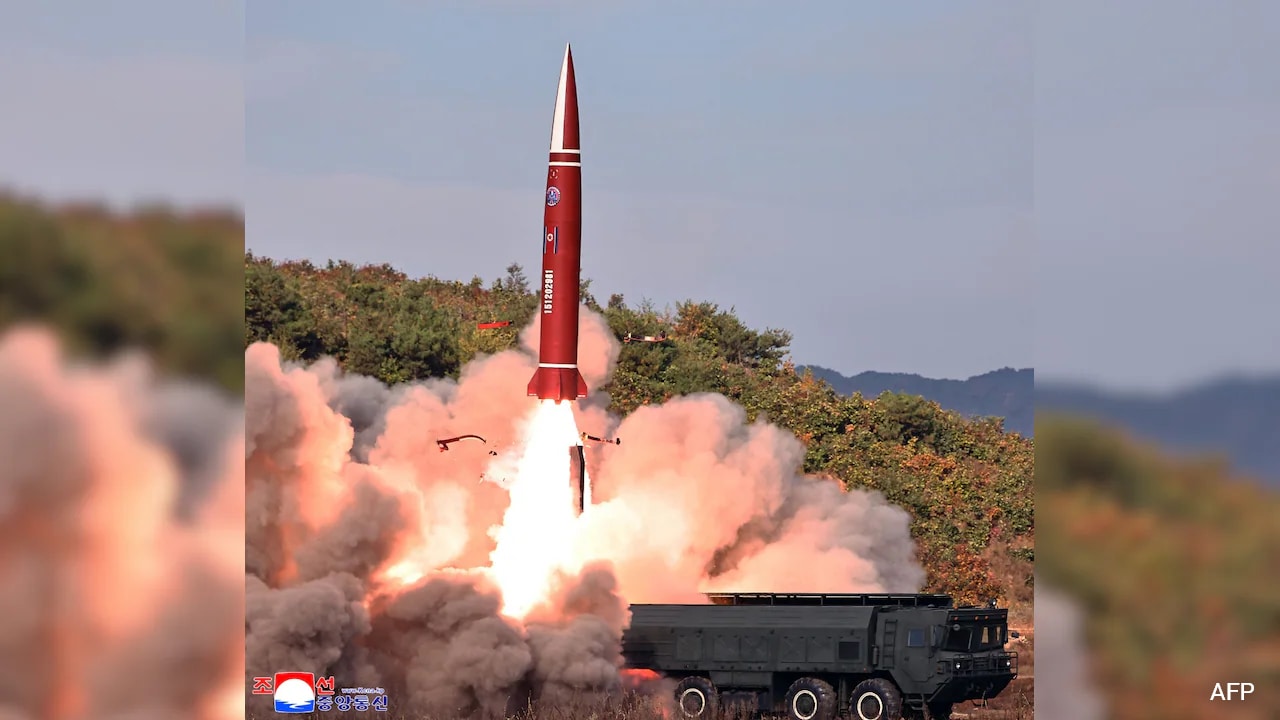
Everyone loses their minds when Pyongyang launches a ballistic missile. Sirens blare in Japan, emergency alerts light up phones in Seoul, and cable news anchors dust off their maps of the Pacific. Yet when North Korea test fires strategic cruise missiles, the reaction feels almost muted.
That's a massive mistake.
If you're paying attention to East Asian security, cruise missiles actually keep defense planners awake at night way more than the giant intercontinental ballistic missiles paraded through Kim Il Sung Square. Ballistic missiles fly high into space on predictable arcs, making them relatively easy for modern radar networks to spot from hundreds of miles away. Cruise missiles don't play by those rules. They hug the terrain, fly below radar horizons, and change direction mid-flight to slip right past billion-dollar air defense batteries.
When state media like the Korean Central News Agency (KCNA) reports another round of strategic cruise missile launches, they aren't just making noise for domestic propaganda. They're signaling a shift toward tactical nuclear delivery systems that are genuinely hard to stop.
Why Strategic Cruise Missiles Matter More Than You Think
To understand why these tests rattle military analysts, you have to look at the word "strategic." In military jargon, "strategic" doesn't just mean important. It's code for nuclear-capable.
North Korea spent the better part of the last decade building up its Hwasal-1 and Hwasal-2 long-range cruise missile programs. Unlike older anti-ship missiles meant for coastal defense, the Hwasal series—which translates to "Arrow"—is designed to carry miniaturized nuclear warheads like the Hwasan-31 deep into enemy territory.
Think about the physics of interception. South Korea and the United States spend billions maintaining the THAAD (Terminal High Altitude Area Defense) system and Patriot batteries across the peninsula. Those systems are engineered to catch high-speed ballistic warheads falling from the upper atmosphere. A subsonic cruise missile flying 50 meters above the Yellow Sea or weaving through Korean mountain valleys presents a completely different headache. Ground-based radar can't see through mountains. By the time a sensor picks up a low-flying cruise missile, defenders might only have seconds to react.
And here's the legal loophole Pyongyang exploits every single time.
United Nations Security Council resolutions strictly ban North Korea from conducting launches using ballistic missile technology. Technically, cruise missiles aren't ballistic. They're powered by jet engines and use aerodynamic lift, operating more like unmanned kamikaze aircraft than rockets. Because of that technicality, Pyongyang can fire off salvos of nuclear-capable cruise missiles without triggering automatic UN sanctions votes—especially when Russia and China are already blocking new penalties at the Security Council.
Inside North Korea's Growing Cruise Missile Arsenal
People still picture North Korea's military as a museum of rusty Soviet-era hardware. While plenty of their conventional army relies on aging gear, their missile forces operate on a completely different level. Over the past few years, Pyongyang has diversified its cruise missile lineup to launch from land, sea, and even underwater.
The Hwasal Series and Land-Attack Capabilities
The backbone of this force is the Hwasal-1 and Hwasal-2. In multiple tests monitored by South Korea's Joint Chiefs of Staff, these missiles have flown figure-eight and oval patterns over the sea for more than two hours before hitting targets 1,500 to 2,000 kilometers away.
Do the math on that range. Two thousand kilometers puts every single U.S. military base in South Korea and all of Japan—including Okinawa—squarely inside the blast radius. By programming complex flight paths with multiple waypoints, North Korean engineers are proving their missiles don't just fly straight. They can approach a target from behind, attacking airfields or command centers from the exact direction where radar coverage is weakest.
Submarine-Launched Threats Like the Pulhwasal-3-31
Land-based launcher trucks are vulnerable because U.S. and South Korean spy satellites watch North Korean roads 24/7. If a truck rolls out of a mountain tunnel, intelligence analysts usually spot it.
Submarines change the math entirely. North Korea has actively tested the Pulhwasal-3-31, a submarine-launched strategic cruise missile. Firing a cruise missile from beneath the waves means an attack could come from the East Sea without any prior warning on land. Even if North Korea's diesel-electric submarines are noisy compared to American nuclear subs, a single vessel slipping out into coastal waters forces allied navies to spend massive resources hunting it down during a crisis.
The Russia Connection
We can't talk about North Korean weapons testing without addressing Moscow. Since Kim Jong Un and Vladimir Putin deepened their military partnership, intelligence agencies in Seoul and Washington have tracked millions of artillery shells and dozens of ballistic missiles flowing from North Korea to Russia for use in Ukraine.
What is Pyongyang getting in return? Hard currency, fuel, food, and almost certainly technical help. Russian engineers have decades of experience building terrain-hugging cruise missiles like the Kalibr and Kh-101. Even modest Russian assistance with guidance chips, turbofan engines, or satellite navigation could dramatically improve the accuracy of North Korea's cruise missiles. Every time Pyongyang conducts a new test flight, Western intelligence analysts scrutinize the telemetry to see if Russian fingerprints are showing up in the flight performance.
How South Korea and the US Actually Track These Launches
You might notice something interesting whenever North Korea fires a cruise missile. With ballistic missiles, South Korea's military usually sends out an alert within minutes of launch. With cruise missiles, the official confirmation sometimes takes hours—or doesn't happen until North Korean state media publishes photos the next morning.
Why the delay? It comes down to sensor geometry.
Space-based infrared satellites operated by the U.S. Space Force detect the massive, super-hot exhaust plumes of ballistic rockets the second they ignite. Cruise missiles use small turbofan jet engines that burn much cooler. From orbit, they're way harder to spot.
Instead, allied forces rely on:
- E-737 Peace Eye airborne early warning aircraft operated by the Republic of Korea Air Force, which look down from high altitude to spot low-flying objects against ground clutter.
- Aegis-equipped destroyers patrolling the East Sea and Yellow Sea, using powerful phased-array radars to scan the horizon.
- Signals intelligence that monitors North Korean command communications and telemetry broadcasts during test windows.
Because low-altitude tracking is tricky, Seoul and Washington often keep quiet immediately after a launch so they don't reveal the exact limits of their radar coverage to Pyongyang. If North Korea doesn't know exactly when or where its missile was detected, it can't easily adjust its tactics for the next test.
Separating Propaganda From Real Military Capability
Whenever KCNA releases glossy photos of Kim Jong Un smiling next to a plume of smoke, skepticism is healthy. Pyongyang has a long history of exaggerating its capabilities, editing photos, or testing weapons under ideal weather conditions that wouldn't hold up in an actual war.
There's a big difference between hitting a stationary wooden target on an uninhabited island during peacetime and penetrating a heavily defended airspace jammed with electronic warfare. Modern U.S. and South Korean forces don't just rely on kinetic interceptors to shoot missiles down. They use sophisticated electronic jamming to blind a missile's guidance system, spoof its GPS signals, and knock it off course before it ever gets near a city or base.
North Korean cruise missiles also fly at subsonic speeds—roughly 500 to 600 miles per hour. While flying low buys them stealth, slow speed becomes a liability once they are spotted. Fighter jets like the F-35A or F-15K can actually intercept and shoot down subsonic cruise missiles using air-to-air missiles, provided they get vectored in early enough.
Still, relying on perfection in missile defense is a losing strategy. If Pyongyang launches twenty cruise missiles simultaneously alongside a barrage of ballistic missiles and heavy artillery, even the best air defense network gets saturated. You only need one nuclear-armed cruise missile to leak through to cause catastrophic damage. That's the exact scenario North Korean war planners are practicing for.
How to Follow North Korea Missile News Without Falling for Hype
Next time a headline pops up about North Korea test firing strategic cruise missiles, look past the sensationalism and check three specific details to understand what actually happened:
- Check the flight duration and path. If the missile flew for over two hours in a figure-eight pattern, Pyongyang is testing guidance reliability and long-range endurance—meaning they're targeting regional bases in Japan or rear-area ports in South Korea.
- Look at the launch platform. A test from a standard wheeled truck is routine maintenance and crew training. A test from a submarine, a railcar, or a newly unveiled naval corvette means North Korea is actively expanding how and where it can hide its nuclear arsenal.
- Watch who attends the launch. When Kim Jong Un shows up in person with senior munitions officials, the regime is usually validating a weapon for operational deployment rather than running a basic engineering trial.
Keep an eye on official statements from South Korea's Joint Chiefs of Staff and independent analysis from groups like 38 North or the Center for Strategic and International Studies (CSIS) Missile Threat project. Those sources strip away the state media theatrics and show you what the hardware can actually do on a real battlefield.