Everyone on financial Twitter and K-pop forums is celebrating like BTS is about to announce a ten-night stadium run in Beijing tomorrow morning. They aren't.
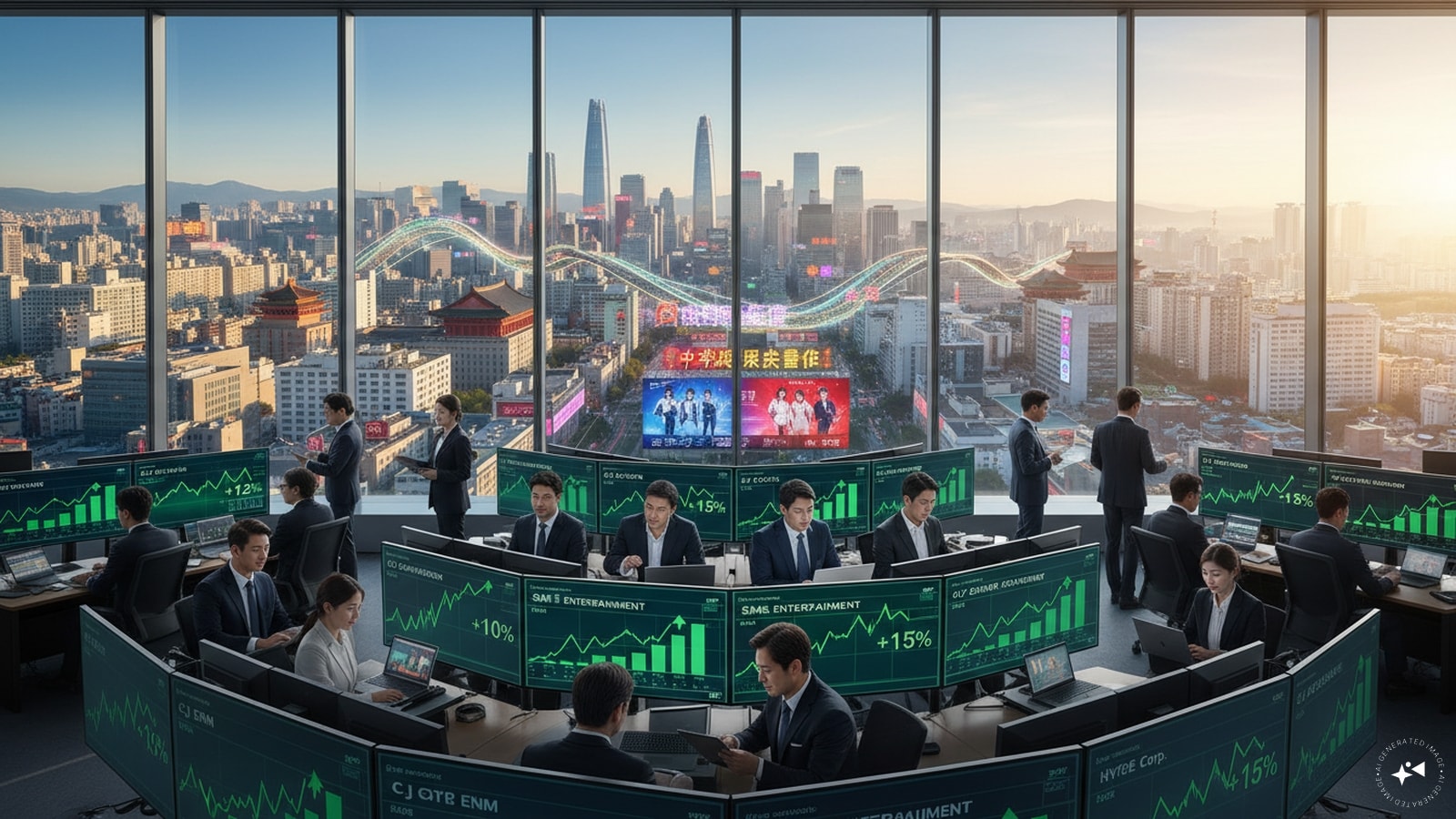
If you've been watching the Seoul stock exchange lately, you saw the instant sugar rush. Following the November 2026 summit between South Korean President Lee Jae Myung and Chinese President Xi Jinping, entertainment stocks went wild. Shares in HYBE—the powerhouse behind BTS—jumped as much as 7%. SM Entertainment climbed around 7%, JYP Entertainment ticked up 2%, and media giant CJ ENM skyrocketed over 20%. Traders immediately priced in the end of Beijing's decade-long freeze on South Korean pop culture.
They missed the fine print.
While Seoul and Beijing just wrapped up follow-up negotiations to expand their Free Trade Agreement (FTA) into services and investment, the ink on that deal does not magically reopen mainland arenas to K-pop idols. Yes, both governments agreed to broaden cultural exchanges. Yes, Korean films, games, dramas, and variety show co-productions got a massive green light. Yet live K-pop concerts remain firmly stuck in diplomatic purgatory.
Why the 2026 FTA Deal Isn't a Free Pass for K-Pop
To understand why HYBE, SM, and JYP are celebrating cautiously rather than booking flights, you have to look at what the November 2026 trade expansion actually covers.
When Presidents Lee and Xi finalized the services and investment chapter of the Korea-China FTA, Beijing pledged most-favored-nation treatment for South Korean films and video games. It also opened the door for joint productions in animation, dramas, and variety television while promising fairer pre-screening rules. For a conglomerate like CJ ENM, which produces movies and television formats, that's a goldmine. That explains why their stock surged triple what the music agencies saw.
Live music is a completely different animal. According to South Korean officials familiar with the negotiations, the updated agreement contains zero provisions requiring either country to approve live performances by singers from the other side.
Beijing has spent ten years enforcing an unofficial blockade on Korean entertainment—known in Seoul as the hallyu ban, or xianhanling—ever since South Korea deployed the US-backed THAAD missile defense system in 2016. Because China never formally admitted the ban existed, it isn't going to hold a press conference to repeal it. Instead, Xi Jinping stated that China is willing to pursue "healthy and beneficial" cultural exchanges gradually.
In Beijing's political vocabulary, "healthy and beneficial" is doing a lot of heavy lifting. Chinese regulators have spent the last several years cracking down on what they view as toxic fanquan (fandom culture) and criticizing the aesthetics of male idol groups. Letting a Korean film screen in Shanghai is one thing. Letting 50,000 screaming fans pack a stadium for a Seoul-based boy band is another.
The $10,000-Seat Litmus Test
If there won't be an official proclamation ending the freeze, how will we know when K-pop is actually back in mainland China?
Market analysts have a very specific benchmark. Lim Do-young, an analyst at Daol Investment & Securities, pointed out that the real proof won't come from trade memos or small fan meetings. It will come when a K-pop act stages a full-scale commercial concert drawing over 10,000 attendees with a complete setlist of at least 15 songs.
We aren't there yet. Just look at what happened in late 2025 when the Dream Concert faced postponement and girl group Kep1er saw a planned mainland appearance canceled. Small fan signings in Macau or Hong Kong have happened for years, and idols regularly post on Chinese platforms like Bilibili. None of that counts as a true reopening.
Still, you can see why the Big Four agencies are salivating over the math. According to data cited by Daol Investment & Securities, China's live concert market is roughly 85% the size of Japan's and nearly 2.8 times larger than South Korea's entire domestic market. K-pop spent the last decade conquering North America and Europe because it had no choice—its most natural geographic neighbor was locked shut. Unlocking mainland touring wouldn't just add a few extra tour dates; it would fundamentally alter the revenue ceiling for every major agency.
How HYBE, SM, and JYP Are Actually Playing This
Smart entertainment executives didn't wait around for November's summit to build their mainland infrastructure. If you look closely at corporate filings and joint ventures over the past two years, HYBE, SM, and JYP have all taken radically different routes to get around the wall.
HYBE's Local Beachhead
HYBE isn't just banking on BTS flying into Beijing. The company quietly established a dedicated Beijing subsidiary to handle local operations directly. Having boots on the ground in the capital allows HYBE to navigate regulatory clearances, manage local brand partnerships, and handle distribution without relying entirely on third-party middlemen. When concert permits finally loosen up, HYBE already has the corporate entity required to apply for them.
SM Entertainment's Tencent Shield
SM Entertainment took an equity-first approach. By deepening ties with Tencent Music Entertainment Group—which sits as SM's second-largest shareholder—SM effectively tied its mainland fortunes to China's dominant tech and streaming powerhouse. You don't survive regulatory scrutiny in Beijing without powerful local allies. Having Tencent in your corner doesn't guarantee stadium permits overnight, but it gives SM unmatched distribution leverage across QQ Music, Kugou, and WeChat ecosystems.
JYP and CJ ENM's Localization Play
JYP Entertainment looked at the regulatory friction and decided the smartest move was to build groups from within. Through its Chinese subsidiary, JYP teamed up with CJ ENM and Tencent Music to launch a joint venture specifically designed to scout, train, and debut localized artists for the Greater China market. Groups like Boy Story laid the groundwork years ago, and this newer structure doubles down on domestic talent. If regulators restrict foreign performers, localized acts trained under the K-pop system can still capture the market legally.
The Geopolitical Trap Nobody Wants to Mention
Here is the uncomfortable truth that stock boosters ignore. Even if Beijing starts approving concert permits next spring, K-pop's return to China will walk across a political minefield every single day.
Over the last ten years, Chinese netizens and state media have grown intensely sensitive to geopolitical messaging. Any artist or agency that fails to align with Beijing's "One China" policy—or makes an offhand comment perceived as sympathetic to Taiwan or Hong Kong independence—faces immediate blacklisting. We've seen western luxury brands and Taiwanese entertainers get wiped off Chinese streaming platforms overnight over a single social media post.
K-pop groups today are far more globalized than they were in 2015. They feature American, Australian, Japanese, Thai, and Taiwanese members who have spent years speaking freely to Western press. Managing a global world tour that hits Los Angeles, Taipei, Tokyo, and Shanghai requires tightrope-walking that can easily backfire. One mistranslated interview or poorly vetted brand sponsorship could freeze an entire agency's mainland revenue stream all over again.
On top of that, the Chinese market itself isn't sitting around waiting to be rescued. While Korean agencies were locked out, domestic C-pop idol groups—many trained by former K-pop coaches—stepped in to fill the vacuum. Chinese variety survival shows created massive local fanbases that spend aggressively on domestic stars. K-pop still carries immense prestige, especially legacy giants like BTS, EXO, and TWICE, but younger Chinese Gen Z listeners have plenty of homegrown alternatives now.
What You Should Watch Next
If you're tracking this story as an investor, a music industry observer, or a fan waiting for tour dates, stop reacting to vague diplomatic headlines. Watch the operational milestones instead.
First, keep an eye on China's Ministry of Culture and Tourism approval databases. Every foreign commercial performance in mainland China must be publicly registered and approved at the provincial or municipal level weeks before tickets go on sale. Until you see a major HYBE, SM, or JYP act listed on an official municipal approval notice in Shanghai, Guangzhou, or Beijing, any tour rumor is pure noise.
Second, watch joint television and variety co-productions. Because the November 2026 FTA expansion explicitly covers broadcast co-productions, Korean producers and mid-tier idols appearing on Chinese streaming variety shows will be the true first wave. That's the low-risk testing ground Beijing prefers before allowing massive live gatherings.
Third, monitor merchandise and pop-up retail expansion. Even without stadium tours, Korean agencies generate massive margins through character IP, album imports, and experiential pop-up stores in tier-one Chinese cities. If customs clearances and retail approvals accelerate for HYBE's Beijing unit or SM's Tencent ventures, real money will hit balance sheets long before BTS steps onto a mainland stage.
Seoul and Beijing definitely cracked the window open. Just don't mistake a draft of fresh air for an open door.