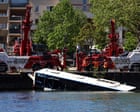
The sight of a public transport bus submerged in the cold waters of the Seine near Paris is not merely a freak accident. It is a loud, wet alarm for a city’s infrastructure. When four people were pulled from the wreckage of a vehicle that should have stayed firmly on the asphalt of the Quai de Grenelle, the narrative immediately shifted to the heroism of the first responders. While that bravery is real, it masks a more disturbing reality about transit safety, driver fatigue, and the physical decay of the barriers meant to keep heavy vehicles from sliding into the river.
Initial reports focus on the survival of the driver and three passengers. They escaped with their lives. However, the investigation into how a multi-ton bus breached a reinforced perimeter suggests that this was an avoidable failure. We are looking at a collision of mechanical oversight and a city struggling to balance its postcard-perfect aesthetics with the brutal physics of modern transportation. Read more on a similar topic: this related article.
The Physics of a Breach
A standard transit bus weighs roughly 12 to 15 tons without passengers. When that mass is in motion, even at low city speeds, it carries a kinetic energy that most decorative or aging Parisian railings are simply not designed to absorb. The incident near the Pont de Bir-Hakeim highlighted a critical vulnerability in the riverfront’s defense.
The guardrails along much of the Seine were installed decades ago. They were designed to stop smaller, lighter cars from the mid-20th century. Put a modern electric or hybrid bus against those same structures, and the metal folds like foil. If the city continues to deploy heavier, battery-laden vehicles to meet green energy goals, it must simultaneously upgrade the physical barriers that line its waterways. Additional journalism by TIME delves into comparable views on the subject.
Evidence from the scene suggests the bus did not merely skid. It mounted the curb and punched through the barrier with enough momentum to clear the embankment entirely. This indicates either a total loss of braking capability or a medical emergency that left the accelerator pinned.
The Human Factor and Driver Exhaustion
Behind every mechanical failure often lies a human story of burnout. The Parisian transport network, operated largely by the RATP, has been under immense pressure for years. Staffing shortages have led to increased overtime and split shifts that wreak havoc on a driver's circadian rhythm.
Micro-sleep is a silent killer in urban transit. A driver loses consciousness for three seconds, and a bus traveling at 40 kilometers per hour covers over 33 meters. In the tight, high-traffic corridors along the Seine, 33 meters is more than enough distance to cross three lanes of traffic and enter the water.
We must ask why these vehicles are not equipped with more aggressive Driver Monitoring Systems (DMS). While newer models have lane-assist technology, many of the older units in the fleet rely entirely on the manual reflexes of an overworked employee. The city wants to present a high-tech image to the world, but the cockpit of a standard city bus often feels like a relic of the 1990s.
The Maintenance Backlog and Fleet Health
The bus involved in the plunge was not a brand-new model. Investigators are currently stripping the wreckage to examine the steering linkage and the pneumatic braking system. There is a persistent whisper among mechanics in the depots about "deferred maintenance."
When a transit authority is squeezed by budget cuts and the need to keep every available bus on the road to meet high-frequency schedules, the deep-tissue maintenance often suffers. Brakes that should be replaced are "adjusted." Tires that are nearing the end of their tread life are pushed for another thousand kilometers.
- Pneumatic Failure: If the air pressure in the braking system drops suddenly, a fail-safe should engage the parking brake. If that fail-safe is corroded, the bus becomes a runaway projectile.
- Electronic Interference: Modern city grids are packed with electromagnetic noise. While rare, there have been documented cases of interference affecting the Electronic Control Units (ECUs) of older hybrid buses.
The Rescue Operation as a Distraction
The efficiency of the Brigade des Sapeurs-Pompiers de Paris is world-class. Within minutes, divers were in the water and the four victims were being treated for hypothermia and shock. This spectacle of competence is used by officials to steer the conversation away from the cause.
By praising the rescue, the administration avoids answering why the bus was able to enter the water in the first place. Public safety is not just about how fast you can pull someone out of a river; it is about ensuring the vehicle never reaches the water. The "river-rescue" narrative is a convenient shield for a systemic failure in urban planning.
The Impact on Tourism and Public Trust
Paris is a city defined by its relationship with the Seine. Millions of tourists use the Batobus, the river cruises, and the buses that run the embankments. When a photo of a submerged bus goes viral, it chips away at the perceived safety of the city’s primary arteries.
For the average Parisian commuter, this is not an isolated curiosity. It is a reminder that their daily transit depends on a fragile chain of well-maintained parts and alert drivers. If any link in that chain snaps, the consequences are literal and cold.
Rebuilding the Barrier System
The solution is expensive and unpopular. It requires the installation of high-impact, crash-rated bollards and reinforced steel cabling along the most dangerous curves of the river road. This often clashes with the "heritage" look of the city. Preservationists argue that heavy-duty highway barriers ruin the view of the Eiffel Tower or the Notre Dame cathedral.
This is the central conflict of Paris in the 2020s. Is the city a living museum or a functioning metropolis? If it is the latter, then safety must take precedence over sightlines. A decorative iron fence is no match for a 15-ton bus. The city needs to implement "stealth" security—barriers that are anchored deep into the quay’s foundations but designed to blend into the stone masonry.
The Tech Gap in Urban Safety
We talk about autonomous vehicles, yet we fail to implement basic geo-fencing on public buses. It is technically possible to equip every city bus with a GPS-linked speed limiter that prevents a vehicle from exceeding 30 kilometers per hour in high-risk zones near the river.
Furthermore, Automatic Emergency Braking (AEB) systems that detect stationary objects or sudden drops in elevation should be mandatory for any vehicle operating on the quays. The fact that a bus can still be driven off an embankment in a major world capital in 2026 is an indictment of the slow pace of safety integration.
Accountability and the Road Ahead
The RATP and the Paris police must produce a transparent report that goes beyond "driver error." We need to see the maintenance logs of the specific vehicle. We need to see the shift logs of the driver for the thirty days leading up to the accident.
If the investigation reveals that the driver had been working excessive hours or that a known mechanical fault was ignored, there must be legal consequences for the management, not just the person behind the wheel. The four people rescued from the Seine are lucky. The next group might not be.
The city must decide if it will continue to patch over these cracks or if it will finally commit to the massive infrastructure overhaul required to keep its citizens on dry land. The Seine is a beautiful backdrop, but it is a lethal one for a bus that loses its way.
Inspect the quays. Audit the depots. Replace the barriers.