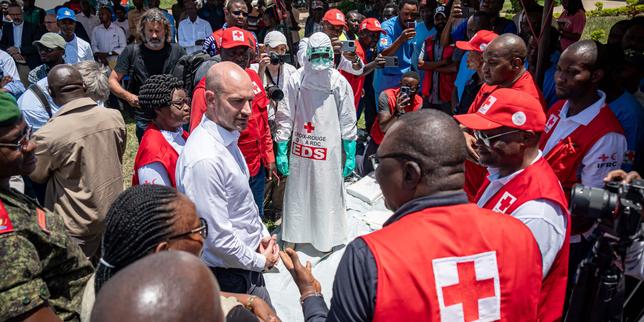
The headlines out of Paris regarding the latest Ebola flare-up in the Democratic Republic of Congo follow a depressingly familiar script. French officials stand at podiums, pledge solidarity, dispatch emergency funds, and pat themselves on the back for swift international humanitarian altruism. Jean-Noël Barrot steps up to reaffirm Paris backing Kinshasa, offering standard diplomatic platitudes wrapped in financial aid packages. Everyone nods. Everyone feels good.
And that is precisely why the outbreak management keeps failing.
Throwing cash and political photo-ops at a hemorrhagic fever in Central Africa while ignoring the structural mechanics of local distrust is not aid. It is theater. When foreign capitals treat public health crises in the Kivu provinces as diplomatic PR opportunities, they miss the entire operational reality on the ground. The issue in the DRC is never a shortage of well-meaning declarations from the Quai d Orsay. The issue is an institutional architecture that treats local populations as passive recipients of western benevolence rather than active architects of their own survival.
I have spent enough time tracking infectious disease logistics in fragile states to watch millions of euros evaporate into administrative overhead, armored convoys, and security details while community clinics go without basic saline drips.
Let us dismantle the lazy consensus. The standard narrative claims that stopping Ebola in the DRC requires more foreign cash, more international experts, and louder expressions of solidarity from European capitals. That premise is false. More money channeled through top-down bureaucracies merely accelerates inefficiency. What actually stops outbreaks is radical local agency, decentralized cold-chain logistics run by people who actually speak the regional dialects, and an immediate cessation of treating health interventions as geopolitical charity.
When Jean-Noël Barrot talks about standing shoulder-to-shoulder with Kinshasa, he is addressing domestic voters in France, not nurses in Beni.
Consider the mechanics of mistrust. Decades of extraction, political instability, and heavy-handed international interventions have forged a population that views men in hazmat suits arriving on UN helicopters with deep, rational suspicion. When foreign actors parachute in with millions of dollars in emergency aid, they bypass existing community health networks. They set up parallel structures that pay local workers astronomical wages compared to the local economy, instantly corrupting the local medical ecosystem and alienating traditional healers who hold actual community sway.
Stop trying to fix foreign medical crises by exporting western bureaucratic panic.
If Paris actually wanted to support Kinshasa in a meaningful way, it would stop underwriting centralized patronage networks and start funding decentralized, community-led surveillance teams directly. That means cutting out the middlemen in international organizations who skim forty percent of every euro for administrative costs before a single syringe reaches a provincial clinic. It means acknowledging that local health workers do not need a lecture from European diplomats on solidarity; they need uninterrupted electricity, secure supply chains for personal protective equipment, and the autonomy to manage burials and contact tracing according to cultural realities rather than distant UN mandates.
The uncomfortable truth is that international solidarity often acts as a narcotic for local governments, allowing them to abdicate domestic healthcare investments while pocketing foreign goodwill. Every time Paris writes a blank check for an emergency response, it subsidizes the chronic underfunding of the Congolese public health sector.
We keep funding the fire department while ignoring the fact that the building is constructed entirely out of kindling.
Until the international community shifts its paradigm from emergency charity to permanent capacity building owned entirely by local municipal health boards, every flare-up will be met with the same performative anxiety. Jean-Noël Barrot can pledge all the support he wants. Until that support stops looking like a colonial relief effort and starts looking like an investment in sovereign local infrastructure, the virus will continue to outpace the diplomacy.
Stop applauding the arrival of the check. Ask why the floor keeps collapsing beneath the people writing it.