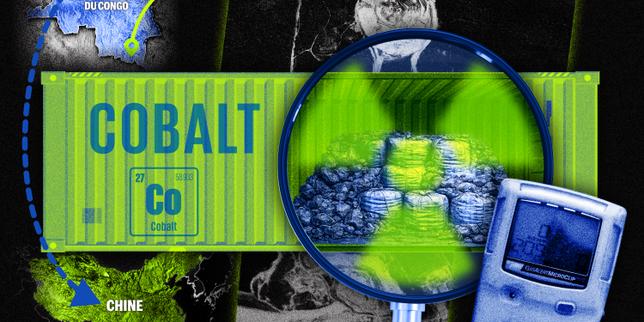
Every few months, a headline warns that uranium from the Democratic Republic of Congo is sliding secretly into Chinese hands, bypassing international controls. Observers clutch their pearls. Security analysts warn of rogue supply chains. Western capitals scramble to draft memos about critical mineral security.
It is a completely manufactured panic built on economic illiteracy and a fundamental misunderstanding of how global commodities actually move. Don't forget to check out our earlier article on this related article.
The lazy consensus says Beijing is conducting some grand, shadowy heist of African resources beneath the regulatory radar. The truth is much more mundane, far less cinematic, and infinitely more capital-driven. Nobody is smuggling yellowcake in backpacks. The metal moves through broad daylight via standard commercial contracts, customs declarations, and corporate balance sheets.
If you want to understand why the narrative of clandestine Chinese uranium acquisition falls apart, you have to look past the spy-thriller aesthetics and examine the mechanics of mining, refining, and global trade. If you want more about the context here, Business Insider provides an in-depth breakdown.
The Raw Material Fallacy
Start with a basic reality check that most journalists refuse to acknowledge. Unrefined uranium ore straight out of the ground is practically useless for a nuclear reactor.
You cannot dig up pitchblende in Katanga, pack it into a shipping container, and drop it straight into a nuclear power plant or a centrifuge cascade. Natural uranium requires a brutal, capital-intensive industrial process called milling to turn it into uranium concentrate, commonly known as yellowcake. Even then, yellowcake is only roughly eighty percent uranium oxide. From there, it must go through conversion facilities to become uranium hexafluoride, followed by massive isotope enrichment infrastructure to raise the concentration of the fissile U-235 isotope from its meager natural level of zero point seven percent up to reactor-grade or weapons-grade levels.
China possesses domestic production, massive state-backed enrichment capacity, and long-term procurement networks spanning Kazakhstan, Namibia, Niger, and Australia. The idea that Beijing needs to sneak raw, low-grade dirt out of central Africa through illicit backchannels ignores the basic physics and chemistry of the nuclear fuel cycle. You do not smuggle raw materials that require billions of dollars in industrial chemistry to render useful.
When transactions happen, they happen through structured corporate entities operating under mining codes. The paperwork exists. The export taxes, however poorly collected or negotiated, are part of public record.
Follow the Capital, Not the Conspiracy
Let us look at who actually owns and operates the mines in question.
The mining sector in the Democratic Republic of Congo is dominated by international joint ventures, state-backed enterprises, and private equity syndicates. When a major mining project changes hands or signs an offtake agreement, it is rarely done via midnight handshakes in parking lots. It is executed through multi-jurisdictional holding companies registered in tax-friendly hubs, backed by international banking syndicates.
I have sat in boardrooms where asset sales in Central Africa were negotiated. The real story is never about geopolitical espionage. It is about cash flow, risk mitigation, infrastructure financing, and debt servicing.
Chinese firms win contracts in the region because Western mining majors spent the last decade pulling back from high-risk jurisdictions under mounting environmental, social, and governance pressures. Western boards grew terrified of regulatory fines, supply chain scrutiny, and reputational damage. When Western capital retreats from a high-risk frontier, someone else steps into the vacuum. That is not a covert operation. That is basic market economics. Capital abhors a vacuum, and industrial conglomerates with high risk tolerance move in to fill it.
Blaming China for buying assets that Western corporations abandoned out of risk aversion is like refusing to buy a house and then crying when your neighbor purchases it at a discount.
The Geopolitical Projection Trap
Why do politicians and think tanks love the narrative of under-the-radar smuggling? Because it provides an easy scapegoat for institutional failure.
It is much easier for Western policymakers to blame foreign subterfuge for supply chain vulnerabilities than to admit that their own domestic mining permitting processes take fifteen years, or that their financial markets refused to back high-risk African infrastructure projects.
Imagine a scenario where a Western consortium attempts to build a modern transport corridor from the copper and cobalt belts of central Africa to an Atlantic or Indian Ocean port. They will spend a decade drowning in environmental impact assessments, legal challenges, community disputes, and changing tax regimes. Meanwhile, state-backed international competitors deploy engineering teams, pour concrete, lay rail lines, and secure logistics networks within a fraction of that timeframe.
The bottleneck is not Chinese stealth. The bottleneck is Western bureaucracy and capital paralysis.
When you frame every normal commercial transaction as an existential threat, you misdiagnose the disease. You start treating supply chain security as a law enforcement problem rather than an industrial policy problem. You cannot arrest your way to resource independence. You have to out-build, out-finance, and out-compete.
The Uncomfortable Reality of the Global Market
The global market for critical energy minerals does not care about your geopolitical feelings. Uranium, cobalt, copper, and lithium flow to the highest bidder with the most reliable logistics chain.
If a mining operation in Central Africa sells its output to a Chinese state-owned enterprise, it is usually because that enterprise fronted the capital to build the mine, provided the infrastructure to move the product, or offered a guaranteed floor price that local stakeholders needed to balance their budgets.
To disrupt this dynamic, Western governments need to stop whining about invisible supply lines and start deploying serious, patient capital into frontier markets. That means government-backed development finance institutions taking on real sovereign and operational risk, streamlining permitting for domestic processing, and building industrial ecosystems that can actually absorb and refine raw materials at scale.
Until then, every breathless report about secret mineral flows is just political theater designed to distract from a simple, brutal truth. Nobody stole the supply chain. We handed it away.