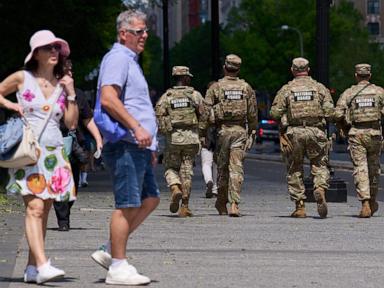
The indefinite presence of National Guard troops in the United States capital represents a fundamental shift from emergency response to a permanent security fixture, signaling a failure in the transition from tactical stabilization to sustainable civil governance. When military forces are integrated into the daily urban fabric without a clear exit criteria or "condition-based" withdrawal strategy, the result is operational inertia. This inertia is not merely a logistical oversight; it is a strategic bottleneck that degrades force readiness, inflates federal expenditures, and alters the psychological contract between the state and its citizenry.
The Triad of Institutional Failure
The persistence of a domestic military footprint stems from three distinct institutional breakdowns. Each layer reinforces the other, creating a feedback loop that makes withdrawal politically and operationally difficult. For a more detailed analysis into similar topics, we suggest: this related article.
- The Intelligence-Security Gap: Law enforcement agencies often rely on military presence as a hedge against intelligence uncertainty. Because the cost of a "false negative" (failing to prevent an event) is perceived as higher than the cost of "false positives" (maintaining unnecessary troops), the default setting becomes permanent mobilization.
- Jurisdictional Fragmentation: Washington D.C. operates under a complex web of overlapping authorities—the Secret Service, Capitol Police, Metropolitan Police Department, and various federal agencies. When these entities cannot achieve a unified security architecture, the National Guard functions as a "gap-filler," masking systemic inefficiencies in inter-agency coordination.
- The Absence of Threshold Metrics: Traditional military operations are governed by "End States" and "Transition Points." In the current domestic deployment, there is an absence of quantifiable metrics—such as specific threat-level reductions or law enforcement staffing benchmarks—that would trigger a drawdown.
The Force Readiness Decay Function
Maintaining thousands of troops in a non-combat, static security role creates a hidden tax on the long-term viability of the National Guard. Unlike active-duty components, the National Guard is a dual-status force designed for surge capacity, not sustained urban patrolling.
The primary cost function here is the Opportunity Cost of Skill Degradation. Infantrymen, engineers, and support specialists stationed at street corners are not training for their primary federal missions. Over time, the delta between their current utility and their required combat proficiency widens. This creates a "Readiness Debt" that must eventually be repaid through intensive retraining cycles, further straining the defense budget. To get more details on this issue, in-depth reporting can also be found on Reuters.
The second variable in this decay function is Employer and Family Retention. The National Guard relies on the stability of the "Citizen-Soldier" model. When deployments transition from "short-term emergency" to "open-ended service," the friction between military requirements and civilian careers intensifies. High-tempo deployments for low-intensity missions lead to an inevitable attrition of mid-level leadership—the NCOs and officers who provide the backbone of the force.
The Economic Architecture of Static Defense
The financial burden of a semi-permanent military presence in a domestic setting is often obscured by general defense appropriations, but a granular analysis reveals a highly inefficient capital allocation.
- Per-Diem and Lodging Scalability: Housing thousands of troops in commercial hotels or temporary facilities is significantly more expensive than utilizing established military installations. This creates a continuous drain on the National Guard Bureau’s budget, often necessitating supplemental funding from Congress that bypasses standard fiscal oversight.
- Asset Depreciation: The continuous use of tactical vehicles and communication gear in an urban environment accelerates wear and tear. These assets are designed for rugged terrain and high-intensity bursts, not the "stop-and-start" idling of city patrols.
- Civilian Economic Friction: The physical infrastructure of military security—concrete barriers, fencing, and restricted zones—acts as a non-tariff barrier to local commerce. It disrupts the logistical flow of the city, reducing the efficiency of the local service economy and lowering tax yields for the municipal government.
Psychological Normalization and the Policing Paradox
The most profound long-term impact is the normalization of military visibility in civil life. This phenomenon shifts the "Overton Window" of domestic security. When the public becomes accustomed to seeing M4 carbines and camouflage on the subway or at the grocery store, the distinction between civil policing and military occupation blurs.
Policing, by definition, is based on the principle of consent and de-escalation within a community. Military training, conversely, is rooted in force projection and area denial. Substituting one for the other changes the nature of the interaction between the state and the public. It creates a "Security Theater" that may provide a sense of safety but actually masks the underlying volatility. If the police cannot secure the capital without military reinforcement, it suggests a systemic collapse of the civil security apparatus.
Strategic Path to Demobilization
To break the cycle of indefinite deployment, the security apparatus must shift from a "Force-Heavy" posture to a "Tech-Integrated" model. This requires three tactical pivots:
- Hardening of Physical Infrastructure: Permanent, aesthetically integrated security measures must replace temporary military barriers. This allows for the same level of protection with a fraction of the manpower.
- Automated Surveillance Integration: Leveraging AI-driven threat detection and advanced sensor arrays can provide the "Early Warning" capability that currently requires hundreds of boots on the ground.
- The "Reserve-on-Call" Framework: Instead of active patrolling, National Guard units should be transitioned to a high-readiness "Quick Reaction Force" (QRF) stationed at nearby bases like Joint Base Andrews or Fort Belvoir. This maintains the surge capacity while removing the military footprint from the public eye.
The failure to implement these transitions suggests that the deployment has moved beyond security and into the realm of political signaling. A military force that does not know when its mission is over is no longer a tool of defense; it is a symptom of administrative paralysis. The strategic imperative is to return the National Guard to its status as a reserve force, thereby restoring the operational boundaries essential to a functioning republic. This requires the immediate establishment of "Condition-Based Withdrawal" protocols, pegging troop levels to specific, public intelligence benchmarks rather than political comfort levels.