The death of a high-ranking Brigadier General and multiple subordinates during an insurgent assault on a military base in Borno State is not a statistical anomaly but a symptom of structural decay in the static defense model employed by the Nigerian military. This event exposes a critical failure in the Security-to-Density Ratio, where the geographical spread of Forward Operating Bases (FOBs) exceeds the military's capacity for rapid reinforcement and aerial overwatch. When a command element of this seniority is neutralized within a fortified perimeter, it confirms a breach in the fundamental hierarchy of combat effectiveness: Intelligence, Perimeter Integrity, and Kinetic Response.
The Triad of Operational Failure
To understand the mechanics of this breach, one must deconstruct the engagement into three distinct failure points. Insurgent groups, primarily the Islamic State West Africa Province (ISWAP), have transitioned from hit-and-run tactics to Complex Multi-Vector Assaults (CMVA). If you found value in this piece, you might want to look at: this related article.
1. Intelligence Asymmetry and the Observation Gap
The primary failure occurs long before the first shot is fired. For an insurgent force to mobilize enough technicals (armed pickup trucks) and infantry to overrun a base housing a General, they must achieve Massing without Detection. This indicates a total breakdown in the local human intelligence (HUMINT) network and a lack of persistent Signals Intelligence (SIGINT).
The insurgents successfully exploited a "Blind Spot Corridor." By leveraging local terrain and perhaps civilian coercion, they negated the military's technological edge. In this context, the death of a General suggests he was likely in a transition phase—either conducting an inspection or coordinating a specific maneuver—meaning the insurgents possessed high-level, time-sensitive intelligence regarding his location. This is "Targeted Attrition," a strategy designed to decapitate leadership and shatter troop morale simultaneously. For another perspective on this event, see the latest update from The Washington Post.
2. The Static Base Vulnerability Paradox
The Nigerian military utilizes a "Super Camp" strategy, designed to concentrate forces to prevent small outposts from being picked off. However, this creates a Static Target Profile.
- The Perimeter Hardening Deficit: If a base can be breached by mobile insurgents, the physical engineering of the site—trenches, berms, and Hesco barriers—is either substandard or improperly manned.
- Thermal and Night Vision Deficiency: Most insurgent assaults in the Northeast occur during dawn or dusk (the "Grey Hours"). A lack of widespread distribution of thermal imaging equipment allows attackers to close the distance to within 50 meters before being engaged by heavy weaponry.
3. Reinforcement Lag and the Force Multiplication Deficit
In a functional counter-insurgency (COIN) environment, a base under attack triggers a Quick Reaction Force (QRF). The failure to save a high-ranking officer indicates that the QRF was either ambushed en route or stayed grounded due to a lack of air support. The "Air-to-Ground Coordination Gap" remains the most significant bottleneck. Without 24/7 drone loitering or immediate Close Air Support (CAS), isolated bases are essentially "islands" that can be overwhelmed by sheer numerical local superiority, regardless of the quality of the soldiers inside.
The Mechanics of Insurgent Evolution: ISWAP vs. State Forces
The threat landscape has shifted from the disorganized chaos of early Boko Haram to the disciplined, semi-conventional maneuvers of ISWAP. We must categorize their tactical advantages to understand why state forces are currently at a disadvantage.
The Mobility-Firepower Trade-off
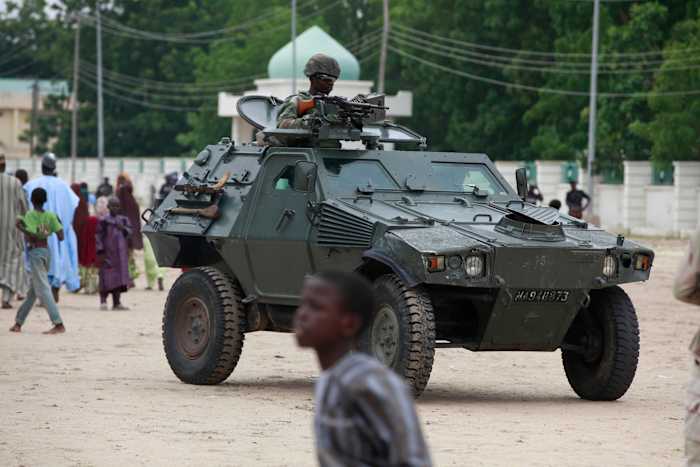
The Nigerian Army relies on heavy armored personnel carriers (APCs) and Main Battle Tanks (MBTs) which are restricted to established roads due to the sandy terrain of the Chad Basin. Conversely, insurgents utilize "Technicals"—light, highly mobile vehicles equipped with anti-aircraft guns used in a direct-fire role.
- Insurgent Velocity: High. They can navigate off-road, bypassing military checkpoints.
- State Velocity: Low. Movement is predictable and easily ambushed.
This creates a Kinetic Mismatch. The insurgents choose the time and place of the engagement, ensuring they always have a local 3:1 or 5:1 manpower advantage at the point of contact, even if the total military force in the region is much larger.
Decapitation as a Psychological Multiplier
The killing of a General is a "High-Value Target (HVT) Inversion." Usually, the state seeks to kill insurgent leaders to degrade their organization. When the insurgents reverse this, the psychological impact on the rank-and-file soldier is catastrophic. It signals that no level of rank or fortification provides safety. This leads to Tactical Retreat Syndrome, where soldiers may abandon posts prematurely in future engagements because the perceived risk of staying outweighs the perceived reliability of reinforcement.
The Resource Misallocation Model
Analysis of Nigerian defense spending vs. operational outcomes reveals a "Procurement-to-Performance Gap." While the government spends billions on high-end platforms like the A-29 Super Tucano, these assets are often mismatched against the reality on the ground.
- The Maintenance Attrition Rate: A significant portion of the inventory is non-operational at any given time due to a lack of spare parts and specialized technicians.
- The Infantry Training Deficit: Modern COIN requires specialized urban and bush-warfare training. There is evidence that many frontline troops are general-purpose infantry thrust into a high-intensity asymmetric environment for which they are under-equipped mentally and tactically.
Operational Limitations and Geographic Constraints
We must acknowledge the "Tyranny of Distance." The Northeast is a vast, porous region. The border with Niger, Chad, and Cameroon allows for an Insurgent Sanctuary Effect. When pressured, ISWAP fighters simply cross an invisible line where the Nigerian Army cannot legally follow.
The military's current posture is Reactive rather than Proactive. They wait for the insurgents to strike a base and then attempt to repel them. This cedes the initiative. To regain the advantage, the military would need to shift to a "Nomadic Patrol" model, but this requires a level of logistical support (mobile fuel bladders, satellite communications, and aerial resupply) that the current infrastructure cannot sustain.
The Strategic Shift: From Occupation to Interdiction
The current strategy of "holding ground" via fixed bases is failing. The loss of a General is the ultimate proof of this failure. The following structural changes are required to prevent a total collapse of the security architecture in the Northeast.
- Transition to "Lizard" Units: Small, highly mobile, autonomous platoons that operate in the bush for weeks at a time. These units must be independent of FOBs, removing the "fixed target" problem. Their goal is not to hold land, but to intercept insurgent supply lines and "technical" convoys.
- Decentralized Air Support: Instead of keeping all air assets at major hubs like Maiduguri, the military must deploy tactical drones (UAVs) at the battalion level. Every commander must have their own "eye in the sky" to prevent the massing of insurgent forces.
- The Professionalization of the Frontier: The use of "Civilian Joint Task Forces" (CJTF) as a primary source of HUMINT is a double-edged sword. It creates a blurred line between combatants and non-combatants, often leading to intelligence leaks. The military must develop a professional, covert HUMINT branch that operates independently of local political structures.
The death of a General is not just a loss of personnel; it is a signal that the insurgents have mastered the state's current playbook. If the Nigerian military continues to prioritize "defending the base" over "hunting the force," the attrition of senior leadership will accelerate. The only path forward is to dissolve the static lines and adopt the same fluid, mobile, and decentralized characteristics that have made the insurgents so difficult to eradicate. Failure to do so will result in the "Green Zone" effect, where the government controls only the city centers while the hinterlands—and the roads connecting them—belong to the insurgency.