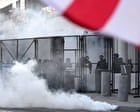
The incident involving a juvenile sustaining a permanent ocular injury during the "No Kings" protest in Los Angeles serves as a case study in the breakdown of non-lethal engagement protocols. When law enforcement agencies deploy kinetic impact projectiles (KIPs) into dense, moving crowds, the margin for error diminishes to zero. The resulting trauma—in this case, the loss of an eye—represents a failure of the tiered response hierarchy, where the objective of "crowd dispersal" was superseded by an uncontrolled application of force. Analyzing this event requires deconstructing the tactical environment, the physics of the munitions used, and the legal liability frameworks that govern federal agent conduct on domestic soil.
The Kinematics of Non-Lethal Munitions
The term "non-lethal" is a misnomer that obscures the actual risk profile of the hardware. In professional ballistics and medical trauma analysis, these are classified as "less-lethal" or "reduced-lethality" weapons. The specific injury—a ruptured globe—indicates a direct impact from a high-velocity projectile, likely a 40mm sponge round or a bean bag round.
The probability of permanent disability from these munitions is governed by three physical variables:
- Impact Velocity: Most KIPs are designed to be effective at ranges of 20 to 50 feet. At close range, the kinetic energy exceeds the structural threshold of human bone and soft tissue.
- Target Accuracy: Standard operating procedures (SOPs) for federal agents, including Customs and Border Protection (CBP) or Federal Protective Service (FPS) units often deployed to civil unrest, mandate aiming for "large muscle groups" like the thighs or buttocks. Any impact above the sternum is categorized as an unauthorized use of force.
- Projectile Mass and Surface Area: A 40mm sponge round is designed to distribute force across a wide area to cause blunt force trauma without penetration. However, the human orbit (the eye socket) is a structural vulnerability. If the projectile strikes the ocular region, the force is concentrated rather than dissipated.
The Los Angeles incident suggests a breakdown in "target acquisition." In high-stress, low-visibility environments—common in night-time protests—the transition from identifying a threat to discharging a weapon happens in milliseconds. When an agent fires into a crowd rather than at a specific, verified threat, the weapon loses its "tactical" classification and becomes an "indiscriminate" tool of injury.
The Jurisdictional Friction of Federal Intervention
The presence of federal agents at a local Los Angeles protest creates a complex legal and operational "gray zone." Unlike the Los Angeles Police Department (LAPD), which operates under a specific city charter and civilian oversight boards, federal agents often operate under broader Department of Homeland Security (DHS) mandates.
The Bivens Constraint
Victims of federal excessive force face a significantly higher bar for recovery than those injured by local police. Under the Bivens v. Six Unknown Named Agents precedent, individuals can sue federal officers for constitutional violations. However, the Supreme Court has consistently narrowed the "Bivens remedy" over the last decade. In the context of a protest, a federal agent can argue that their actions were tied to national security or the protection of federal property, which creates a formidable shield against personal liability.
Unified Command Failures
Strategic failure often stems from a lack of "Unified Command." When federal agencies (such as BORTAC or FPS) operate alongside local law enforcement, different Rules of Engagement (ROE) apply. If the LAPD is under a court-ordered injunction to limit the use of KIPs, but the federal agents are not, the tactical environment becomes unpredictable. This creates a "Risk Asymmetry" where the protestors assume a specific level of restraint from local police that is not shared by the federal units present.
The Three Pillars of Tactical Miscalculation
The injury sustained by the 17-year-old victim is not an isolated accident but the output of a flawed engagement model. We can categorize the systemic failures into three distinct pillars.
1. Escalation Dominance
Law enforcement strategy often relies on "Escalation Dominance"—the idea that by meeting resistance with a higher tier of force, the crowd will choose to disperse. In Los Angeles, the use of KIPs represents a jump from "Command Presence" and "Verbal Commands" directly to "Intermediate Weapons." When this jump happens prematurely, it triggers a "fight or flight" response in the crowd, increasing chaos and making precise targeting impossible.
2. The Accuracy Paradox
The more a crowd moves, the less accurate less-lethal munitions become. Agents are trained on stationary targets in controlled environments. In a "No Kings" march characterized by rapid movement, smoke, and strobe lights, the "Point of Aim" rarely aligns with the "Point of Impact." The "Accuracy Paradox" states that as the need for crowd control increases, the tools used for that control become exponentially more dangerous to bystanders.
3. Biological Vulnerability
The choice of munitions ignores the physiological reality of the participants. A 17-year-old's facial structure and bone density differ from the "average male" profile used in ballistic testing. By deploying these weapons in a demographic-diverse environment, agents accept a high "Collateral Injury Rate."
Quantifying the Cost of Ocular Trauma
Beyond the immediate physical agony, the "Cost Function" of this incident extends into long-term systemic impacts. For the individual, the loss of an eye entails:
- Permanent Depth Perception Deficit: Eliminating the possibility of careers in aviation, certain medical fields, and high-precision trades.
- Secondary Glaucoma Risk: Blunt force trauma to the eye often leads to increased intraocular pressure in the remaining structures, necessitating lifelong medical monitoring.
- Psychological Traumatic Load: The "flashpoint" nature of the injury—occurring during a political expression—creates a durable distrust of state institutions.
For the state, the cost is measured in "Legitimacy Erosion." Every instance of a permanent injury to a minor during a protest acts as a multiplier for future unrest. It provides a visual and emotional anchor for anti-government sentiment, which in turn necessitates more aggressive policing, creating a self-reinforcing loop of violence.
Evidence Preservation and the Litigation Roadmap
The lawyer for the teenager has signaled a move toward a major civil suit. For this to reach a settlement or verdict, the legal team must bypass the "Qualified Immunity" defense. This requires a granular reconstruction of the event using:
- Photogrammetry: Using bystander video to triangulate the exact position of the shooter and the victim.
- Body-Worn Camera (BWC) Analysis: Federal agents have been slower to adopt BWCs than local departments. The absence of footage will be a primary point of contention, often interpreted by juries as a deliberate "information blackout."
- Munition Recovery: Identifying the specific batch and type of projectile to determine if it was expired or "out of spec," which can increase flight instability.
The "No Kings" march incident is a symptom of a broader trend where "crowd management" has shifted toward "crowd suppression." The use of kinetic force against a juvenile suggests that the operational priority was the immediate clearance of a geographic area rather than the preservation of life or limb.
Strategic Recommendation for Agency Reform
To mitigate the risk of permanent disability in civil disturbance scenarios, the operational framework must move away from projectile-based dispersal in dense urban environments. The current model is statistically destined to produce "high-severity, low-frequency" injuries like the one seen in Los Angeles.
The immediate tactical pivot must involve:
- Strict Elevation Restraints: Hard-coding a "Below the Waist" mandate into the firing mechanism of less-lethal launchers through training and mechanical stops.
- Acoustic and Visual Deterrents: Prioritizing Long Range Acoustic Devices (LRAD) and high-intensity lights over kinetic impactors to achieve dispersal without physical contact.
- Third-Party Observation: Mandatory real-time oversight from a non-engaged safety officer whose sole job is to veto the use of KIPs if the crowd density makes "clean" targeting impossible.
The failure in Los Angeles was not just a failure of aim; it was a failure of the decision-making calculus that determined a 40mm round was a proportional response to a marching crowd. Until the "Less-Lethal" designation is treated with the same gravity as "Lethal" force, these catastrophic outcomes will remain a recurring line item in the ledger of American civil unrest.



