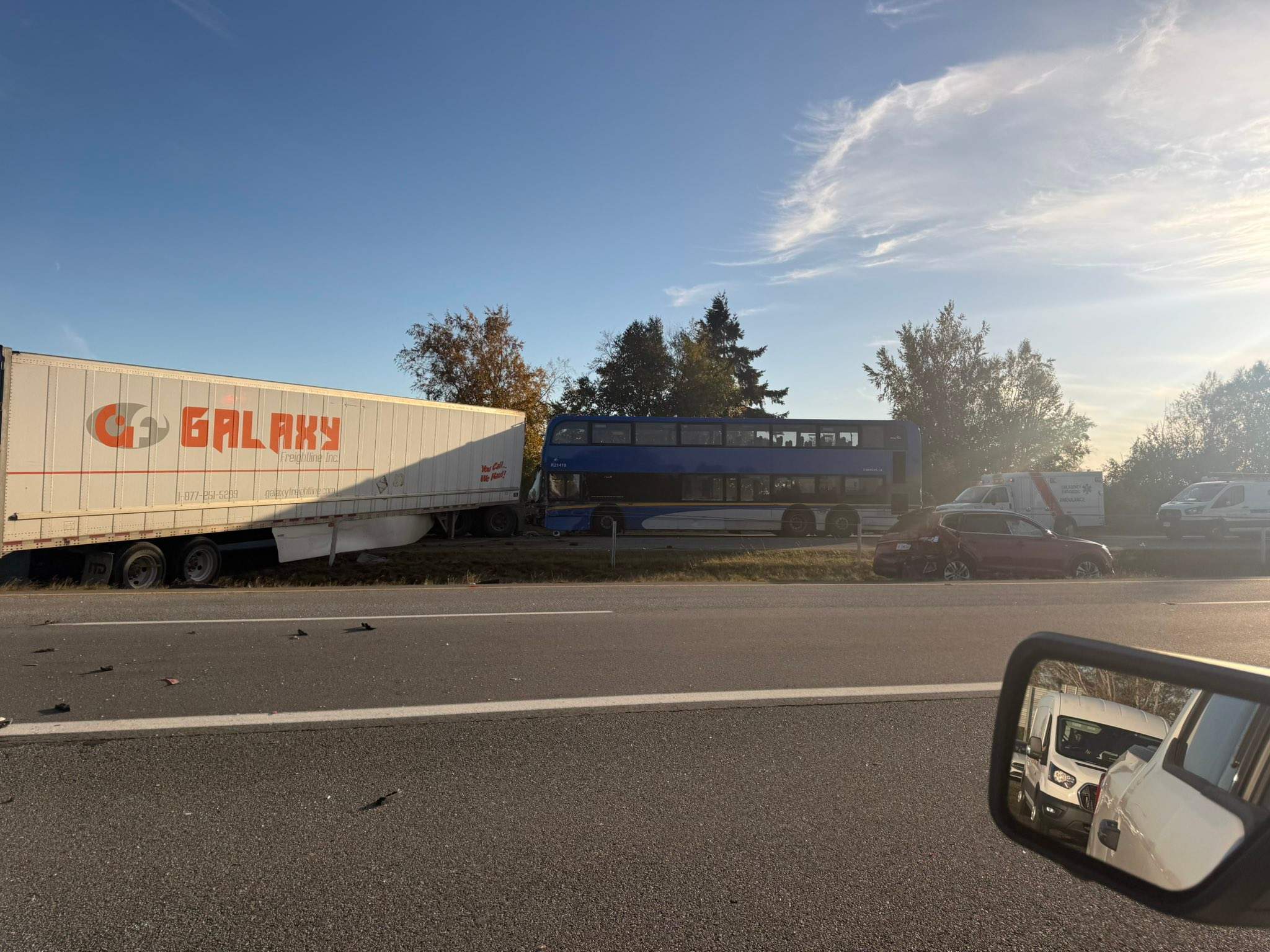
One semi-truck crossed a median on a Friday afternoon and turned a routine rush-hour commute into a four-hour gridlock nightmare.
If you've ever driven Highway 99 through Delta and South Surrey heading toward the Highway 91 interchange or the George Massey Tunnel, you know how fast a minor hiccup snowballs into a standstill. On October 16, 2026, a multi-vehicle pileup involving a semi-trailer, a double-decker transit bus, and passenger cars shut down the corridor just after 5:30 p.m. and didn't reopen until shortly after 9:30 p.m. Thirteen people were taken to hospital—two in serious but stable condition, including one airlifted, and eleven others in stable condition—while roughly 50 to 60 passengers were aboard the bus. Discover more on a similar topic: this related article.
Early snapshots from a crash like this are notoriously messy. When a semi-truck, a high-profile double-decker coach, and smaller passenger vehicles collide at highway speed, first responders have to stabilize victims, secure heavy wreckage, and clear lanes before they can confirm total vehicle counts or injury severity. That's why initial reports on scenes like this sometimes diverge on exact injury counts or whether passengers were on board before police and paramedics complete their triage. Further journalism by TIME highlights similar views on the subject.
What Happened Near the Highway 91 Interchange
Dash-camera footage and police updates pointed to a semi-truck and trailer crossing out of its lane into oncoming or adjacent traffic near the Highway 99 and Highway 91 corridor along the Delta–Surrey border. Heavy commercial rigs carry massive kinetic energy, and when one loses traction, swerves around stopped traffic, or crosses a median, surrounding drivers have almost nowhere to go.
A double-decker bus adds another layer of complexity to any highway collision. Compared with a standard sedan or even a single-deck commuter coach, a double-decker sits taller, catches more crosswind, and carries dozens of riders who may be standing, moving, or seated without restraints. According to police reports cited by CTV News and CBC News, about 50 to 60 people were on the bus when the crash unfolded, and 13 people across the scene required hospital transport.
Surrey Fire Services, BC Emergency Health Services (BCEHS) ground crews, an air ambulance, and police converged on the site as traffic backed up along southbound Highway 99 toward the Massey Tunnel. DriveBC closed the affected stretch just after 5:30 p.m. on a busy Friday evening and reopened it a little after 9:30 p.m., leaving thousands of drivers stuck or rerouting onto local arterials.
Why Highway 99 Bottlenecks Punish Drivers So Hard
Honestly, the crash itself is only half the story. The real reason a single collision on Highway 99 ruins an entire Friday night across Delta, Surrey, and Richmond comes down to corridor geography and choke points.
South of the Fraser River, Highway 99 funnels regional commuters, cross-border travelers, port freight, and transit routes into a tight network of interchanges and river crossings. When lanes narrow or merge near the Highway 91 interchange and head toward the Massey Tunnel, there is very little slack in the system. A single jackknifed trailer or multi-car pileup doesn't just block one lane—it traps an entire column of vehicles with no immediate off-ramp escape.
Drivers make two classic mistakes when a major highway locks up like this:
- Waiting until the bumper-to-bumper queue starts to bail. By the time you see brake lights stretching back toward the tunnel or interchange, local parallel roads are already filling up with people who guessed earlier.
- Treating local neighborhood streets like high-speed bypasses. Cutting through residential or agricultural roads in Delta and Surrey can shave time if you check live routing early, but speeding through unfamiliar turns when stressed drivers are jockeying for position creates secondary fender-benders.
Let's be real: no highway geometry is going to stop every distracted or misjudging driver overnight. Still, mixing heavy freight trucks, high-occupancy double-decker buses, and dense evening commuter traffic at high speeds leaves zero margin for error when something goes wrong.
How to Handle a Sudden Highway Closure Without Losing Your Mind
When you hit a sudden closure on Highway 99 or any major corridor, panic and stubbornness cost you the most time. A few practical habits actually make a difference when you're stuck or planning around an active incident:
- Check official feeds before moving an inch. Pull up DriveBC and local police advisories rather than relying solely on third-party social posts, which often lag behind lane reopenings or misstate which direction is moving.
- Decide early between waiting and rerouting. If emergency crews and tow trucks are clearing heavy commercial vehicles, a closure can stretch for hours. If you're still before a major arterial split, switching routes early beats sitting motionless for ninety minutes.
- Keep an emergency kit in your trunk. Even a mild October evening or a chilly spring rainstorm feels a lot longer when your car is idling in gridlock—keep water, a phone charger cable, basic first-aid items, and a warm layer handy.
- Save any dash-cam video immediately. If you were near the scene, lock or export your footage right away so you don't accidentally overwrite it, and share it with investigating police if appropriate.
The October 16 collision ended without fatalities, which is the best news anyone can hope for after a crash involving a semi-trailer and a packed bus. For everyday commuters, though, it's a sharp reminder to build buffer time into Friday travel, leave extra following distance around heavy trucks, and treat every stretch of Highway 99 near major interchanges with a little more caution.