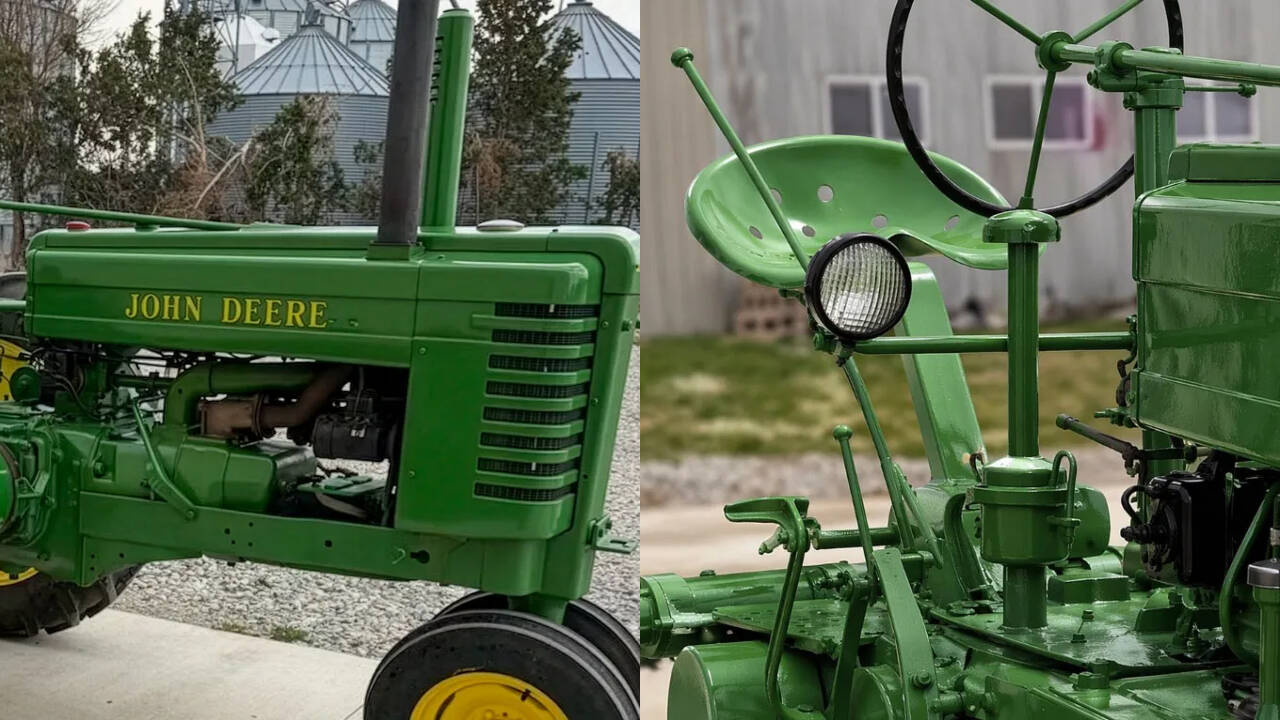
Old iron remembers things people forget. Steel bends, rusts, and takes a beating, but it holds onto the exact history of the hands that shaped it. Most people look at a rusted piece of farm machinery rotting under a shelter belt and see scrap metal heading for a salvage yard. Nebraska farmer Shelley Bruha saw something entirely different when he spotted an abandoned 1946 John Deere GM tractor sitting beneath a shade tree on a neighboring property.
There was no clean serial number visible to verify its pedigree. The paint had long since surrendered to decades of Midwestern weather. But tractors are like fingerprints, especially the ones worked hard on family land. Bruha spotted one specific detail that stopped him in his tracks. It wasn't a manufacturer badge. It was a custom-extended hand clutch rod, born from a childhood memory that had happened decades earlier.
The Fencerow Mishap That Started It All
Back when Bruha was just a boy growing up in Dorchester, Nebraska, he climbed up onto his father's open-station John Deere GM. His father had recently tightened the hand clutch. When the young boy drove it toward the field's edge, he didn't have the physical leverage or weight to pull the stiff mechanism back. He couldn't slow down. He plowed right through a fencerow.
Most fathers would have banned their kid from touching the machine again. His dad took a smarter route. He knew the boy needed to help with the chores, so he drove the tractor into town to see a local welder. He gave simple instructions: extend that rod, make the hand clutch long enough so a kid can reach it, and give him the leverage to pull it.
That custom modification turned an ordinary piece of equipment into a tailored tool. The family relied on that tractor through years of heavy fieldwork before it eventually left their operation, trading hands and drifting away into the Nebraska countryside like so many other vintage workhorses.
The Rare Breed Under the Wartime Constraints
To understand why finding this specific machine mattered, you have to look at what the 1946 John Deere GM actually represents in agricultural history. World War II was still actively shaping American manufacturing when Deere launched the 34-horsepower GM model in 1942.
The Office of Price Administration kept a tight grip on manufacturing under the Emergency Price Control Act. That federal oversight froze prices on machinery models unless a manufacturer made substantial structural updates. Deere positioned the GM as a wartime variant of the popular Model G. They justified a higher price tag—roughly $1,400 at the time—by upgrading the basic frame to include an electric start, lights, a beefier 412-cubic-inch two-cylinder engine, and a six-speed transmission instead of the standard four-speed.
Rubber rationing created unique manufacturing quirks during those years. Many early GM tractors rolled straight out of the factory onto steel wheels instead of rubber tires. Production wrapped up shortly after the war in 1947, with only about 13,000 units ever built—making it a rare cousin to the much more common Model G, which saw over 64,000 versions roll off assembly lines. Today, finding one is tough enough. Finding your own family's machine is nearly impossible.
Spotting the Clue That Disproved Odds
When Bruha walked up to the neglected tractor rusting under the tree, he didn't need papers to prove ownership. He reached for the hand clutch. There it was: the exact custom extension welded decades prior to solve a young boy's leverage problem.
The machine was rough. Bringing it back required patience, mechanical know-how, and a deep respect for old two-cylinder engines. Restoring a dead tractor isn't just about throwing a coat of bright green and yellow paint on sheet metal. It means freeing stuck pistons, cleaning out decades of sludge, rewiring electrical systems, and making sure the flywheel and clutch components mesh the way they did during the Truman administration.
Bruha got the old Deere running again. The restoration wasn't meant for a sterile museum floor. The tractor returned to active duty of a different sort, showing up at local tractor drives, community parades, and historic plow days.
When you see it move toward the edge of a field today, the operator handles that extended hand clutch with total ease. The mechanical fix that once saved a kid from a runaway ride through a fence line is the exact same feature keeping a family's agricultural heritage alive. Old iron doesn't lie, and if you treat it right, it eventually finds its way home.
Shelney Bruha's restored John Deere tractor story on Max Armstrong's Tractor Shed
This video provides additional context and background on vintage machinery discoveries and rural heritage stories similar to the Bruha family's restored tractor.