Silence.
That is the first thing you notice when you step out of the roaring, strobe-lit cavern of a major UFC arena and walk through the heavy double doors into the media bullpen, where the air smells faintly of stale coffee, sweat, and adrenaline. For decades, that exact transition—from the raw, unfiltered chaos of a prize fight to the measured, strategic theater of a post-fight press conference—has been the exclusive domain of one man. Dana White does not merely answer questions behind a microphone; he wages a secondary bout against every skeptical reporter in the room.
Now, picture that same bullpen relocated two thousand miles east to a cramped, cobalt-blue room at 1600 Pennsylvania Avenue.
According to news reports, Donald Trump publicly floated the idea of naming UFC CEO Dana White as his White House press secretary, a remark delivered with the casual showmanship that defines both men's public personas. On the surface, the headline reads like late-night comedy fodder or an off-the-cuff rally line designed to elicit cheers from a friendly crowd. Yet dismissing the moment as mere political theater misses the deeper current running beneath modern American public life. To understand why the leader of the free world would look at the architect of mixed martial arts and see the ideal spokesperson for the executive branch, you have to look at how the rules of persuasion have fractured—and been rebuilt—over the past twenty years.
The Anatomy of a Modern Podium
Consider a hypothetical veteran White House correspondent—let us call her Sarah—who has spent fifteen years decoding the careful, syllable-by-syllable choreography of Washington briefings. Sarah knows the unwritten code. When a press secretary says, "We are actively monitoring the situation," it means no decision has been made. When they say, "I won't get ahead of the president," it means the internal debate is still raging. In Sarah's world, ambiguity is a shield, and restraint is the highest form of discipline.
Now, drop Dana White behind that same wooden lectern.
White built a multi-billion-dollar global empire out of a sport that Senator John McCain once famously dismissed as "human cockfighting." He did not accomplish that feat through diplomatic hedging or focus-grouped talking points. He did it by leaning into the microphone, locking eyes with his critics, and speaking in the blunt, unvarnished vernacular of a Boston bouncer who happened to discover venture capital. If a fighter misses weight, White calls him unprofessional. If a reporter asks a question he deems dishonest, White does not pivot to a talking point; he dismantles the premise of the question on live television, often turning the press corps itself into the antagonist of the evening's broadcast.
Watching that dynamic play out in real time is jarring if you were raised on the polished decorum of traditional statesmanship. Honestly, it can be unsettling. Even for observers who study political communication for a living, there is a disorienting tension between wanting leaders to speak plainly and fearing what happens when institutional guardrails vanish entirely. Where does refreshing candor end, and where does institutional erosion begin?
Two Decades in the Corner
The bond between Donald Trump and Dana White is not a recent marriage of political convenience; it is a twenty-five-year alliance forged when both men were operating on the fringes of respectable establishment circles.
Back in 2001, when the newly acquired Ultimate Fighting Championship could barely secure a venue in the United States due to regulatory bans and moral panic, Trump opened the doors of the Trump Taj Mahal in Atlantic City to host UFC 30 and UFC 31. White has recounted that story dozens of times on arena stages and convention floors—how Trump showed up for the first fight, stayed until the final bell, and treated a struggling combat promotion like a heavyweight championship event.
In the currency of loyalty, neither man ever forgot the debt.
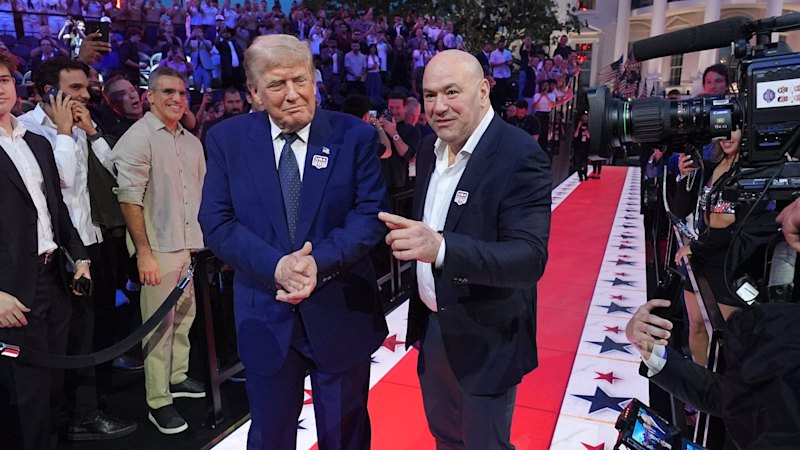
As Trump transitioned from real estate developer and reality television star to political insurgent, White became one of his most visible surrogates, speaking at three consecutive Republican National Conventions in 2016, 2020, and 2024. Meanwhile, Trump became a fixture ringside at major UFC pay-per-views, walking into arenas alongside White to deafening ovations that looked less like political appearances and more like rock concert encores.
To grasp how their communication styles overlap, think of the White House briefing room not as a courtroom, where evidence is weighed by neutral arbiters, but as a pay-per-view broadcast. In traditional politics, the press secretary acts as a translator between the executive branch and the Fourth Estate, attempting to maintain credibility with journalists so that the administration's message filters cleanly down to voters. In the attention economy that Trump and White inhabit, the press corps is no longer the intended audience—or even the intermediary. The cameras are pointed directly at the smartphone screens of millions of viewers who already distrust legacy institutions.
When Trump publicly suggested White for the press secretary role, he was signaling a preference for combat over conciliation. He was telling his supporters that the podium should not be a place where the administration defends itself against media scrutiny, but a place where it goes on offense.
What Happens When the Fight Never Stops
Imagine, for a moment, a hypothetical Tuesday afternoon briefing in the James S. Brady Press Briefing Room under a Dana White tenure.
A reporter from a major network presses the podium on an unpopular economic tariff or a controversial foreign policy move, citing anonymous administration officials and academic forecasts. A traditional press secretary—someone trained in the mold of Ari Fleischer, Jay Carney, or Karine Jean-Pierre—would reach into a thick three-ring binder, cite competing statistics, and promise to follow up with the relevant agency.
White's playbook operates on entirely different physics. Based on twenty years of post-fight scrums, he would likely challenge the reporter's credibility directly, question the network's ratings, dismiss anonymous sources as cowards, and reframe the entire policy debate as a simple, visceral choice between winners and losers. Within thirty seconds, a five-minute clip of the exchange would explode across social media, generating millions of views while burying the underlying policy details beneath the spectacle of the clash.
That is the hidden trade-off at the heart of this moment.
On one hand, the public gets undeniable authenticity. There is no mistaking where Dana White stands, and there is zero reliance on bureaucratic jargon that puts voters to sleep. People are exhausted by rehearsed evasions; when someone steps up to a microphone and talks like a human being at a neighborhood bar, it cuts through the noise like a flare in the dark.
On the other hand, governance is not a three-round title bout. Diplomacy cannot always be reduced to a viral soundbite, and economic policy rarely bends to sheer force of personality. When every press briefing becomes a main-event slugfest, the quiet, unglamorous work of accountability—the tedious questions about budget allocations, regulatory oversight, and legal precedents—gets drowned out by the roar of the crowd.
The Reality Behind the Headline
Of course, the distance between a public shout-out and a formal appointment in the West Wing is vast. White oversees TKO Group Holdings' crown jewel, a global sports juggernaut with international broadcast deals, sovereign wealth partnerships, and a year-round calendar of live events. Trading an executive suite in Las Vegas and a nine-figure compensation package for a government salary, grueling daily prep sessions, and Senate-adjacent scrutiny would defy every conventional law of business gravity. White himself has repeatedly stated in interviews that he has zero interest in holding a formal political office, preferring to remain a private businessman and loyal friend.
Yet the fact that the suggestion was made—and immediately treated as plausible by millions of observers—tells us everything we need to know about the era we are living in.
We have entered a chapter of public life where the boundaries separating sports entertainment, celebrity culture, and high statecraft have dissolved almost completely. The same algorithms that reward a knockout highlight reel reward a combative press briefing. The same instincts that sell out an arena in Las Vegas are now deployed to win news cycles in Washington.
Whether Dana White ever steps foot behind the White House podium is almost beside the point. The blueprint has already been drawn, tested under the bright lights of the Octagon, and validated at the ballot box.
Picture that cobalt-blue room in the West Wing late at night, long after the cameras have been packed away and the reporters have filed their stories. The podium stands empty under the overhead lights, waiting for tomorrow's bell to ring.