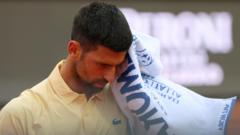
Novak Djokovic didn't just lose in Rome. He looked like a man who'd rather be anywhere else on the planet than the red clay of the Foro Italico. If you're a tennis fan, you've seen this movie before—the slow start, the frustration, the eventual roar. But this time the roar never came. Alejandro Tabilo, a Chilean player who's played the tennis of his life lately, dismantled the world number one in 67 minutes. That’s not a match. That’s a workout.
The scoreline of 6-2, 6-3 tells a story of total dominance, but it doesn't capture the eerie silence from the Djokovic camp. Novak didn't earn a single break point. Not one. For the greatest returner in the history of the sport, that’s more than a bad day at the office. It’s a systemic failure. You have to wonder if that bizarre incident with the water bottle hitting his head two days prior played a role. Or maybe, just maybe, the 24-time Grand Slam champion is finally feeling the weight of the years.
The Tabilo Factor and the Death of the Big Three Aura
Alejandro Tabilo walked onto that court without an ounce of fear. Usually, players facing Djokovic start the match down a break mentally. They see the trophy cabinet, the weeks at number one, and the "rubber man" defense that makes winning a point feel like climbing Everest. Tabilo didn't care about the resume. He swung freely, hitting 22 winners and keeping Djokovic pinned behind the baseline.
It’s becoming a trend. The "aura" that used to win Djokovic matches before the first serve is fading. Young players like Jannik Sinner and Carlos Alcaraz broke the seal, and now the rest of the tour realizes that if you've got the power and the nerve, Novak can be moved. He looked sluggish. His footwork, usually precise enough to be studied in a lab, was messy. He was reaching for balls he'd usually slide into with ease.
Why the Water Bottle Incident Isn't a Total Excuse
We saw the footage. A fan’s water bottle fell out of a backpack and smacked Djokovic right on the crown of his head while he was signing autographs. It looked painful. He dropped to the floor. The tournament organizers said he was fine, and Novak even joked about it the next day by wearing a cycling helmet to practice. It was a great bit of PR.
But in a sport of fine margins, "fine" isn't good enough. If your balance is off by 1%, you're late on the forehand. If your focus drifts for a second, your serve placement suffers. Djokovic admitted after the match that he didn't feel like himself on court. He felt under high stress and lacked the coordination he usually relies on. Honestly, it’s a bit scary. If he’s still feeling the effects of a head impact, the quick turnaround for the French Open becomes a massive hurdle. He wasn't just losing points; he was losing his sense of timing.
The Lack of Match Rhythm is Killing His Season
Djokovic has barely played this year. He skipped Madrid. He lost early in Monte Carlo. He parted ways with his long-time coach Goran Ivanisevic. It feels like a season of transition for a guy who’s usually the most stable force in tennis. You can't just flip a switch and be "Grand Slam Novak" without the miles in your legs.
Clay is the most demanding surface for rhythm. You need to know exactly how to slide, when to accelerate, and how to grind out ten-minute games. Against Tabilo, Djokovic tried to shorten points. He went for big shots too early. He looked like a guy who didn't want to be in a dogfight. That’s the most concerning part for his fans. The hunger that defines him seemed dampened by a lack of competitive sharpness.
What This Means for Roland Garros
The French Open starts soon. Usually, Rome is where Djokovic builds his final layer of armor before heading to Paris. This year, he’s heading to France with more questions than answers. He has no titles in 2024. Let that sink in. We’re nearly halfway through the year, and the most dominant player ever hasn't lifted a trophy.
The favorites list for Roland Garros just got a lot more crowded. You've got Sinner and Alcaraz dealing with injuries, but they've got youth on their side. You've got Casper Ruud and Stefanos Tsitsipas who live for the dirt. And then there's the Tabilos of the world who now know that the king is human. If Djokovic doesn't find his "gear" in the opening rounds in Paris, we might be looking at the most unpredictable Grand Slam in a decade.
The Physical Reality of Being 36 on Clay
Tennis is a young man's game that Djokovic has been winning as an old man. But clay is the great equalizer. It hurts the joints. It drains the lungs. Every match is a marathon. When you're 36, recovery isn't what it was at 26. The gap between his best and his worst is widening.
He didn't show the "grinta"—that Italian word for grit—that usually defines his stay in Rome. He looked flat. His body language was defeated from the middle of the first set. It’s rare to see him look so toothless. If the head injury from the bottle is truly behind him, then the issue is purely about tennis and confidence. Neither of those are easy fixes when the clock is ticking toward a major.
Watch the early rounds of the French Open closely. Look at his return of serve. If he’s still failing to create break points against lower-ranked players, the era of dominance is officially in its twilight. He needs matches. He needs wins. Most importantly, he needs to remember how to suffer on the court. Without that willingness to hurt, he’s just another guy with a racket.
Go back and watch the highlights of the Tabilo match. Don't look at the winners. Look at Djokovic’s eyes. He looks tired. Not physically exhausted, but mentally drained. The circus surrounding his coaching changes, the freak accidents, and the rise of the next generation is a lot to handle. He’s got two weeks to find his soul again before the Parisian clay tries to swallow him whole.


