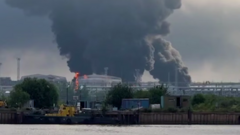
The Baltic wind doesn’t just blow through St Petersburg; it bites. It is a wet, freezing draft that rolls off the Gulf of Finland, turning the grand architecture of Russia’s cultural capital into a beautiful, frozen fortress. For decades, the citizens here relied on a silent, massive heart to keep that cold at bay. That heart was the Petersburg Oil Terminal. It was a sprawling labyrinth of steel tanks, pipes, and fire-suppression systems, humming quietly on the edge of the water, processing tens of millions of tons of energy every year. It was a symbol of security. Imperial. Untouchable.
Then came the drone. Recently making waves in related news: The Weight of a Quarter Millennium.
It traveled nearly a thousand kilometers. It bypassed some of the most sophisticated air defense networks on earth. When it struck, it didn’t just rupture a fuel tank; it shattered an illusion. For the first time since the Second World War, the citizens of Russia’s second-largest city heard the unmistakable thud of a front-line explosion echoing across their harbor.
To understand what happened that night, we have to look past the military briefings and the sterile satellite imagery. We have to look at the invisible lines of energy, geography, and human psychology that collided in a single, fiery flash. Additional insights on this are covered by Reuters.
The Mirage of Distance
For the average resident of St Petersburg, the conflict in Ukraine was something that happened on a television screen. It was distant. It was a tragedy unfolding in a different climate, hundreds of miles to the south. Life in the cafes along the Nevsky Prospekt continued with its usual elegant rhythm.
Consider a hypothetical worker at the terminal—let's call him Mikhail. Mikhail had worked at the facility for twelve years. His job was routine. He checked valves, monitored pressure gauges, and watched the massive tankers fill up with oil destined for global markets. To Mikhail, the war was a background hum. The terminal was protected. It was a critical piece of state infrastructure, guarded by layers of military tech.
But modern warfare has no respect for geography.
The drone that changed everything was a cheap, lightweight assembly of carbon fiber and a small engine, carrying a payload that pale in comparison to a traditional missile. Yet, its impact was monumental. When the drone struck the terminal, it didn’t just create a fire; it proved that distance is a mirage.
The immediate aftermath was chaotic. Smoke billowed into the gray Baltic sky. Fire crews rushed to the scene, battling a blaze that threatened to ignite neighboring tanks. For hours, the city held its breath. The physical damage to the infrastructure was contained, but the psychological damage was absolute. The war had arrived on the doorstep of the tzars.
The Mathematics of the Sky
How does a homemade aircraft travel the length of a continent unnoticed? The answer lies in a terrifying shift in military technology.
Traditional air defense systems are built to stop giants. They look for high-flying, fast-moving targets—jets, cruise missiles, bombers. They scan the upper atmosphere with powerful radar waves.
The drones used in this attack fly low. Very low. They hug the treetops, skimming just above the terrain, hiding in the radar shadows cast by hills, forests, and apartment buildings.
Imagine trying to spot a single sparrow flying through a dense forest at twilight. That is the task facing air defense operators trying to track these targets.
[Drone Flight Path: Low Altitude] ---> [Radar Shadow / Hills & Trees] ---> [Blind Spot in Traditional Radar]
By the time the radar registers the threat, the distance has closed. Seconds remain.
This creates a brutal numbers game. A single air defense missile can cost millions of dollars. A long-range drone can be assembled for a fraction of that cost, using off-the-shelf GPS components and engines no more complex than those found in a lawnmower. If a nation launches ten drones, and nine are shot down, the single drone that hits its target can cause tens of millions of dollars in damage. The economic math favors the attacker.
The Fragile Flows of the Global Economy
The St Petersburg terminal is not just a local fuel dump. It is a vital artery for the Russian economy.
For years, the wealth of the nation flowed through these pipes. Oil was pumped from the depths of Siberia, sent via vast pipeline networks to the Baltic coast, and loaded onto ships to fund the state apparatus. When a node in this network is compromised, the ripples extend far beyond the immediate blast radius.
Insurance companies notice. Shipping conglomerates recalculate their risk matrices. Suddenly, sending a multi-million-dollar tanker into the Baltic Sea requires a higher premium. The cost of doing business spikes.
This is the true objective of modern strategic strikes. It is rarely about destroying an entire army in a single battle. It is about creating friction. It is about making the daily operations of an adversary slow, expensive, and deeply uncertain.
The Quiet Chill
In the days following the strike, the fires were extinguished. The damaged steel was cleared away. Officials issued reassuring statements, declaring that the situation was under control and that defenses had been adjusted.
But the atmosphere in the city changed.
Walk down the harbor docks today, and you will see people looking up. Not at the historic spires or the flocking sea gulls, but at the empty, gray sky. They are listening for a faint, lawnmower-like drone that signals the arrival of a new reality.
The warmth hasn't left the radiators in St Petersburg. The oil still flows, and the lights still flicker to life in the grand apartments. But the comfort of security, the absolute certainty that the chaos of the world could be kept at bay by distance alone, has vanished.
A single plume of black smoke over the Baltic proved that in the modern world, nowhere is truly far away. The cold has a way of finding its way in.


