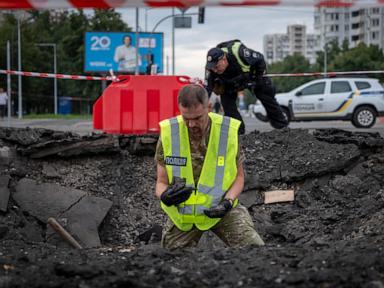
The sirens do not gently wake you. They tear through the silence of 3:00 AM like jagged metal scraping against concrete. It is a sound that five million people in Kyiv have memorized, a sound that transforms a warm bed into a potential trap. You have exactly three choices: the cold, damp concrete of a subterranean metro station, the narrow corridor between two load-bearing walls of your apartment, or the gamble that tonight, the fire in the sky will miss you.
For eleven people in the Ukrainian capital, the gamble failed.
Air defense systems are often described in technical briefs as shields. They are painted as sterile, mathematical equations of interceptors and trajectories. But on the ground, a shootdown is not a neat subtraction of a threat. It is a violent collision of thousands of pounds of explosive material directly above a living, breathing city. When a Russian missile is intercepted, it does not vanish. It shatters. Tons of burning titanium, toxic fuel, and jagged shrapnel rain down onto civilian neighborhoods, puncturing roofs, melting parked cars, and ripping through bedroom windows.
Consider a hypothetical resident named Olena. She does not exist as a single registered casualty, but she represents the precise reality of those eleven wounded. She did everything right. She moved away from the glass. She sat on a blanket in her hallway, clutching a pet or a phone, waiting out the thunder. Then, a chunk of a destroyed drone, still white-hot from detonation, tore through her ceiling.
This is the psychological tax of modern aerial warfare. The victory of a successful interception is simultaneously a tragedy of falling debris.
While the capital swept up shattered glass and bandaged the wounded, hundreds of miles to the south, the nature of the conflict was shifting beneath the waves of the Black Sea. This war is no longer confined to trenches and urban artillery duels. It has become an asymmetrical laboratory where the antiquated naval doctrine of massive, expensive warships is being systematically dismantled by cheap, explosive-laden sea drones.
Ukraine, a nation effectively without a traditional, functioning blue-water navy, managed to strike Russian vessels in their own heavily guarded waters.
To understand how bizarre and unprecedented this is, imagine a lone cyclist defeating a armored convoy using nothing but slingshots and speed. The Black Sea Fleet was once the crown jewel of regional intimidation, a floating fortress designed to project power across the region. Now, those multi-million-dollar vessels are vulnerable to remote-controlled speedboats packed with explosives, guided by operators sitting in dark rooms miles away, staring at glowing monitors.
The strategy is simple but devastating: saturation. By launching waves of these unmanned surface vessels alongside aerial drones, the attackers force naval crews into a state of chaotic triage. A warship’s radar can track multiple targets, but human eyes and deck-mounted machine guns can only aim so fast in the pitch black of a rolling sea. One drone gets targeted; another slips through the wake. The resulting detonation doesn't just poke a hole in a hull; it punctures the illusion of naval supremacy.
The contrast between these two theaters of the same war reveals a grim symmetry.
In Kyiv, the civilian population bears the physical weight of defending the sky. Every intercepted missile saves a power plant or a government building but risks a apartment block. The stakes are profoundly intimate—a kitchen table split in two, a child’s toy covered in soot.
In the Black Sea, the stakes are geopolitical and economic. By forcing Russian warships on the defensive, Ukraine chips away at the naval blockade that has choked grain exports and threatened global food security. It is a high-tech chess game played with low-cost pieces, where the loss of a single ship alters the strategic calculus of entire maritime trade routes.
Yet, back on the streets of the capital, the grand strategies of naval warfare offer little comfort when the dawn reveals the true cost of the night's bombardment. Neighbors gather around craters that weren't there when they went to sleep. They look up at the gaping holes in the facades of buildings they pass every day on their way to work. There is no time for profound mourning; the glass must be swept, the tarps must be nailed over the broken windows, and the shattered lives must be pieced back together before the sun goes down and the sirens begin to wail again.
The true metric of this conflict cannot be found in the sterile tallies of intercepted targets or the tonnage of damaged vessels. It is found in the resilient, exhausting rhythm of a city that refuses to stop living, even when the sky above it collapses in flames.