The friction starts at the palm. By midnight, it moves to the lower back, a dull, radiating ache that comes from bending over a granite cobblestone for six hours straight.
Maria Ramos is sixty-four, and her fingers are stained a deep, bruised purple. It does not come from wine. It comes from the thousands of bougainvillea petals she has been shredding since the sun dipped behind the Sierra de Guadarrama. Around her, the Calle de Alcalá—usually a roaring artery of diesel exhaust and shouting commuters—has fallen into a strange, rhythmic hush. There are no cars. There are only the soft, scraping sounds of wooden crates being dragged across asphalt and the sharp, clean snap of flower stems.
This is the geometry of devotion. For months, Madrid has been preparing for a single afternoon. The headlines standardly describe it as a logistical marvel: one million people descending on the Spanish capital to glimpse the Pope during the traditional Corpus Christi processions. They quote municipal crowd control figures and hotel occupancy rates. But those numbers are bloodless. They fail to capture the scent of crushed serrano stalks under a million feet, or the precise, agonizing artistry required to turn a city of asphalt into a temporary garden.
To understand why a million human beings would choke the plazas of a modern European metropolis until the air itself grows hot, you have to look at the ground.
The Architecture of the Temporary
A city is built to endure. We construct them out of steel, concrete, and glass so we can pretend that the things we make are permanent. But on this specific Sunday, Madrid chooses the opposite. It builds an empire of dust.
The tradition of the alfombras de flores—flower carpets—is an ancient liturgy of ephemeral art. For twenty-four hours before the arrival of the papal procession, neighborhood guilds, families, and volunteers reclaim the streets from the automobiles. They trace massive, intricate geometric patterns directly onto the pavement using chalk. Then, the filling begins.
Consider the logistics of a miracle. To cover even a single avenue requires tons of raw material.
- The Borders: Coarse dark earth and dried peat moss provide the sharp outlines.
- The Fields: Millions of flower heads—marigolds for vibrant yellows, geraniums for deep reds, and lavender for the muted purples.
- The Textures: Chopped pine needles, rice husks, and even colored sawdust are used to create depth and shadow.
Imagine the vulnerability of this work. A sudden gust of wind down the Gran Vía can erase three hours of meticulous shading in three seconds. A stray dog can ruin a sacred monogram. A single premature rain cloud over the Iberian peninsula can turn a masterpiece into a muddy slurry. Yet, the artists don't use glue. They don't use fixatives. They rely entirely on the weight of the petals and the dampness of the morning dew.
It is an exercise in beautiful futility. The creators know with absolute certainty that within minutes of the monstrance passing over their work, the boots of the faithful, the wheels of the security detail, and the brooms of the street sweepers will reduce their labor to a fragrant mulch.
That is not a flaw in the design. It is the entire point.
The Geometry of the Million
By 10:00 AM, the temperature in the capital is already climbing toward thirty degrees Celsius. The heat in Madrid during June does not arrive gently; it drops like a heavy, wool blanket.
The crowd behaves less like a collection of individuals and more like a slow, deliberate fluid. It fills the Puerta del Sol. It backs up into the narrow veins of the Calle Mayor. From an aerial view, the sea of humanity appears monolithic, a static block of white shirts and waving yellow-and-white Vatican flags. But step closer, into the press of shoulders, and the monolith fractures into a thousand distinct human realities.
There are the professional pilgrims, identifiable by their broken-in hiking boots, wide-brimmed straw hats, and the inevitable plastic rosaries clicking against water bottles. There are the local madrileños, impeccably dressed despite the stifling humidity, holding their grandchildren aloft on tired shoulders.
Then there are people like Mateo, a twenty-two-year-old student from Guadalajara who slept on the floor of a crowded gym gym just to secure a spot near the Cibeles Fountain. He is not particularly religious, a fact he admits with a self-conscious shrug of his sunburnt shoulders.
"My grandmother gave me her medal before she died last winter," Mateo says, his voice competing with the low, rolling murmur of a crowd reciting the Angelus. "She told me she stood in this exact spot forty years ago. I don't know if I believe what the man in white believes. But I know I believe in her."
This is the invisible current that moves a million people. It is rarely a pure, unadulterated theological certainty. More often, it is a complex web of memory, grief, cultural stubbornness, and the deep, modern hunger to be part of something that cannot be experienced through a glass screen. In an era where every human interaction is mediated by an algorithm, there is a radical, almost rebellious quality to allowing oneself to be crushed, sweated on, and moved by a crowd of strangers.
The Approaching Silence
A distinct phenomenon occurs when a crowd of that magnitude falls silent. It does not happen all at once. It begins at the perimeter, where the flashing blue lights of the police motorcycles signal that the procession has left the Almudena Cathedral.
The roar of chatter—the rustle of potato chip bags, the crying of infants, the tinny ringtones of smartphones—begins to die down, neighborhood by neighborhood, block by block. It is a wave of quiet that travels up the street faster than a man can run.
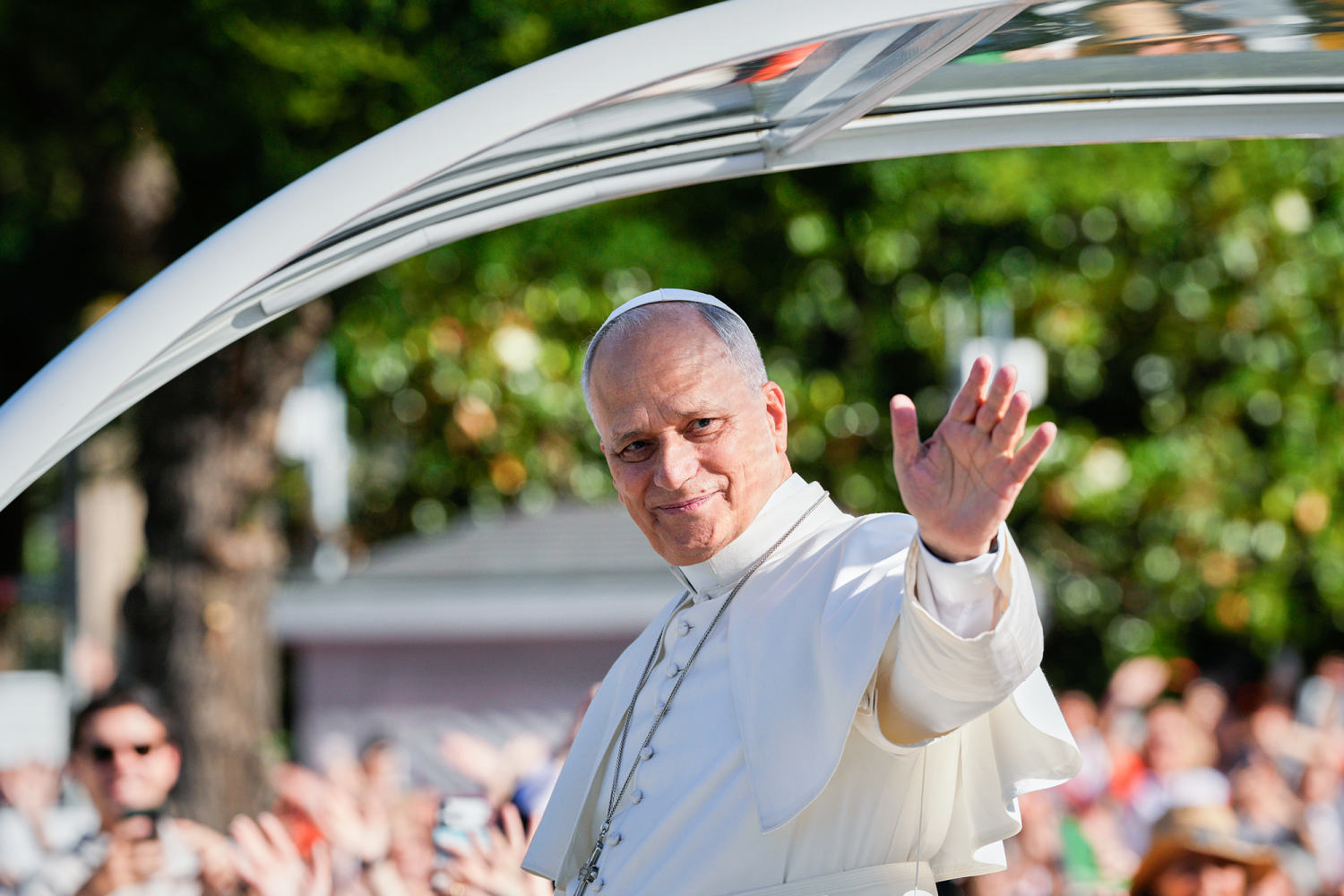
When the Pope finally appears, he is not a distant figure on a balcony. He is right there, moving at walking pace, framed by the massive stone arches of the city. For those at the front of the barricades, the distance is less than five meters. You can see the dust on the hem of his white cassock. You can see the heavy, rhythmic rise and fall of his chest as he breathes the hot, pollen-heavy Madrid air.
The contrast is striking. On one side, the immense, institutional weight of the Catholic Church, represented by Swiss Guards in their medieval slashes of yellow and blue, bishops in heavy silk vestments, and the gleaming gold of the monstrance. On the other side, the fragile, momentary canvas of flowers beneath their feet.
The heavy silver carriage rolls forward. The iron-shod wheels crush the first layer of petals.
A sharp, intense burst of fragrance rises into the heat—the scent of thousands of carnations dying all at once under the weight of tradition. It is a sensory spike that hits the back of the throat. For many in the front rows, this is the moment the tears arrive. Not because of a speech or a blessing, but because of that sudden, overwhelming smell of beautiful destruction.
The Cleaners of the Dawn
By midnight, the one million have evaporated. They have packed into the Metro stations, filled the terrace bars of La Latina to drink cold beer and nurse their sunburns, or boarded long-distance buses back to provincial towns across Spain.
The city belongs to a different army now.
The blue overalls of the Empresa Municipal de Transportes take the stage. Large, mechanized sweepers with rotating wire brushes move down the Paseo del Prado. They do not look like priests or artists. They are tired men and women working the graveyard shift, eager to get the avenues cleared before the morning rush hour.
They plow through the remnants of the red and yellow carpets. What took Maria Ramos and her guild twelve hours to assemble is sucked into the dark belly of a sanitation truck in twelve seconds. The air still smells faintly of jasmine, but it is now mixed with the sour tang of industrial detergent and diesel.
Where the great floral tapestries once lay, there are only damp, grey patches on the asphalt, quickly drying under the streetlights.
A casual tourist walking down the Calle de Alcalá tomorrow morning would see absolutely no evidence that a million people were here. They would see no sign that millions of flowers were sacrificed to create a path for a single man. The city resets itself. The concrete wins, as it always does.
But if you walk close to the curb, right where the granite stones meet the gutter, you can still find them. Small, stray petals of purple bougainvillea, jammed tightly into the cracks of the earth, refusing to be swept away.