Saltwater tastes like copper when your heart is hammering against your ribs.
Picture a bridge three stories above a pitch-black sea. It is two in the morning in the Gulf of Oman. Outside the reinforced glass, the water looks like spilled ink, broken only by the harsh, sweeping beams of naval spotlights cutting through the humid air. On the radio, a voice crackles—calm, metallic, and absolute. Turn back. Stop your engines. You are approaching a naval blockade.
For the average person scrolling through headlines over morning coffee, a wire report stating that the United States military fired on a commercial vessel after it attempted to breach a blockade reads like another distant, sterile chess move on a geopolitical board. A ship ignored a warning. Shots were fired. Nobody died, or maybe the hull took minor damage, and the world kept spinning.
That version of the story is a lie of omission.
When a warship opens fire on a merchant vessel in one of the narrowest, most volatile maritime corridors on earth, the shockwave does not stop at the water's edge. It travels through fiber-optic cables, rattles trading floors in London and Singapore, spikes the cost of diesel in Ohio, and leaves twenty-two exhausted sailors staring at bullet holes in the steel bulkhead just feet from where they sleep.
To understand what actually happened in the Gulf of Oman, you have to step off the bridge of the destroyer and onto the deck of the freighter. You have to look at the invisible architecture of global trade—and see how terrifyingly fragile it really is.
The Invisible Highway Under Siege
Most people never think about how their groceries, their phones, or the plastic casing on their toothbrushes arrive at their front door. We treat the global supply chain like gravity: an automatic, unbreakable law of nature.
In reality, it is a miracle of razor-thin margins and quiet agreements.
Consider a hypothetical container ship—let’s call her the MV Horizon Star—hauling forty thousand tons of industrial components, grain, and consumer electronics. Her crew isn't made up of mercenaries or ideological zealots. They are ordinary men from the Philippines, India, Ukraine, and Greece, working nine-month contracts to pay for their children’s schooling back home. Their captain, a man with thirty years of salt in his veins, is governed by two relentless pressures: the weather and the clock.
Every hour a commercial ship sits idle burns thousands of dollars in bunker fuel and triggers steep contractual penalties from charterers. Shipping companies operate like high-wire walkers; if they stop moving, they fall.
Now, place that captain at the mouth of the Gulf of Oman, the vital throat connecting the Arabian Sea to the Strait of Hormuz. Roughly a fifth of the world’s petroleum passes through this chokepoint, alongside millions of tons of non-oil cargo. When a military blockade is enforced here, it acts like a sudden, violent clot in the main artery of the global economy.
On the night the U.S. Navy intercepted the commercial vessel attempting to run the blockade, the collision wasn't just between steel and gunpowder. It was a collision between two entirely incompatible worlds. On one side stood a modern naval warship, operating under strict rules of engagement, tasked with enforcing international sanctions or wartime containment. On the other stood a commercial operator—perhaps pressured by owners desperate to avoid bankruptcy, perhaps gambling that a superpower wouldn't dare fire on an unarmed merchant ship, or perhaps caught in a fog of miscommunication and spoofed GPS signals.
The Navy followed its escalation protocol. Radio hails. Visual flares. Warning shots across the bow, sending geysers of white foam erupting into the night.
Imagine standing on the wing of that bridge when a five-inch naval gun or a twenty-five-millimeter chain gun barks in the dark. The sound doesn't just hit your ears; it compresses your chest. The flash turns midnight into blinding noon for a fraction of a second.
The vessel kept pushing forward. So the Navy fired to disable.
The Anatomy of a Maritime Standoff
Why would a commercial ship ever try to run a military blockade? To anyone sitting safely on dry land, it looks like pure madness. You don't bring a cargo hull to a missile fight.
Yet history shows us that sailors have been running blockades since the first wooden galleys blockaded Mediterranean ports. During the American Civil War, sleek, low-slung steamers painted slate-gray slipped past Union gunboats in the dead of night, driven by the astronomical profits of cotton and munitions. In the Tanker War of the 1980s, right in these very waters of the Persian Gulf and the Gulf of Oman, commercial captains routinely ran dark—turning off their transponders and running without navigation lights—just to deliver crude oil and survive another voyage.
Modern maritime enforcement is vastly more sophisticated, yet the psychological pressure on the water remains identical.
Think of a naval blockade as an invisible wall built out of radar waves, satellite surveillance, and the implicit promise of lethal force. Unlike a concrete barrier on a highway, you cannot see it until you hit it. For a merchant captain receiving conflicting orders—a nervous shipping magnate in a distant office demanding the cargo be delivered on time, versus a warships' tactical officer barking orders over VHF Channel 16—the bridge becomes a pressure cooker.
There is also the darker reality of modern maritime shadow fleets. In recent years, a sprawling network of aging tankers and cargo ships has emerged, operating with obscured ownership, switched-off Automatic Identification System transponders, and flags of convenience from landlocked or tiny island nations. These vessels are the ghosts of the high seas, specifically hired to slip past embargoes and blockades.
When a U.S. warship encounters a vessel breaching a blockade in the Gulf of Oman, the crew on the destroyer faces an agonizing calculation. Is this a stubborn, panicked merchant captain making a terrible mistake? Is it a sanctions-busting shadow ship smuggling illicit cargo? Or is it a Trojan horse—a commercial hull packed with explosives or drones, disguised as a harmless freighter?
In asymmetrical naval warfare, hesitation can be fatal. In October 2000, the USS Cole was nearly sunk in Aden harbor by a small fiberglass boat loaded with explosives. That memory is baked into the DNA of every watch officer in the U.S. Fifth Fleet. When a ship ignores warnings and closes distance, the warship does not have the luxury of giving the benefit of the doubt.
What Happens When the Firing Starts
The mechanics of disabling a commercial ship without sinking it are brutally delicate. Naval gunners are trained to target non-vital structural areas or propulsion systems—aiming for the rudder, the stern, or the superstructure well away from the living quarters and the bridge, though at sea, pitching waves turn precision into a gamble.
Even "controlled" gunfire against a merchant hull is terrifying. Commercial ships are not built with the compartmentalized armor of a warship. They are floating warehouses made of relatively thin mild steel, packed with fuel oil, hydraulic lines, and pressurized pipes. A single stray round rupturing a fuel tank can turn a routine interdiction into an environmental catastrophe and a floating inferno.
I have spoken with merchant mariners who have survived live-fire incidents in contested waters, and the detail they always return to isn't the politics. It is the sensory overload. The smell of cordite mixing with diesel exhaust. The high-pitched whine of alarms screaming across the control console. The sudden, suffocating realization that the thick steel walls around you—the very thing that protects you from a fifty-foot ocean swell—offer virtually zero protection against modern ordnance.
One chief engineer described hiding behind a cast-iron diesel block in the engine room while rounds punched through the upper hull, ringing the ship like a giant, hollow bell. He didn't care about foreign policy. He didn't care about oil futures or regional deterrence. He was staring at a laminated photo of his daughter taped to his toolbox, wondering if the next impact would breach the hull below the waterline.
The Ripple Effect in Your Wallet
When the smoke cleared in the Gulf of Oman, the immediate crisis on the water ended. The vessel halted. Boarding teams secured the decks. The press releases went out, sanitized and clinical.
And then the real bill arrived.
Maritime insurance underwriters in London—specifically the Joint War Committee—do not read press releases with detachment. They calculate risk in fractions of a percentage point. The moment shots are fired at a commercial vessel in the Gulf of Oman, the entire region is reclassified. War-risk insurance premiums, which already cost tens of thousands of dollars per transit, skyrocket overnight.
Follow the chain reaction.
First, major shipping lines suspend transits through the area or reroute vessels around the Cape of Good Hope at the southern tip of Africa. That detour adds ten to fourteen days to a voyage between Asia and Europe.
Second, those extra two weeks burn millions of gallons of additional fuel and tie up global container capacity, effectively shrinking the number of available ships in the world.
Third, freight rates climb. A container that cost three thousand dollars to ship suddenly costs six thousand.
Fourth, six weeks later, you walk into a store, or open an app to order household staples, or pull up to a gas pump, and notice the prices have crept upward again. Nobody connects the extra forty cents a gallon or the delayed shipment of appliances to a dark stretch of water off the coast of Oman. The connection is invisible, buried beneath layers of logistics, wholesale markups, and corporate earnings reports.
We like to believe we live in a digital, weightless economy. We forget that ninety percent of everything we touch spent weeks riding on the back of a diesel-powered steel box, guided by tired human beings navigating waters policed by warships.
The Thin Margin Between Order and Chaos
The incident in the Gulf of Oman exposes an uncomfortable truth that both governments and markets prefer to ignore: global stability rests on voluntary compliance.
The world’s oceans are simply too vast to police by force alone. There are over fifty thousand merchant ships trading internationally at any given moment, crewed by nearly two million seafarers. The U.S. Navy, even with its immense technological reach, cannot physically stop every ship on earth. The system only works because captains generally obey radio warnings, insurers generally underwrite standard risks, and nations generally respect maritime boundaries.
When a commercial ship attempts to run a blockade, it tests the brittle edge of that consensus. And when a warship is forced to pull the trigger to enforce it, it proves just how quickly the civilized veneer of global commerce can strip away, leaving raw force in its place.
It is easy to look at the headline, nod at the assertion of naval authority, and move on to the next news cycle. It is harder—and far more honest—to recognize what that gunfire actually represents. It is a warning flare fired into the dark, illuminating how close our comfortable, interconnected lives sit to the edge of disruption.
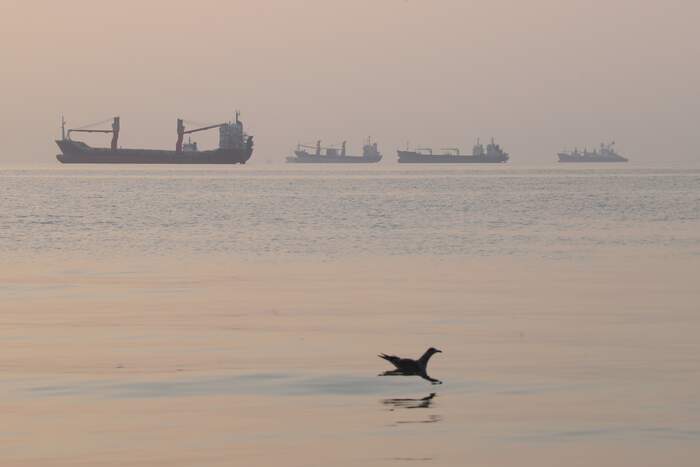
Out in the Gulf of Oman, the spotlights eventually switched off. The crippled merchant ship sat heavy in the swell, her engines silent, her crew waiting in the humid dark for whatever comes next. Miles away, other cargo ships kept moving along the shipping lanes, their navigation lights blinking steadily against the horizon—green on starboard, red on port—gliding over deep, indifferent water, trusting that tonight, nobody on the radio will tell them to stop.