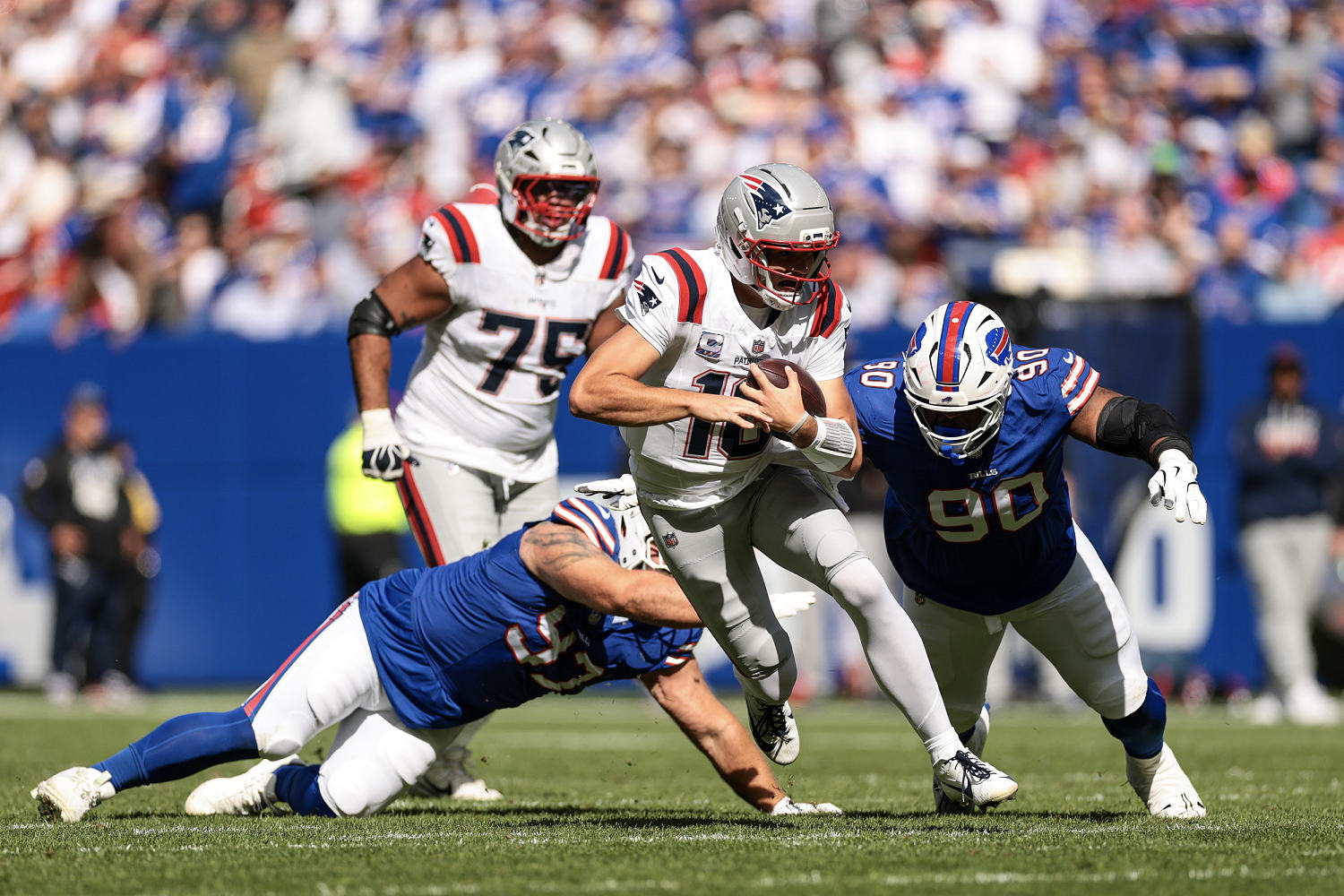
The early-season NFL landscape operates under a persistent illusion of stability. Through the first three weeks of a campaign, variance rules the box score, small sample sizes inflate efficiency metrics, and underlying structural flaws remain masked by fortunate turnover differentials. Week four serves as the primary market correction of the professional football calendar. Teams with unsustainable defensive regression to the mean are exposed, offensive coordinators face schematic adjustments as multi-week tape becomes available, and the variance dampens to reveal true roster capability. Deconstructing the mechanics of week four performance requires abandoning superficial narratives about momentum or psychological resilience in favor of cold operational indicators: situational efficiency, pressure rate optimization, and red-zone conversion sustainability.
The modern NFL quarterback market relies heavily on early-career valuation models that fluctuate wildly based on system support. Week four typically provides the definitive stress test for signal-callers undergoing systematic career rehabilitation or regression. When a franchise quarterback struggles in the opening month, the failure point is rarely individual physical decay; it is a breakdown in processing speed relative to defensive coverage adjustments.
Defensive coordinators enter October with three full game scripts of opponent tendencies. Blitz package frequencies double, simulated pressures increase, and pre-snap disguises force quarterbacks to identify coverage shells post-snap within a sub-three-second window. Quarterbacks who successfully navigate this transition exhibit three core operational traits: high completion percentages against zone coverage schemes, low turnover-worthy play rates under moderate duress, and an ability to exploit single-high safety structures through quick-game timing routes.
Conversely, signal-callers who regress during this period fail because their offensive line protection metrics deteriorate simultaneously with defensive schematic complexity. Pass protection is a statistical multiplier. When an offensive line drops below a thirty percent pressure rate allowed under standard dropback conditions, the entire offensive playbook opens. Once that threshold is breached, the play-caller is forced to adopt max-protection schemes, reducing route runners in the pattern and neutralizing downfield stretch concepts. The resulting offensive stagnation is misattributed to quarterback decline when the root cause is structural blocking failure and predictable route distribution.
Evaluating elite status within a conference requires stripping away raw point differentials and examining efficiency on high-leverage downs. Third-down conversion percentage and red-zone touchdown efficiency serve as the twin pillars of conference supremacy. Through the first month of the season, division leaders often pad their statistics against bottom-tier competition, creating an inflated perception of dominance.
The transition into late September and early October introduces parity through schedule strength equalization. Conference frontrunners are separated from pretenders by their capacity to maintain offensive efficiency without relying on explosive, low-probability
Structural Failures and Efficiency Metrics in the NFL Quarterback Resurgence
sports
Performance variance in professional sports is rarely a product of random distribution; it is the direct downstream effect of system architecture, constraint management, and tactical iteration. Evaluating early-season quarterback performance requires shifting away from superficial box scores and toward operational efficiency frameworks. When evaluating baseline mechanics, pressure response curves, and scheme adaptability, specific quarterbacks demonstrate structural redemption while others expose fatal limitations in their offensive coordinators' conceptual designs.
The Mechanics of Quarterback Redemption
Resurgence in athletic performance under high cognitive load requires a two-variable adjustment: reduction of processing latency and optimization of the mechanical release point. Struggling play-callers often misdiagnose execution failures as physical deficits when the root cause is systemic cognitive overload.
When a passer accelerates their internal clock, two primary operational changes occur:
- Information Filtering: The elimination of post-snap diagnostic noise through simplified progression reads. By reducing the decision tree from four options to a binary read, the signal-to-noise ratio improves exponentially.
- Kinetic Chain Alignment: Eradicating wasted movement in the lower body during the drop-back phase. Footwork synchronization dictates spatial awareness in the pocket; inconsistency in this phase breaks the temporal alignment between route development and throwing windows.
Redemption is therefore an engineering problem. A passer who struggles under duress cannot simply try harder to throw accurately. The scheme must alter the pocket architecture to create a wider margin for error, compensating for declining lateral mobility or slow processing speeds through schematic leverage.
The AFC Hierarchy and Structural Dominance
Evaluating conference superiority demands a cost-benefit analysis of roster construction and quarterback allocation efficiency. The upper tier of the American Football Conference is characterized not merely by talent accumulation, but by elite risk mitigation.
The dominant teams operate on a principle of resource asymmetry. By maximizing cheap production on rookie-scale contracts or heavily optimized veteran extensions, front offices insulate themselves against systemic failure. When evaluating the conference's premier squads through a strategic lens, three operational advantages emerge:
- Pass Protection Efficiency: Maintaining a pocket integrity index that allows standard five- and seven-step drops to materialize without structural collapse.
- Explosive Play Generation Rate: The ability to stress defensive structures vertically without relying on unsustainable third-down conversion rates.
- Red Zone Conversion Probability: Minimizing variance inside the twenty-yard line through high-efficiency play design that neutralizes defensive disparity.
Teams that fail to meet these efficiency benchmarks rely on high-variance plays to survive. This creates an unsustainable baseline where a single tactical misstep or turnover cascade leads to catastrophic failure.
The End of Historical Streaks as a Diagnostic Indicator
The cessation of a long-standing statistical streak is not a historical anomaly; it is the inevitable byproduct of regression to the mean accelerated by tactical evolution. Defensive coordinators do not defeat historic streaks through brute force; they do so by systematically removing the opponent's primary high-probability option and forcing them into low-percentage alternatives.
When an offensive streak dies, the autopsy almost always reveals a failure to adapt to defensive shell manipulation. Modern defenses utilize disguised coverages that present symmetrical pre-snap pictures while executing asymmetrical post-snap rotations. This disrupts the quarterback's visual mapping process.
The resulting breakdown exposes the underlying fragility of rigid offensive systems. Teams that rely on a single dominant concept or an unyielding reliance on historic tendencies become predictable. The death of a streak marks the precise moment defensive adaptation outpaced offensive iteration.
Strategic Allocation Moving Forward
To maintain competitive advantage in the current operational environment, coaching staffs must abandon static play-calling models in favor of modular offensive architectures. Success is no longer defined by how well a team executes its primary identity, but by how rapidly it can diagnose a defensive countermeasure and pivot to an alternative production vector. The teams that navigate this landscape effectively will treat every snap as an independent data point, adjusting systemic flaws before they manifest as catastrophic losses.


