The narrative is officially exhausting.
Every time an NFL player tears an ACL on synthetic turf, the entire sports world recycles the same predictable script. Players take to social media to beg for natural grass. Commentators nod solemnly. Fans point across the Atlantic to European soccer leagues or the upcoming World Cup, treating FIFA's grass mandates like some holy grail of player safety. Also making news lately: The Ninety Minutes That Smelled of Wet Grass and Total Desperation.
They are all chasing a fantasy.
The current public debate frames the issue as a binary choice: evil, cost-cutting plastic versus pure, benevolent, injury-healing dirt. This isn't just a simplification; it is flat-out wrong. The "grass is always safer" consensus ignores the brutal physical realities of modern stadium construction, the limits of agronomy, and the specific kinetic violence of American football. Additional details on this are detailed by FOX Sports.
If the NFL flipped a switch and forced every stadium to install natural grass tomorrow, the player safety crisis wouldn't disappear. It would just mutate.
The World Cup Illusion: What FIFA Actually Installs
NFL players watching World Cup matches see a pristine green carpet and wonder why billions of dollars can't buy them the same luxury. What they fail to realize is that FIFA isn't playing on the backyard grass of their childhoods.
They are playing on hybrid pitches.
Most elite global soccer venues use systems like SISGrass or Desso GrassMaster. These are engineered surfaces where millions of synthetic polyethylene fibers are injected roughly 20 centimeters deep into a sand-based rootzone, intertwining with real perennial ryegrass. It is roughly 95% natural grass by surface area, but the skeleton is entirely plastic.
Why do they do this? Because pure natural grass cannot survive the sheer architectural design of modern mega-stadiums.
- Sunlight Starvation: Modern stadiums are built to maximize luxury suites and acoustic volume, not to keep plants alive. Soaring roofs and massive video boards create permanent microclimates of shade and stagnant air.
- The Microclimate Trap: Without a synthetic matrix holding the rootzone together, pure grass under a closed roof turns into a slippery, muddy swamp within three games.
When the NFL forced the Arizona Cardinals and Las Vegas Raiders to use natural grass, both franchises had to spend hundreds of millions of dollars building stadium-wide rolling trays. These massive, multi-ton slabs of concrete and dirt must be wheeled completely outside the stadium structure just to let the grass see the sun.
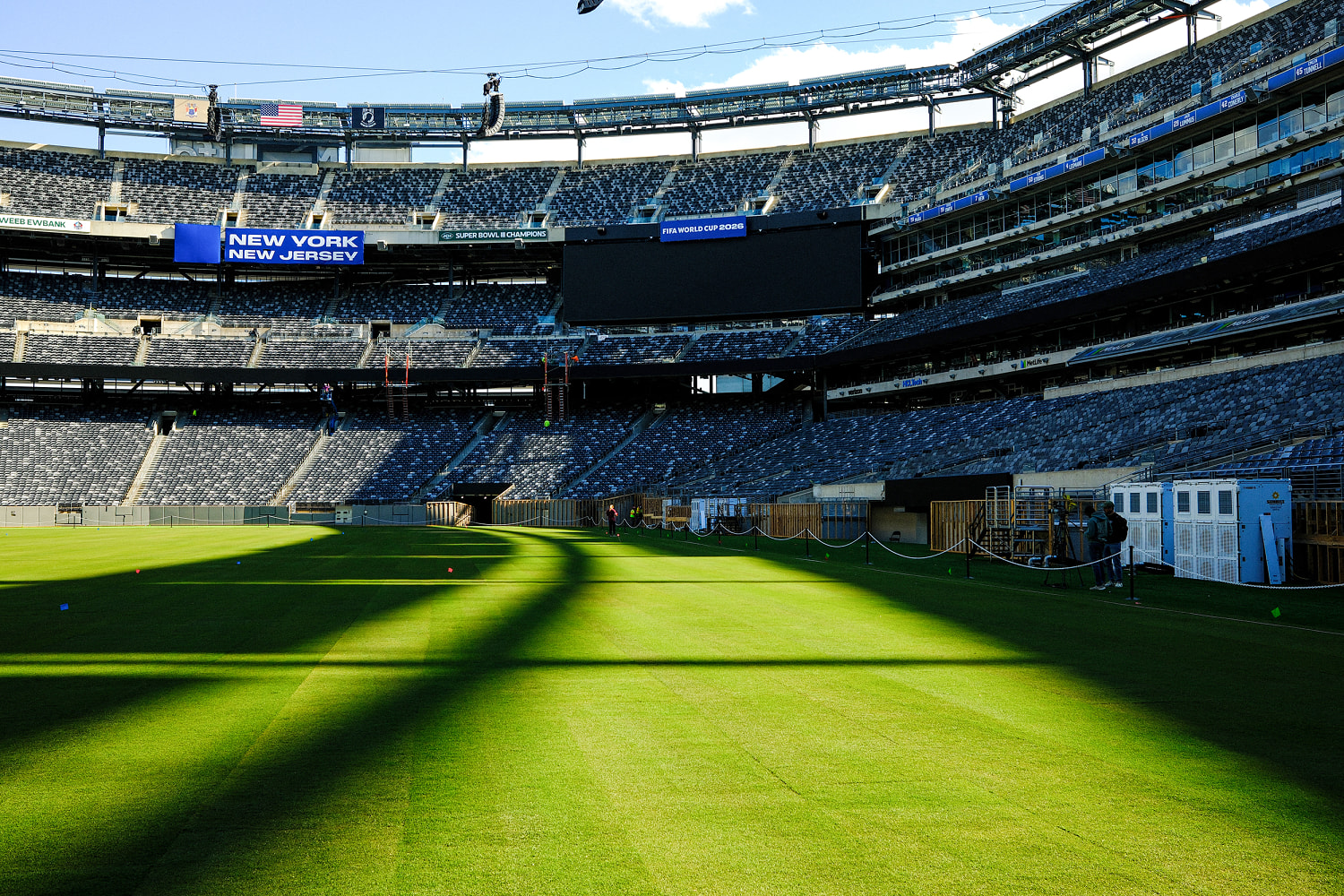
For stadiums landlocked in the middle of dense metropolitan areas—like MetLife Stadium in New Jersey or SoFi Stadium in Los Angeles—rolling trays are physically impossible. There is nowhere to roll them. Forcing these venues to use pure natural grass means accepting rapidly decaying, unstable sod that chunks up under a 300-pound lineman's foot. That is not a player safety upgrade; it is a lawsuit waiting to happen.
The Cleat-to-Surface Formula: The Real Enemy is Friction
The common argument against turf is that it "catches" a player's foot, causing non-contact joint injuries. The assumption is that natural grass always gives way, releasing the cleat and saving the knee.
This thinking completely misunderstands surface friction and rotational resistance.
In agronomy and sports science, surface safety is measured by Cleat Mark Depth (CMD) and rotational traction, often quantified via a Clegg Impact Hammer or a specialized traction testing rig. The goal is to keep rotational resistance within a specific safe window, typically between 35 and 50 Newton-meters ($Nm$).
$$\text{Rotational Resistance} = \mu \cdot L \cdot r$$
Where $\mu$ is the coefficient of friction between the cleat and the surface, $L$ is the vertical load applied by the athlete, and $r$ is the effective radius of the cleat pattern.
When an NFL edge rusher stands at 6-foot-4 and weighs 260 pounds, running a 4.5-second forty-yard dash, the vertical load ($L$) they exert when planting their foot to change direction is astronomical.
On a cold, wet November afternoon in Chicago, a natural grass field's shear strength drops significantly. The grass tears instantly under that load. The player slips. While a slip might save an ACL, it frequently causes groin pulls, hamstring tears, and high-ankle sprains because the body cannot find leverage to decelerate.
Conversely, consider a hot September game on a poorly maintained natural grass field in the South. The clay-heavy soil bakes into concrete. The grass roots dry out. Suddenly, the rotational resistance of that "safe" natural grass field spikes well past 60 $Nm$. The foot locks into the hard dirt just as securely as it would on older-generation field turf.
The problem isn't the material; it is the consistency.
The Data the Players' Union Ignores
The NFL Players Association (NFLPA) frequently cites a statistic stating that non-contact lower-body injuries are roughly 28% higher on synthetic turf than on grass. It sounds damning.
But as any data analyst who has worked inside an NFL front office will tell you, that aggregated number hides massive variables.
When epidemiologists look at sports injuries, they look at confounding factors. A study published in the American Journal of Sports Medicine analyzed multi-year data and found that when you control for variables like game temperature, player shoe types, and specific stadium age, the statistical gap between modern infill turf systems and high-performing natural grass narrows to almost zero.
Furthermore, the "grass is always safer" data relies heavily on data collected during the era of slit-film turf systems. Slit-film turf—which features a web-like fiber structure—is notorious for catching cleats. Recognizing this, many stadiums have spent millions ripping it out to replace it with monofilament systems, which feature single, straight blades of faux-grass designed to mimic the exact release characteristics of natural sod.
| Surface Type | Average Rotational Resistance ($Nm$) | Shear Strength Stability | Weather Vulnerability |
|---|---|---|---|
| Old Slit-Film Turf | 55–65 (High Risk) | Static / Unyielding | Low |
| Modern Monofilament Turf | 40–50 (Optimal) | Managed / Predictive | Low |
| Engineered Hybrid Pitch | 35–45 (Optimal) | High (Fiber Reinforced) | Medium |
| Pure Natural Grass (Poor Weather) | 20–30 (Slippage Risk) | Low (Fails under high load) | High |
Look at the numbers. A poorly managed natural grass field in a freezing December rainstorm offers terrible shear strength. Players lose their footing entirely. A modern, heated monofilament synthetic field with a shock pad underneath offers highly predictable, consistent rotational resistance from the first quarter to the fourth, regardless of whether it is snowing or eighty degrees out.
I've Seen Teams Waste Millions Chasing the Grass Myth
During my time consulting for sports venue logistics, I watched an ownership group spend millions of dollars to convert a multi-use stadium surface from a premium synthetic turf to a natural grass field because of public pressure from the fans and players.
The result was a disaster.
The stadium hosted a college football game on Friday night, a concert on Saturday night, and an NFL game on Sunday afternoon. By Sunday at 1:00 PM, the middle of the field between the hash marks wasn't grass. It was painted green mud. The ground staff tried to patch it with heavy rolls of sod just hours before kickoff, but the sod didn't have time to knit its root system into the sandy base layer.
During the second quarter, a star wide receiver planted his foot on a seam where the new sod met the old dirt. The sod shifted like a loose rug on a hardwood floor. He high-ankled out for six weeks.
The irony was palpable. The team spent millions to install grass to protect their assets, and the inherent instability of an overworked natural field broke their best player anyway.
Stop Asking for Grass, Demand Better Regulation
The current debate is asking the wrong question entirely. The question shouldn't be "How do we get rid of turf?" The question must be "Why does the NFL allow sub-standard testing metrics for both surfaces?"
Right now, the NFL uses a basic testing protocol before every game to measure field hardness (G-max). If the field registers below a certain threshold, it is cleared for play. This is an incredibly primitive bar for safety. It only measures vertical impact deceleration—essentially how hard the floor is if you hit your head on it.
It does not adequately measure:
- Rotational torque in real-time under high-velocity shifts.
- The degradation of the field's infill consistency over the course of a three-hour game.
- Moisture-to-fiber friction ratios on different cleat geometries.
The real fix isn't to mandate grass; it is to implement a strict, dynamically tested performance standard that every stadium surface must hit on game day, regardless of whether that surface is made of seeds or polymers. If a natural grass field is chewing up and creating potholes, it gets red-lighted. If a synthetic field is drying out and causing the coefficient of friction to skyrocket, it gets red-lighted.
If players want to protect their careers, they need to drop the nostalgic obsession with natural grass. The future of sports science isn't found in a bag of fertilizer; it is found in the precise, cold engineering of balanced friction. Anything less is just sentimental PR that leaves knees vulnerable.