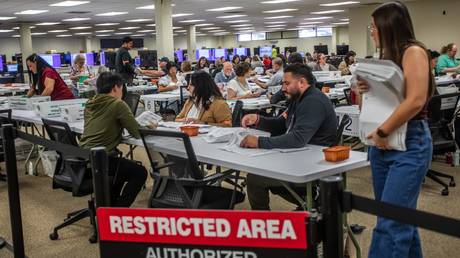
Federal courts rarely step into the middle of executive branch rhetoric unless the legal lines get crossed in a big way. Yet that's exactly what happened when a federal judge ordered the Trump administration to stop threatening election officials, drawing a sharp constitutional boundary around how federal power interacts with state-run elections.
If you're trying to figure out what this actually means on the ground, strip away the cable news shouting. This isn't just political theater. It's a collision between federal executive authority, the First Amendment, and the Elections Clause of the U.S. Constitution. Expanding on this idea, you can find more in: The Last Generosity and the Price of Proof.
Local clerks and secretaries of state run American elections. The federal government doesn't. When federal officials use the weight of their offices—or the implied threat of Department of Justice investigations and federal funding cuts—to pressure local administrators, courts view that as unconstitutional coercion.
Why the Judge Stepped In
Courts don't issue injunctions lightly. To get a federal judge to block executive branch actions or speech, plaintiffs have to clear an exceptionally high legal bar. They must prove immediate, irreparable harm and show a strong likelihood of winning on the merits of their case. Analysts at The Washington Post have shared their thoughts on this situation.
The core issue in disputes like this comes down to the line between protected political speech and unlawful intimidation. Anyone in public office can criticize how an election is run. That's standard politics.
Things change fast when criticism turns into threats of prosecution, baseless criminal referrals, or withholding federal grants unless local officials alter certification procedures or voter roll maintenance. At that point, federal officials aren't just speaking. They're wielding state power to coerce state actors.
Under the Tenth Amendment and the anti-commandeering doctrine—established firmly in Supreme Court cases like Printz v. United States—the federal government can't force state officials to enforce federal regulatory programs or bend state election laws to fit federal preferences. When a judge orders the administration to stop threatening election officials, the court is essentially enforcing that constitutional wall.
The Real-World Impact on Local Election Workers
Most people picture high-profile secretaries of state when they hear "election officials." Honestly, that's a misconception. The bulk of election administration rests on county clerks, municipal registrars, and volunteer poll workers in small towns across the country.
When Washington turns up the heat, those local offices feel it immediately. I've followed election administration battles for years, and the pattern is always the same:
- Staffing shortages spike. Experienced county clerks quit rather than face legal bills or public harassment. According to multiple surveys by the Brennan Center for Justice, roughly one in three local election officials report experiencing harassment, abuse, or threats, leading to massive turnover across swing states and rural counties alike.
- Routine processes grind to a halt. Fear of federal retaliation makes local administrators second-guess standard tasks like curing ballots, testing tabulators, or updating voter registrations.
- Legal costs drain county budgets. Small counties don't have massive legal departments. Responding to federal inquiries or defending against politically motivated subpoenas eats up money meant for basic voting infrastructure.
A judicial order barring threats gives these local officials breathing room. It tells county clerks they can follow their state's written election statutes without looking over their shoulders for a federal subpoena every time they certify a precinct tally.
How Federal Law Protects Election Administration
You don't have to guess about the rules governing election interference. Federal statutes are blunt about this.
Section 11(b) of the Voting Rights Act of 1965 makes it illegal for any person—whether acting under color of law or as a private citizen—to intimidate, threaten, or coerce anyone for voting or attempting to vote, or for urging or aiding any person to vote. Courts have repeatedly held that election workers who facilitate voting fall under these broader federal protections against intimidation.
18 U.S.C. § 594 goes even further, criminalizing intimidation or coercion aimed at interfering with a person's right to vote as they choose. While these laws are traditionally used against private actors or rogue local officials, federal courts don't give executive branch officials a free pass to violate statutory protections.
The First Amendment Defense
Whenever a court restricts what government officials can say, the administration's lawyers immediately raise the First Amendment. Their argument is predictable: government officials have a right to speak on matters of public concern, and courts shouldn't police political rhetoric.
That argument usually fails when the speech crosses into "true threats" or unconstitutional coercion. The Supreme Court clarified this boundary in National Rifle Association of America v. Vullo, ruling unanimously that government officials cannot use the power of their office to coerce third parties into punishing or suppressing disfavored speech or conduct.
In plain English, you can't use a government badge to bully someone into doing something you lack the legal authority to order them to do directly. The judge's order relies directly on that principle.
What Happens If the Administration Ignores the Order
A court order is only as strong as its enforcement mechanism. If federal officials continue making threatening statements or launching retaliatory investigations after an injunction is issued, plaintiffs go straight back to the judge to file a motion for civil or criminal contempt.
Contempt proceedings against executive branch officials are messy, slow, and historically rare, but they carry real teeth. A federal judge can impose daily fines on agencies, invalidate unlawful administrative actions, or refer specific officials for sanctions. More importantly, formal judicial findings of noncompliance become immediate ammunition for appellate courts and congressional oversight committees.
The administration also has the right to appeal. They'll almost certainly ask the circuit court for an emergency stay, arguing the injunction is overly broad and chills legitimate executive oversight of federal elections. Until an appellate panel steps in, though, the lower court's order remains binding law.
How You Can Track and Verify These Legal Battles
If you want to stay informed without getting pulled into partisan spin, skip the viral social media clips and look at the primary sources. Court filings tell you what's actually happening because lawyers face severe penalties for lying to a federal judge, unlike commentators on television.
- Read the actual preliminary injunction order. Look for the "Findings of Fact" and "Conclusions of Law" sections. That's where the judge lays out the exact evidence of threats that justified the ruling.
- Check PACER or CourtListener. Free legal archives like CourtListener host full dockets for major federal cases. Reading the plaintiffs' complaint alongside the Department of Justice's response shows you the strongest arguments on both sides.
- Follow local election board meetings. Your county clerk or board of elections holds public meetings where they discuss funding, security, and state directives. Watching how your local office operates gives you a far clearer picture of election integrity than national headlines ever will.
- Verify state-level election statutes. Every state publishes its election code online. When disputes break out over ballot deadlines or certification rules, checking the actual state statute immediately shows whether an official is following the law or bending it.
Pay close attention to the appellate docket over the next few weeks, because how the circuit court handles a stay request will determine whether local election offices keep their legal shield through the next election cycle.