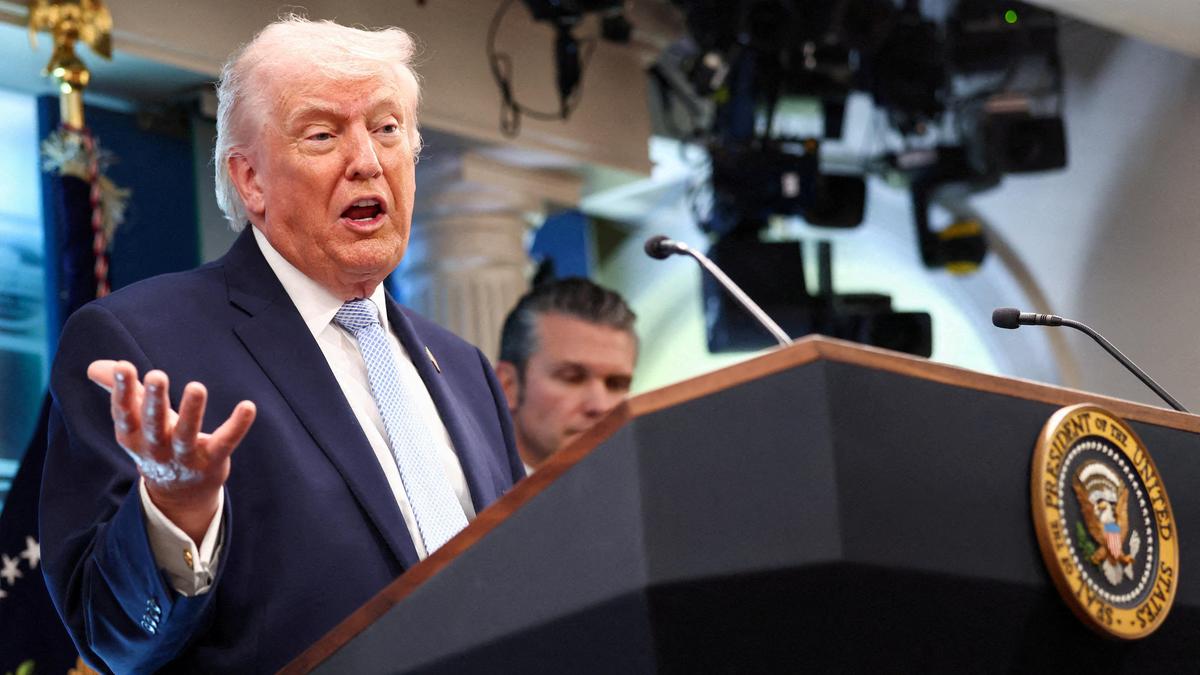
The transatlantic alliance is facing a terminal credibility crisis as the White House prepares to punish NATO members that refused to join the U.S.-Israeli military campaign against Iran. Washington is no longer asking for burden-sharing; it is demanding combat participation. Those who declined to send warships to the Strait of Hormuz or aircraft to the skies over Tehran are now being categorized as "unhelpful" states. This internal "loyalty list" marks a fundamental shift in American foreign policy, moving from the traditional defense of Europe to a transactional model where security is a product sold only to active participants in American regional conflicts.
The Punishment Doctrine
Under the new proposal currently circulating in the West Wing, the administration plans to relocate U.S. troops and high-value military assets from "reluctant" NATO members to those that provided material support for the Iran offensive. This is not a theoretical reshuffling. It is a punitive withdrawal of the security umbrella. Countries like Germany and France, which emphasized international law and the lack of a UN mandate, are the primary targets.
Meanwhile, nations that offered logistical hubs or limited base access—such as the UK, which permitted the use of RAF Fairford and Diego Garcia for "defensive" strikes—find themselves in a precarious middle ground. They are helpful enough to avoid immediate sanctions, but not loyal enough to satisfy the current American demand for a full-fledged coalition. The White House has made it clear that the era of the "free rider" is over, and the definition of a free rider now includes any ally that prioritizes its own regional stability over Washington's global military objectives.
The Hormuz Breaking Point
The friction reached a fever pitch following the closure of the Strait of Hormuz on March 2. When Iran mined the waterway in retaliation for the February 28 strikes, the global economy shuddered. Oil prices spiked, and the Trump administration demanded that NATO allies lead the clearing operations. The logic was simple: Europe and Asia depend on that oil more than the United States does.
When European leaders, led by French President Emmanuel Macron and British Prime Minister Keir Starmer, hesitated to engage Iranian naval forces directly, the White House viewed it as a betrayal of the North Atlantic Treaty’s spirit, if not its letter. Secretary of State Marco Rubio and NATO Secretary General Mark Rutte have been locked in tense negotiations, but the underlying resentment remains. Washington’s perspective is that it spent decades protecting European trade routes, only for Europe to cite "de-escalation" the moment those routes required a fight.
Moving the Chess Pieces
The proposed troop movements would likely see assets shifted toward the "Eastern Flank" or newer, more compliant partners in the Middle East and Eastern Europe. This creates a dangerous paradox for the alliance. By moving troops out of Western Europe to punish political dissent, the U.S. effectively signals to Moscow and other adversaries that certain NATO territories are no longer under active protection.
- Redistribution of Force: Shifting F-35 squadrons and missile defense batteries to "supportive" nations.
- Economic Levers: Potential secondary sanctions on European firms that continue to seek energy deals or diplomatic backchannels with Tehran.
- Intelligence Decoupling: Restricting the flow of high-level signals intelligence to countries deemed "non-aligned" in the Iran conflict.
This is not just about Iran. It is about the precedent of U.S. military hegemony. The administration is signaling that the Article 5 guarantee—the idea that an attack on one is an attack on all—is now conditional. If you are not with the U.S. in its chosen wars, the U.S. may not be with you when your borders are threatened.
The European Counter-Move
European capitals are not sitting idle. The talk of "strategic autonomy," once a fringe French obsession, has become a survival strategy in Brussels. If the U.S. security guarantee is subject to a loyalty test, the European Union must accelerate its own independent military capabilities. However, this is easier said than done. The energy crisis triggered by the Hormuz closure has gutted European industrial margins, leaving little room in national budgets for the massive defense spending required to replace American hardware and logistics.
The two-week ceasefire currently in place offers a brief window for diplomacy, but the damage to the alliance’s foundation is likely permanent. European diplomats are privately describing the U.S. demands as "extortion," while White House officials view European hesitation as "cowardice" funded by American taxpayers.
The Atlantic is widening. For seventy years, NATO was held together by a shared fear of a common enemy and a shared belief in a rules-based order. Today, the common enemy is ill-defined, and the rules are being rewritten by the largest shareholder in the room. The question is no longer whether NATO will survive in its current form, but what will be left of the Western security architecture when the punishment for neutrality is the loss of protection.
Prepare for a fractured continent where security is no longer a right of membership, but a reward for compliance.