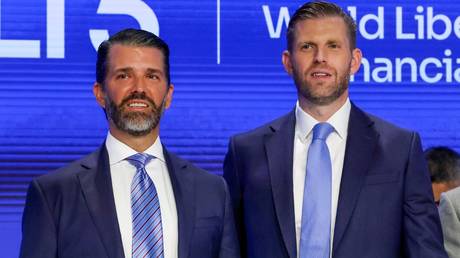
The headlines are vibrating with the usual moral panic. Financial Times breaks the news that Donald Trump’s sons are securing a stake in a mining group backed by the U.S. government, and the keyboard warriors immediately retreat to their partisan corners. One side screams "nepotism," while the other ignores the blatant conflict of interest. Both are missing the actual story.
This isn't just about a famous family getting a piece of the action. It is a masterclass in how the "Green Revolution" is being weaponized into the greatest state-sponsored wealth transfer in modern history. If you think this is about ethics, you're a tourist. This is about the brutal reality of the global supply chain, and for once, the players are being honest about the graft.
The Myth of the Ethical Supply Chain
Mainstream media loves to frame critical minerals—lithium, cobalt, copper, and rare earths—as the "clean" path to the future. They act as if these minerals magically appear in the back of a Tesla through the power of good intentions. In reality, the race for these materials is a dirty, violent, and highly subsidized brawl.
The "lazy consensus" suggests that government intervention in mining is a necessary evil to "save the planet." Wrong. Government intervention in mining is a desperate attempt to play catch-up with China, which currently controls nearly 90% of the processing capacity for several key rare earth elements. When the U.S. government starts throwing money at a mining group, they aren't looking for the most ethical operator or the most efficient geologist. They are looking for a political firewall.
The Trump involvement isn't a bug in the system; it’s a feature of the new American mercantilism. We are moving toward a world where a mining company’s most valuable asset isn't the grade of the ore in the ground, but the strength of its lobbyists in D.C.
Why the Financial Times Got It Backwards
The FT piece focuses on the optics of the Trump sons claiming a share in a group receiving federal support. It frames the story through the lens of traditional "conflict of interest" reporting. That’s an outdated metric. In the 2026 economic environment, the "conflict" is the point.
When you are dealing with critical minerals essential for everything from F-35 fighter jets to the power grid, the line between private enterprise and state interest disappears. We saw this with the Defense Production Act being used to fund domestic mining. We see it with the Department of Energy’s Loan Programs Office.
The smart money understands that these projects are too big—and too politically sensitive—to be left to the free market. They require "political de-risking." By having high-profile political names attached to a project, the company ensures it won't be regulated into oblivion by the next administration. It’s an insurance policy against the shifting winds of bureaucracy.
Critical Minerals are the New Oil and We Are Failing
Let’s look at the numbers the media ignores. To meet the projected demand for energy transition materials by 2040, the world needs about 50 new lithium mines, 60 new nickel mines, and 17 new cobalt mines. For context, it takes an average of 16.5 years to move a mining project from discovery to first production in the United States.
The system is broken. Environmental litigation, NIMBYism, and a labyrinth of federal permits mean that if you play by the old rules, you will never dig a hole in the ground.
This is why the "insider" play is becoming the only play. If you want to bypass the 16-year wait time, you need massive political leverage. You need the kind of noise that only certain names can generate. Is it "fair"? Absolutely not. Is it the only way the U.S. avoids total dependence on the CCP? Perhaps.
The E-E-A-T of the Mining Trench
I have watched junior mining companies burn through $500 million in venture capital just trying to get a single environmental impact statement approved. I’ve seen geologists find world-class deposits in Nevada and Minnesota only to have the projects killed by a single administrative law judge in a windowless office.
The expertise required here isn't just mineralogy. It’s the ability to navigate the "Deep State" of the Department of the Interior.
Common misunderstanding: People think "rare earths" are actually rare. They aren't. They are everywhere. What is rare is the political will to process them. The processing involves toxic acids and radioactive waste. Nobody wants it in their backyard. Therefore, the only way to get a processing plant built in the U.S. is to have a project that is "too big to fail" from a national security perspective.
The Hard Truth About Government Subsidies
The competitor article implies that government support should be a neutral, objective process. That is a fantasy.
Government grants in the energy and mining sectors are essentially "social credit scores" for corporations. They go to companies that align with the current administration's optics. The irony here is that the Trump sons are effectively "hacking" a system designed by their political opponents to favor green energy. They are taking the "National Security" justification—which the Biden administration used to justify billions in subsidies—and applying it to their own portfolio.
It’s a cynical move, but it’s mathematically sound. If the government has decided to pick winners and losers, you might as well make sure you’re on the list.
Challenging the "People Also Ask" Assumptions
Is it legal for political families to benefit from government-backed groups?
Yes, usually through a series of LLCs and holding companies. But the better question is: Why do we have a system where the government is the primary source of capital for mining? When the state becomes the bank, the bank becomes the state.
Will this project actually produce minerals?
Maybe. But in the world of "paper mining," producing minerals is often secondary to producing press releases that drive stock price and attract more government grants. If you want to know if a mine is real, look at the CAPEX (Capital Expenditure) versus the PR budget. If they are spending more on "awareness" than on drills, run.
Does this help U.S. independence?
Only if the processing happens here. Digging dirt in America and shipping it to China for refining—which is what we currently do with the Mountain Pass mine—does nothing for national security. It just exports the pollution and imports the finished product back at a 400% markup.
The Actionable Truth
If you are an investor or a citizen looking at this, stop focusing on the names. Focus on the mechanism. We are witnessing the birth of "Fortress Economics."
The goal isn't profit in the classical sense. The goal is control of the "choke points" of the 21st century.
- Stop believing in "Free Markets" in the energy sector. They don't exist. Everything is subsidized, regulated, or mandated.
- Follow the "Permit Path." The most valuable thing in mining isn't the gold; it’s the permit. If a company has a fast-tracked permit, they have a license to print money.
- Recognize the "National Security" label for what it is. It is a blank check. It allows the government to bypass environmental laws and financial transparency.
The Trump family isn't "disrupting" mining. They are simply the first ones to drop the pretense and treat it like the political spoils system it has become.
You can hate the players, but if you don't understand the game, you're just noise. The transition to a "new economy" isn't being built on solar panels and good vibes. It’s being built on backroom deals, state-funded excavation, and the realization that in the race for the future, the dirtiest hands often hold the most power.
The era of the independent, rugged miner is dead. Long live the politically connected extractor. If you aren't at the table, you're the ore.
Stop asking if this is "right." Start asking who owns the ground under your feet and who gave them the money to dig it up.