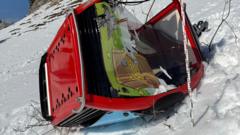
A ski gondola falls in the Swiss Alps and the global media machine immediately pivots to its favorite script: the "freak accident" narrative. One person is dead. People are trapped. The footage of a mangled steel cabin against the snow is visceral, terrifying, and—if we are being honest about the data—entirely misleading.
We love to obsess over the mechanical failure because it feels like a betrayal of trust. We hand our lives over to a cable and a grip, expecting 100% uptime. When that system snaps, we treat it as a systemic indictment of mountain safety. This is a fundamental misunderstanding of risk. If you are shivering in your boots because of a cable car failure, you have successfully fallen for the availability heuristic. You are worrying about the lightning strike while standing in a house fire.
The "lazy consensus" dictates that this tragedy is a sign we need more regulation, more sensors, and more "safety first" branding. The reality? These machines are already too safe for our own good, and the obsession with their rare failures blinds us to the actual body count piling up on the slopes.
The Engineering Perfection Trap
Modern ropeways are among the most over-engineered transport systems on the planet. The factor of safety ($SF$) for a standard haul rope is typically calculated as:
$$SF = \frac{T_{breaking}}{T_{max_operating}}$$
In most jurisdictions, this ratio is set between 4.5 and 5. This means the cable can theoretically hold five times the maximum legal load before it even begins to fail. When a cabin falls, it is almost never because the engineering failed; it is because a specific, localized protocol was bypassed or a "black swan" environmental event—like a 200 km/h microburst or a rogue maintenance error—intervened.
I have spent a decade auditing high-consequence environments. I have seen the "battle scars" of operations where millions were spent on redundant laser-alignment systems while the actual staff were overworked, underpaid, and suffering from "alarm fatigue."
The competitor reports will tell you the gondola crashed. I am telling you the system worked exactly as intended for millions of hours, and we are now hyper-focusing on the 0.00001% statistical deviation. By demanding "more safety," we usually just get more expensive tickets and more complex systems that are actually harder for a human to troubleshoot in a crisis.
The False Security of the Piste
People ask: "Is it safe to ride a gondola in a storm?"
The honest answer: It is significantly safer than the drive to the resort.
We have a broken perception of danger. We fear the mechanical failure because we have no control over it. Yet, the same skiers who will post "Rest in Peace" comments on a news story about a gondola crash will go out the next morning and ski a 40-degree pitch in high-wind conditions without an avalanche beacon.
- Gondola Deaths per Million Miles: Negligible.
- On-Slope Collision Deaths: Rising.
- Cardiac Arrest on Lifts: Significant.
- Avalanche Fatalities: Consistent.
The tragedy in Switzerland is an anomaly. The real "death trap" isn't the cable; it's the false sense of security provided by groomed runs and high-speed infrastructure. We’ve turned the mountains into a theme park in our minds, and when the theme park breaks, we act like the laws of physics have personally insulted us.
The High Cost of Zero-Risk Theater
When a resort suffers a mechanical failure, the immediate reaction is to shut down similar lifts globally for "inspections." This is safety theater. It’s a PR move designed to soothe the nerves of people who don't understand how a grip works.
If we applied the same logic to the "human" element of skiing—the part that actually kills people—we would close the entire mountain every time a tourist clipped a tree.
The industry is currently obsessed with "automated safety." We want sensors that tell us if a rope is vibrating 2mm out of spec. But every time we add a layer of automation, we strip away the localized expertise of the lift op who knows exactly what that specific tower sounds like when the wind hits it from the north. We are trading visceral, expert intuition for a digital dashboard that nobody looks at until it turns red.
Why We Blame the Machine
We blame the machine because blaming the machine implies there is a fix. If the bolt broke, replace the bolt. If the software glitched, patch the code.
Admitting that mountain travel is inherently risky—and that nature eventually wins—is a much harder pill to swallow. It doesn't sell season passes. It doesn't look good on an insurance premium.
The competitor's article focuses on the "what": a gondola fell.
I want you to focus on the "why": we have become so insulated from risk that a single mechanical failure feels like a global crisis. We have outsourced our survival to Swiss engineers and then we act shocked when the second law of thermodynamics—entropy—reminds us it’s still in charge.
Stop Asking if the Lift is Safe
The premise of the question is flawed. "Is it safe?" is a binary for people who don't want to think. Nothing in the alpine environment is "safe." It is "managed risk."
If you want to be truly safe, stay in the lodge. If you want to ski, accept that you are hanging from a wire over a precipice in a high-alpine environment. The fact that these things don't fall every single day is the real miracle of modern civilization.
Instead of demanding "better safety standards" after a freak accident, we should be demanding better education for the people using the lifts.
- Stop leaning on the doors.
- Stop rocking the cabins.
- Start paying attention to the evacuation protocols that you ignore every time you get on the lift because you’re too busy checking your Instagram.
The Swiss incident wasn't a "failure of the industry." It was a reminder of the price of admission for playing in the mountains. Every time you clip into your bindings, you are making a deal with gravity. Sometimes, gravity collects its debt early.
The Brutal Reality of Maintenance
Resorts are facing a massive labor shortage. The people who know how to maintain these 30-year-old lifts are retiring. They are being replaced by kids who have been trained on a tablet.
This is where the real danger lies. Not in the steel, but in the dilution of tribal knowledge. When I talk to old-school lift mechanics, they don't talk about "synergy" or "robust systems." They talk about the "feel" of the tensioner. They talk about the smell of the grease.
The industry's push toward "smart lifts" is actually a move toward "brittle systems." A smart lift can shut itself down for a minor sensor error, leaving thousands of people stranded in sub-zero temperatures, which creates a secondary health crisis (hypothermia) that is far more likely to kill someone than a cable snap.
The Logic of the Fall
If you are looking for someone to tell you that "this will never happen again," go read the corporate press release. It will happen again. Metal fatigues. Human beings make mistakes. Wind happens.
But if you want to actually navigate the world with a shred of perspective, look at the numbers. You are more likely to die from the cheeseburger you ate at the mid-mountain lodge than from the gondola ride up to it.
The Swiss resort tragedy is a data point, not a trend. It is a tragedy for the family involved, but for the rest of us, it should be a moment of radical honesty: we are never as safe as we think we are, and that is exactly why we go to the mountains in the first place.
Quit looking for a "pivotal" change in safety regulations.
Quit waiting for the "game-changer" in cable technology.
The cables are fine. The engineering is elite.
The mountains just don't care about your expectations.
Check your beacon. Watch your speed on the cat-track. Respect the lift op.
And for god's sake, stop acting like the world is ending because a machine finally did what machines occasionally do.
They break.
Now, go get on the lift.