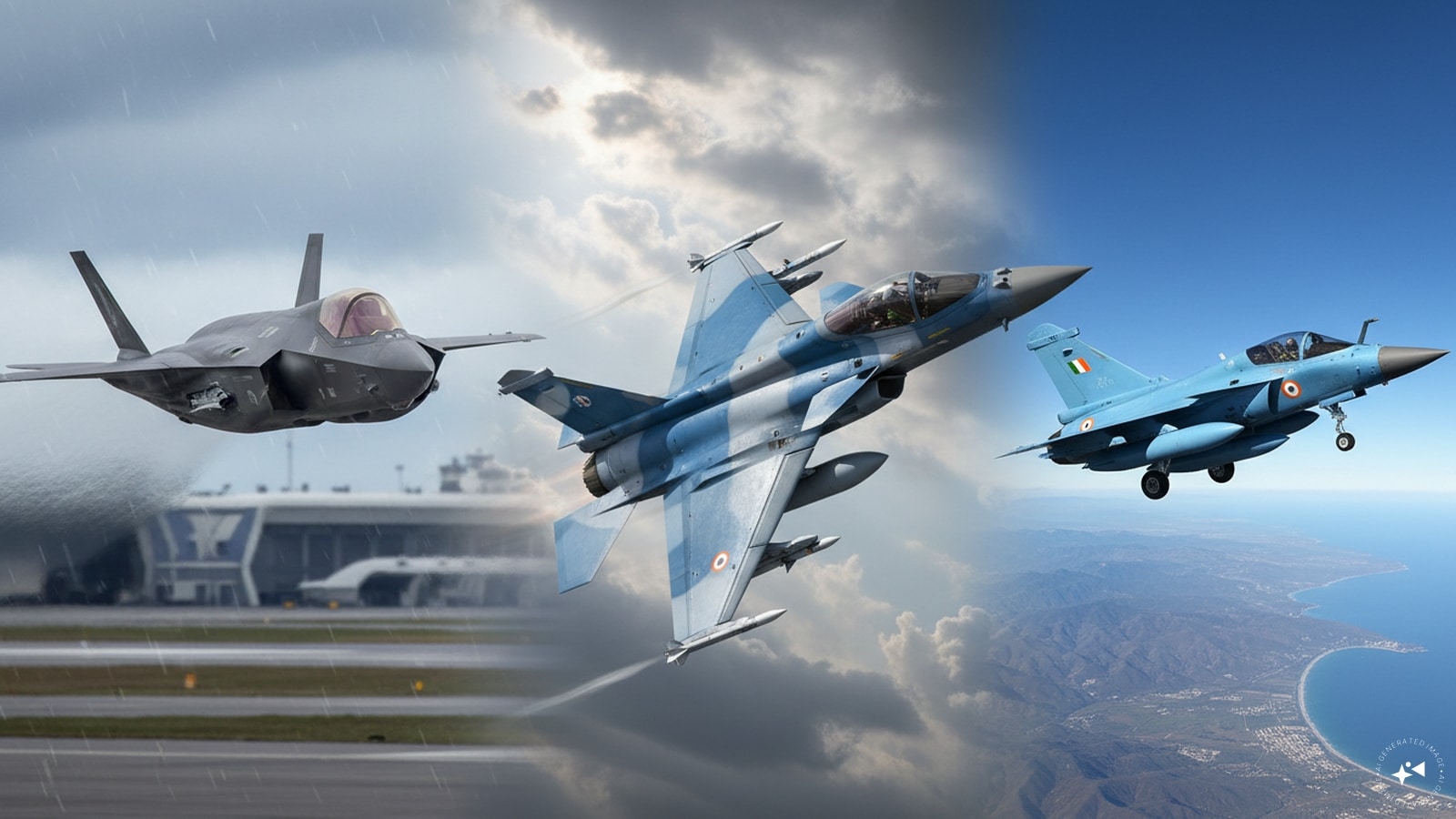
Air combat exercises involving disparate fifth and fourth-generation aircraft platforms, such as the American F-35 Lightning II, the French Rafale, and the Indian Tejas, serve as laboratories for structural interoperability rather than mere demonstrations of tactical cooperation. When military forces from distinct industrial ecosystems operate within a unified exercise architecture like Tarang Shakti 2026, the primary variable under evaluation is not raw kinematic performance, but the friction coefficient of multi-vendor command, control, communications, computers, intelligence, surveillance, and reconnaissance integration.
The convergence of these specific airframes exposes the operational challenges of bridging sovereign data networks. The F-35 relies heavily on the Autonomic Logistics Information System and MADL, a proprietary high-bandwidth directional data link designed explicitly for low-probability-of-intercept and low-probability-of-detection communications among fifth-generation platforms. Conversely, the Rafale incorporates the Thales SPECTRA electronic warfare suite and Link 16 standard data terminals, optimized for European operational doctrine. Meanwhile, the HAL Tejas integrates a mix of Israeli, domestic, and Western avionics, creating a unique data translation requirement when communicating across disparate cryptographic and waveform boundaries.
Military planners organizing large-scale exercises confront a rigid economic and technical trade-off: maintaining absolute tactical security via proprietary data links versus achieving operational efficiency through open-architecture data fusion. When the United States, France, and India deploy assets to a common airspace, mission commanders cannot simply plug their tactical data networks together. They must establish procedural workarounds, gateway translation nodes, or rely on voice communications and non-secure situational awareness relays, which severely degrade the decision-making velocity that fifth-generation platforms are engineered to provide.
The operational value of an exercise like Tarang Shakti 2026 lies in stress-testing these integration bottlenecks. In a contested operational environment, an air wing composed of mismatched assets suffers from sensor-to-shooter latency mismatches. If an F-35 detects a threat target via its Distributed Aperture System, that information must be transmitted to a Rafale or a Tejas in a format their mission computers can ingest without requiring manual pilot interpretation. Evaluating how these platforms share track files, coordinate electronic attack profiles, and deconflict airspace under electronic countermeasures defines the utility of the deployment.
Furthermore, dissimilar air combat training forces participating nations to confront divergent maintenance and logistics paradigms. The F-35 demands an automated, centralized diagnostic infrastructure that ties back to continental United States supply chains, whereas the Rafale and Tejas operate under distinct national sustainment models with higher tolerances for localized field maintenance. Synchronizing turnaround times, ground crew protocols, and ordnance loading procedures during a high-tempo exercise reveals the friction points of coalition logistics.
The strategic takeaway from multinational exercises involving advanced tactical aircraft is that technological superiority matters less than integration velocity. Air forces that master the middleware of coalition warfare—translating disparate data standards, aligning tactical rules of engagement, and synchronizing electronic warfare frequencies—will retain a structural advantage over alliances bound by bureaucratic inertia and incompatible hardware.


