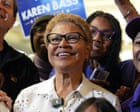
The conventional wisdom of modern political campaigns dictates that enough money can purchase any office in America. Billionaire developer Rick Caruso spent nearly $40 million during the primary season to test that exact theory in Los Angeles, only to find himself forced into a grueling November runoff against U.S. Representative Karen Bass. Despite outspending Bass by a ratio of more than eleven to one, Caruso failed to secure the outright majority needed to avoid a second round of voting. The primary results exposed a profound disconnect between expensive, saturated media campaigns and the deeply entrenched organizing networks that actually dictate power in Southern California.
For months, television screens and digital feeds across the city were dominated by advertisements framing the municipal election as a choice between immediate emergency intervention and bureaucratic inertia. Caruso pitched himself as the decisive outsider capable of cleaning up City Hall and clearing out the tents lining LA sidewalks. Bass countered with her decades of deep-rooted community organizing and legislative experience in Sacramento and Washington. When the final primary tallies were processed, Bass not only erased Caruso’s early election-night lead but climbed ahead of him, proving that personal relationships and institutional trust still hold a structural advantage over raw capital.
The Illusion of the Early Lead
Initial election night returns frequently distort reality in California due to the protracted nature of mail-in ballot counting. Early waves of data showed Caruso holding a comfortable advantage, triggering premature declarations about a shift in the city’s political leanings. This initial bump reflected the voting habits of a specific demographic, primarily older, more conservative, and highly motivated property owners who return their ballots the moment they arrive in the mail.
The trajectory changed as election workers processed the massive volume of drop-box and mail-in ballots cast closer to election day. This later pool of voters skewed younger, more progressive, and far more diverse. The steady shift toward Bass over the subsequent days underscored a persistent flaw in modern political polling, which routinely struggles to measure the intent of non-traditional voters who do not engage with pollsters but do respond to localized, peer-to-peer mobilization.
Money Versus Infrastructure
The sheer scale of the financial disparity in this race should have produced a blowout. Caruso’s campaign weaponized a fortune built on high-end retail developments to construct a ubiquitous media presence. His operation functioned less like a traditional campaign and more like a corporate product launch, utilizing saturated advertising to build instant name recognition and dictate the terms of public debate.
| Campaign Asset | The Caruso Strategy | The Bass Strategy |
|---|---|---|
| Primary Funding Source | Personal fortune ($40M spent) | Traditional donor network ($3.5M spent) |
| Core Messaging | Disruption, outsider business expertise, law and order | Coalition building, systemic solutions, legislative experience |
| Ground Game | Paid canvassers and targeted direct mail | Organized labor partnerships, Black churches, local progressive clubs |
Bass relied on a different currency. Her asset was a network built over thirty years, stretching back to her days founding the Community Coalition in South Los Angeles during the late 1980s. When Caruso launched his ad blitz, Bass activated endorsements from the county’s most powerful labor unions, civil rights organizations, and local Democratic clubs. These groups do not just buy airtime; they deploy thousands of volunteers who knock on doors in neighborhoods that commercial polling often overlooks. Money can buy visibility, but it struggles to replicate the credibility of a trusted neighbor standing on a porch.
The Broken Promises of Outsider Politics
Caruso’s platform leaned heavily on the classic American trope of the business executive sweeping in to fix a broken government. His rhetoric targeted the visible crises gripping Los Angeles, specifically the growth of unhoused encampments and rising anxieties regarding public safety. By promising to declare a state of emergency on day one and build thousands of temporary shelter beds rapidly, Caruso attempted to appeal to a frustrated electorate looking for immediate results.
This approach overlooks the structural mechanics of municipal governance. A Los Angeles mayor is not a CEO with absolute authority; the position operates within a weak-mayor system where real legislative and budgetary power resides with the fifteen members of the City Council. Bass repeatedly capitalized on this reality during debates, subtly reminding voters that an outsider who treats city government as a hostile entity will spend their entire term locked in bureaucratic warfare. Her campaign argued that solving homelessness requires navigating a complex web of county health departments, state funding streams, and federal housing vouchers—environments where she has spent decades building alliances.
The Racial and Economic Realities of the Coalition
The voting patterns that forced the runoff revealed a city divided along stark geographic and socioeconomic lines. Caruso found his strongest support in the wealthier, whiter enclaves of the San Fernando Valley and the Westside, where anxieties over property values and public order run highest. His messaging resonated with residents who feel the city is in decline and view aggressive policing and rapid encampment clearances as the primary solutions.
Bass assembled a multiracial coalition rooted in the city’s working-class core. She carried Central Los Angeles, parts of the Eastside, and dominated the historic Black communities of South LA. More importantly, she secured significant support among Latino voters, a demographic Caruso targeted heavily through Spanish-language advertising and prominent community endorsements. The failure of Caruso to capture a larger share of the Latino vote exposed the limits of top-down media campaigning when contrasted with Bass’s long-standing alliances with local labor leaders and immigrant rights advocates.
The upcoming November runoff shifts the mathematics entirely. In a general election coinciding with high-stakes statewide and federal races, voter turnout will expand significantly, bringing an even larger share of young and progressive voters to the polls. To stay competitive, Caruso cannot simply repeat the playbook of the primary. Sponsoring another round of identical television commercials will yield diminishing returns; his campaign must find a way to break into the working-class neighborhoods that rejected his corporate vision the first time around. Bass faces the opposite challenge, needing to maintain the enthusiasm of her volunteer base while reassuring moderate homeowners that her deep ties to the political establishment will not mean a defense of the status quo. Money will continue to flood the race, but the primary proved that the soul of Los Angeles cannot be bought in a single transaction.