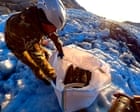
Cold.
It was a cold so absolute it turned the breath in a man’s lungs into tiny, jagged crystals before he could even exhale, a cold that froze the grease inside rifle bolts and snapped steel bayonets like dry twigs against the limestone cliffs of Northern Italy.
If you stand on the Marmolada glacier today, watching the afternoon sun carve deep turquoise channels into the shrinking ice, it is hard to picture the hell that once occupied this exact altitude. Over a century ago, between 1915 and 1918, thousands of Italian Alpini and Austro-Hungarian Kaiserschützen fought a war at eleven thousand feet. They did not just fight each other. They fought the vertical rock, the blinding blizzards, and the White Death—avalanches that swallowed entire barracks whole in the middle of the night. When the armistice finally silenced the artillery in November 1918, the men who survived scrambled down the scree slopes as fast as their frostbitten feet could carry them.
They left everything behind.
For decades, the Dolomites kept their secrets. The snow fell, compressed into blue glacial ice, and locked away the physical debris of the White War. Canned rations, woollen socks, love letters tucked into tunic pockets, wooden skis, and thousands upon thousands of live artillery shells vanished beneath the surface. The mountains became a frozen vault.
Now, the vault is melting open.
A Hiker’s Boot and a Rusting Fuse
To understand what is happening on these peaks right now, picture a hypothetical trekker—let us call him Marco—making his way along a high-altitude ridge near the Passo del Tonale on a crisp August morning. Marco is wearing modern Gore-Tex boots, carrying carbon-fiber trekking poles, and checking a GPS watch. He steps off the marked trail to take a photograph of the valley below. His boot strikes something metallic protruding from a patch of grey, slushy moraine that was covered by ten feet of solid ice just three summers ago.
He bends down. Half-buried in the wet gravel is a cylinder of corroded iron, roughly the size of a wine bottle, with a brass nose cone still screwed tightly into the top.
Marco has just stumbled upon a 75mm Austro-Hungarian shrapnel shell.
This scenario is no longer a rare freak occurrence; it has become a regular, nerve-wracking reality for Alpine guides, glaciologists, and amateur hikers across the Italian Alps. As global temperatures rise, the European Alps are warming at roughly twice the global average. Glaciers like the Presena, the Adamello, and the Marmolada have lost more than half their volume over the last few decades, and the pace of retreat has accelerated dramatically in the 2020s.
As the ice vanishes, the White War is resurfacing in grotesque detail.
I remember the first time I walked a high traverse in the Trentino region and saw the sheer density of the iron left behind. You expect to see old stone walls or perhaps the rusted frame of a cable car station. You do not expect to see tangles of barbed wire coiled like dormant snakes beneath a puddle of meltwater, or the splintered timber of an underground ice city—the famous Città di Ghiaccio carved inside the Marmolada—weeping out of a receding ice wall. Standing there, smelling the sharp, metallic tang of wet rust mixing with the clean pine air of the lower valleys, you feel an unsettling shift in time. The past is not behind us. It is literally beneath our feet, thawing out.
The Physics of a Forgotten Bomb
When people hear that First World War munitions are emerging from melting glaciers, their first instinct is often curiosity, followed quickly by a dangerous assumption. Surely, after a hundred years underwater and encased in ice, the explosives must be dead. Ruined. Harmless chunks of scrap metal.
That assumption gets people killed.
Think of a glacial environment not as a destructive swamp, but as the ultimate biological and chemical deep-freeze. Inside the ice, oxygen is scarce and temperatures remain locked below freezing for decades on end. While the outer iron casing of an artillery shell or a hand grenade rusts and pits when exposed to meltwater, the chemical compounds packed inside—picric acid, TNT, amatol, and nitroglycerin—are remarkably stable in the cold. They do not simply rot away like wood. Instead, they wait.
Consider what happens next: the ice melts, and the shell is suddenly exposed to the brutal temperature swings of an Alpine summer. During the day, the dark, rusted metal absorbs intense high-altitude solar radiation, heating up rapidly. At night, temperatures plummet back below freezing. This daily thermal expansion and contraction cracks old seals, shifts internal firing pins that have been under spring tension since 1917, and degrades chemical stabilizers.
Picric acid, a favorite explosive filler used heavily by both the Italian and Austro-Hungarian armies, is particularly treacherous. Over time, especially when moisture penetrates a casing and reacts with heavy metals like lead, copper, or iron, picric acid forms metallic picrates. These crystals are absurdly sensitive. The friction of a hiker’s boot, the vibration of a falling rock, or the simple act of picking the shell up to inspect it can trigger a full-scale detonation.
The ice preserved the weapon. The heat makes it hair-trigger unstable.
The Men Who Walk Into the Minefield
When a hiker like our fictional Marco does the right thing—backing away carefully, marking the GPS coordinates, and calling the emergency number—a specialized unit is summoned to the mountain. In Italy, the responsibility for clearing these high-altitude ghosts falls largely to the bomb disposal experts of the Italian Army, specifically the Guastatori regiments of the Alpine troops, alongside specialized Carabinieri units.
Their job is a strange, grueling marriage of mountaineering and ordnance disposal.
You cannot drive an armored bomb-disposal truck up a vertical limestone cliff at ten thousand feet. You cannot send in a tracked robot over loose scree and crevasses. These specialists have to climb to the threat carrying heavy packs, ropes, and demolition charges on their backs. They work at altitudes where the air is thin, the weather can turn from bright sunshine to a lethal whiteout in twenty minutes, and the ground itself is shifting beneath them as permafrost thaws and triggers rockfalls.
Once they reach a cache of exposed shells, they face an immediate tactical dilemma. Moving an unexploded, century-old shell is a gamble nobody wants to take. If the fuse is compromised, a single jolt during a helicopter lift or a backpack carry could be fatal. Consequently, the disposal teams often have to destroy the munitions in situ—blowing them up right where they lie on the mountain.
Picture the logistics of that. Before they can detonate a single shell, teams must hike the surrounding ridges to ensure no stray climbers, trail runners, or mountain goats have wandered into the blast radius. They pack modern plastic explosives around the rusted relic, retreat behind a rock outcrop, and trigger a controlled blast. The sharp crack echoes off the pale Dolomite walls, sending a plume of grey smoke into the blue sky, reducing a hundred-year-old instrument of war to harmless shrapnel.
In recent summers, Italian bomb squads have neutralized thousands of individual devices across the northern regions of Trentino-Alto Adige, Lombardy, and Veneto. Sometimes it is a lone mortar round found near a popular via ferrata route. Other times, a retreating glacier exposes an entire forgotten ammunition dump—dozens of shells stacked neatly in rotting wooden crates, exactly where an artillery crew left them before an avalanche buried their position in the winter of 1916.
More Than Just Iron
If it were only bombs emerging from the ice, the story would be a straightforward tale of physical danger and military cleanup. The reality is far more haunting. The glaciers are not just returning the weapons; they are returning the boys who carried them.
Every few years, the retreating ice yields human remains.
In the Presena glacier, the bodies of two young Austro-Hungarian soldiers—believed to be seventeen and eighteen years old—emerged from the melting ice after nearly a century. They had been shot in the head, likely killed during a skirmish in the spring of 1918, and their comrades had buried them in a crevasse because the ground was too frozen to dig a proper grave. The glacier kept them intact. Their woollen uniforms were still recognizable. In one pocket, searchers found a spoon. In another, a letter written in German, tucked away before the final assault.
To stand over a discovery like that—or even to read the forensic reports from the anthropologists who examine them—strips away every romantic illusion we ever built around war history. History books speak of front lines, strategic salients, and artillery barrages. The melting ice gives us a teenager’s spoon. It gives us boots stuffed with newspaper to keep out the frost. It gives us crampons strapped over leather soles that were never meant to survive an Alpine winter.
For the historians and museum curators working in towns like Rovereto, Cortina d'Ampezzo, and Peio, this sudden flood of artifacts is both a treasure trove and a race against time. When an organic object—a leather belt, a wooden ski, a scrap of paper—emerges from the ice after a hundred years, it begins to rot immediately. Exposure to oxygen, sunlight, and bacteria destroys in weeks what the glacier preserved for a century.
Local recovery teams and archaeologists work frantically every summer to document, rescue, and conserve these items before they disintegrate into dust. Yet they are constantly forced to balance historical preservation against raw survival. You cannot send an archaeologist into a boulder field until the bomb squad has cleared the unexploded grenades lying three feet away from a soldier's canteen.
The Invisible Trail of Heavy Metals
Even when the bombs do not explode, and even after the disposal teams pack up their gear and hike back down to the valley, the munitions leave behind a quieter, slower threat.
As those thousands of tons of iron, brass, lead, and chemical explosives corrode in the meltwater, they leach directly into the Alpine watershed. Glaciers are the water towers of Europe. The meltwater flowing off the Dolomites and the Ortler Alps feeds the Adige, the Piave, and the Po rivers—arteries that supply drinking water, agricultural irrigation, and hydroelectric power to millions of people across northern Italy.
Environmental scientists have begun paying closer attention to the chemical footprint of the White War. Lead from millions of fired shrapnel balls, copper from shell driving bands, mercury from percussion caps, and nitrogen-rich explosive residues like TNT and RDX are slowly washing out of the high-altitude scree slopes. While the dilution factor in major rivers is immense, localized alpine lakes and high-mountain streams situated directly below former battlefields are showing measurable traces of heavy metal contamination.
It is a bizarre ecological feedback loop. A war fought with industrial chemicals in 1916 was locked in deep storage by the climate of the twentieth century, only to be released into the water supply by the warming climate of the twenty-first.
Walking the High Ridges Today
I will admit something that might sound strange if you have never spent time in the high mountains: walking through the Dolomites today requires a kind of double vision.
With one eye, you see one of the most breathtaking landscapes on Earth. At sunset, the pale dolomite rock catches the light and glows a deep, fiery pink—a phenomenon locals call enrosadira. Hikers sit outside wooden rifugios with plates of speck and polenta, watching paragliders drift across valleys carpeted in emerald larch forests. It feels peaceful. Eternal. Untouched.
With the other eye, you notice the scars. You notice that the rocky ledges you are scrambling over are actually reinforced firing trenches hand-chiseled into the cliff face by teenage conscripts. You notice the rusted iron rings bolted into the vertical rock where men hauled heavy cannons up sheer walls using pulleys and raw muscle. And if you look closely at the grey, muddy tongue of a dying glacier, you realize you are looking at a massive, slow-motion excavation site.
For anyone planning to hike, climb, or ski in these mountains, the rules of engagement have changed. The Dolomites are no longer just a playground for outdoor enthusiasts; they are an active historical hazard zone.
Local authorities across northern Italy have launched public awareness campaigns aimed at tourists, and the advice is brutally simple, though people still ignore it out of souvenir-hunting greed. Never touch a piece of rusted metal on a mountain trail. Do not kick it to see if it is solid. Do not try to pry a brass fuse off a shell casing to take home as a paperweight. Every year, amateur relic hunters—men who sweep the mountains with illegal metal detectors looking for belt buckles and badges to sell online—end up in emergency rooms missing fingers, or worse.
If you see something suspicious protruding from the ice or scree, you stop. You take a photo from a safe distance, note your location on your phone or map, and report it to the local mountain rescue or the rifugio manager down the trail.
What the Ice Leaves Behind
The glaciers of the Dolomites are not coming back. Even under the most optimistic climate scenarios, glaciologists project that the vast majority of the ice in the Italian Alps will disappear within the next few decades. The Marmolada, once known as the Queen of the Dolomites for its massive white cloak, could be largely ice-free by 2040.
As that final layer of blue ice thins and vanishes, the mountains will be stripped completely bare. Every trench, every buried barrack, every lost rifle, and every unexploded shell will finally lie exposed under the open sky.
We often talk about climate change in abstract metrics—parts per million of carbon, fractions of a degree Celsius, millimeters of sea-level rise. Those numbers are easy to tune out. They feel distant, technical, almost theoretical.
Up here at ten thousand feet, there is nothing theoretical about it. You can hold the evidence in your hands, though you shouldn't. The warming climate is peeling back the roof of a century-old battlefield, forcing a modern generation to disarm the anger of their great-grandfathers, one rusted shell at a time.
Stand on the edge of the Presena ice on a quiet afternoon, when the hikers have gone down for the day and the wind drops to a whisper. Listen closely. You can hear the steady, rhythmic drip of meltwater trickling down through the dark stone, washing away the last frozen silence of 1918, revealing the cold iron waiting underneath.


