The rain in the high passes does not fall. It hammers. It arrives not as water, but as weight—a thick, gray curtain dropped from a sky that has forgotten how to be gentle.
Listen. Can you hear it?
Up there, where the air grows thin enough to make your chest ache, the monsoon usually knows its boundaries. It dances against the stone faces of the Himalaya, feeds the terrace farms of Nepal, and drifts quietly away. But the mountains are old, and the atmosphere is restless, and sometimes the sky simply breaks.
We forget how fragile gravity is until it fails.
By the time the statistics began to crawl down the mountain wires, the scale had already outgrown human comprehension. Nearly a thousand souls lost in Nepal. A thousand more when the cruel arithmetic crossed the high, frozen border into Tibet. Numbers. Cold, clean integers pressed onto white reporter pads in Kathmandu and Lhasa. But numbers have a way of flattening reality. They turn a village into a decimal. They turn a mother searching through mud for a blue school notebook into a data point.
Let us step out of the press room. Let us walk down a narrow dirt track in Sindhupalchok, before the hillside let go.
Imagine Karma. He is sixty-two years old, though his hands make him look a century older—cracked knuckles stained with cardamom dust and the dark, rich soil of a hillside farm that has fed his family for five generations. Karma knows the weather the way a sailor knows the pulse of the ocean. He knows when the clouds are just passing ghosts, and he knows when they carry teeth.
That night, the teeth found him.
It did not begin with a roar. That is a cinematic lie. It began with a silence. The crickets stopped. The restless goats in the pen beneath his wooden veranda went utterly still, their breath ragged and hot in the dark. Then came the sound of tearing canvas—the terrifying rip of the earth itself, as millions of tons of stone, water, and ancient pine trees lost their grip on the vertical world.
Karma did not have time for philosophy. He had time for a single shout to his granddaughter, a frantic grab for a wooden lintel, and then the dark came in through the door.
When we talk about the floods and landslides sweeping across the roof of the world, we are talking about a collision between ancient geography and modern atmospheric violence. The Himalaya are young mountains. They are still growing, still thrusting upward into the jet stream, which means they are inherently unstable. Add an unsparing deluge—fueled by warming seas thousands of miles to the south, pumping moisture into the troposphere like an open valve—and you have a recipe for hydraulic dynamite.
The water does not just pool. It races. It tears down narrow gorges, turning dry riverbeds into battering rams of boulders and timber. Whole hamlets, built on alluvial fans that looked safe for a thousand years, simply ceased to exist between one heartbeat and the next.
Consider what happens next.
The rain stops. The gray curtain is pulled back. The sun comes out, mocking and bright, shining down on landscapes that have been violently rearranged.
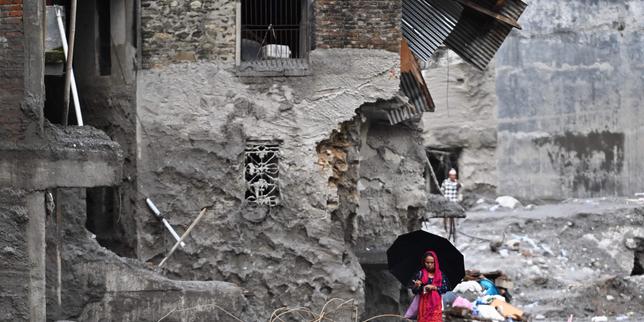
Search parties move through the sludge with long iron poles, probing the gray muck where houses used to stand. Helicopters thrash the thin air, their rotor wash sending up spray from temporary lakes formed behind natural landslide dams—dams that might hold, or might burst at any second, sending a second wave down upon the rescuers.
This is where the true weight of the disaster lives. It is not just in the death toll, though 1,000 lives extinguished in a matter of days is a wound that will bleed for generations. It is in the severance of memory. When a flash flood takes a village, it takes the ancient irrigation channels, the sacred stones, the oral histories passed down by the fire, the graveyards of ancestors. It leaves behind a moonscape of gray silt where nothing can grow and nowhere is safe to build.
Down in the valleys, the survivors huddle under blue plastic tarpaulins provided by relief agencies. They drink water that tastes of chlorine and fear. They look up at the towering, beautiful, indifferent peaks that framed every sunrise of their lives, and they feel a new emotion: betrayal.
The mountains were supposed to be eternal. The stone was supposed to stand.
We look at these tragedies from behind our screens, scrolling through satellite before-and-after sliders that make whole river valleys look like they've been wiped clean by an eraser. We feel a brief, sharp pang of pity. We click a heart. We swipe to the next story.
But the people of the high valleys cannot swipe away the mud. They are left to figure out how to farm on slopes that have become glass slides of shale. They are left to bury their dead in communal graves because individual shrines were washed down to the plains of India.
The air grows colder as autumn creeps down the passes. The monsoon retreats, leaving behind a scarred earth and a silence so deep it feels like waiting. High above the timberline, the wind whips across the snowfields, whistling through empty valleys where the smoke of hearth fires used to rise against the dusk. The mountain does not remember the village. But the village remembers the mountain.