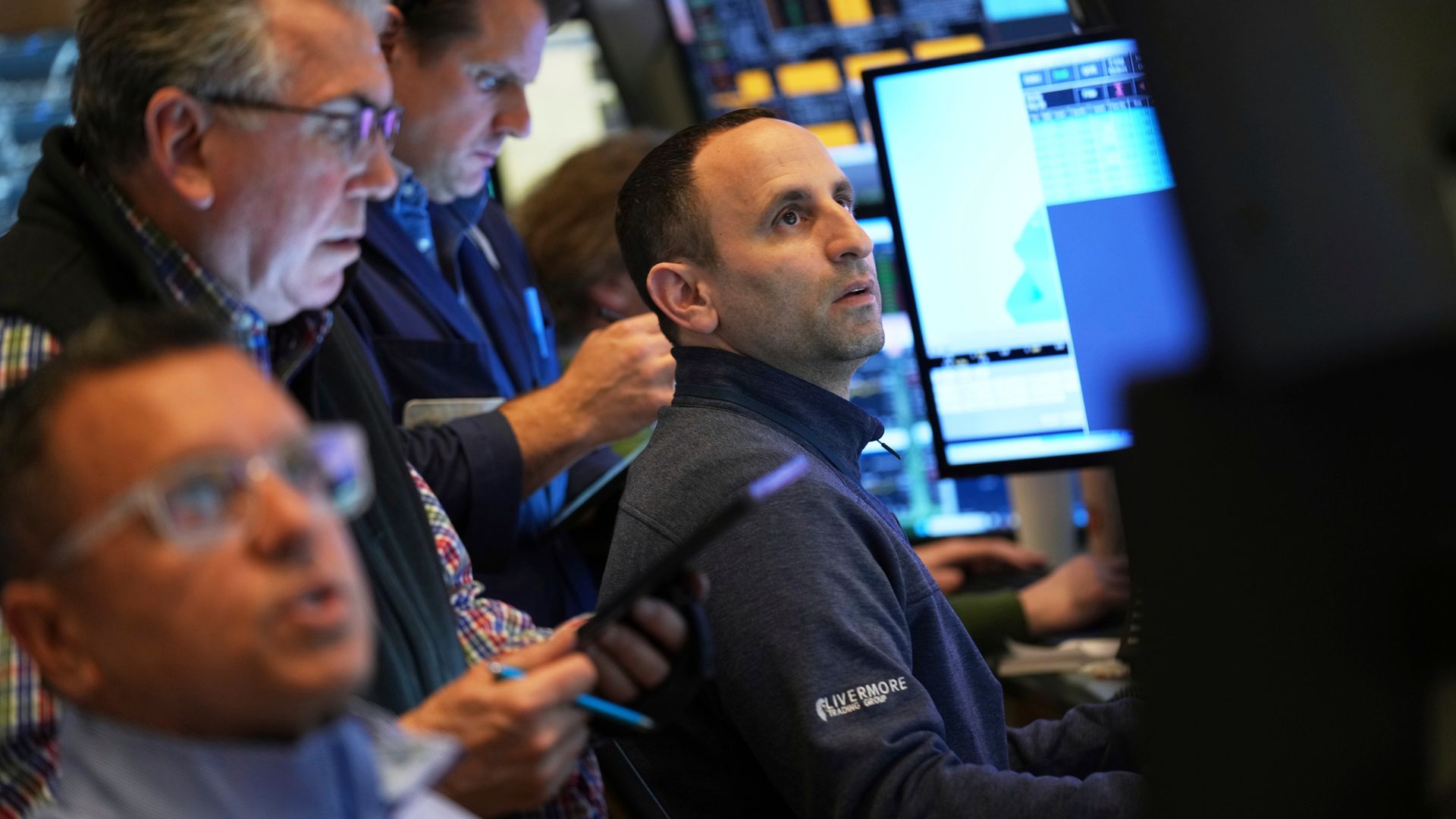
Coffee cups sat half-full across trading desks from London to New York, growing cold while their owners stared past their monitors. The screens were bleeding red.
Markets do not care about poetry. They care about velocity, margins, and the cold geometry of supply and demand. On a Tuesday that started like any other, the global stock market rout hit the tech sector with the force of a falling anvil. Among the casualties was Anthropic, a name whispered in research labs and venture capital boardrooms as a titan of modern computing intelligence. When the sell-off came, it did not discriminate between the legacy giants and the new emperors of artificial intelligence. Meanwhile, you can explore other events here: The Hidden Cost of Silicon Valley's Favorite Leather Jacket.
Panic is rarely logical. It is contagious.
Consider a hypothetical portfolio manager named Sarah, sitting on the forty-second floor of a glass tower in Manhattan. For two years, she watched artificial intelligence stocks climb an apparently endless staircase. She poured capital into the sector not out of reckless abandon, but because every metric pointed upward. Efficiency gains were real. Revenue projections were staggering. Then came the macro squeeze—rising interest rates, tightening liquidity, and a sudden, collective awakening by institutional investors that trees do not grow to the sky. To explore the complete picture, check out the excellent article by Bloomberg.
When the correction hit, Sarah did not analyze individual balance sheets line by line. She hit sell. Everyone hit sell.
Anthropic found itself swept up in this broader market tide. The company builds frontier models, systems designed to reason, code, and analyze at scales that redefine productivity. But in a liquidity crunch, future promises are heavily discounted against present pain. Investors who had been paying premium multiples for high-growth, high-burn startups suddenly wanted cash in hand. The stock market rout was a reckoning with gravity.
Markets are emotional thermometers disguised as math equations.
To understand why a company like Anthropic feels the shockwaves of a global sell-off, we have to look past the ticker symbols and examine how risk is priced in modern finance. Imagine a crowded theater. Everyone is enjoying the performance. Someone smells smoke—perhaps a false alarm, perhaps a genuine threat—and heads for the nearest exit. The stampede is driven by the fear of being last, not by the fire itself.
Global markets operate on the exact same psychological architecture. When inflation ticks up or central banks signal tighter monetary policy, risk assets are the first to be jettisoned. High-valuation technology firms, regardless of their breakthrough research or market adoption, live in the crosshairs of macroeconomics.
Money is expensive now. The era of cheap capital, where venture dollars flowed like water into any enterprise with an ambitious slide deck, is over. Companies are being forced to prove their unit economics. Can they turn computational power into durable revenue? Can they scale without burning through billions in compute costs every quarter?
These are not theoretical questions. They are survival metrics.
Yet, looking only at the red numbers on a trading terminal misses the deeper undercurrent. Corrections have a way of clearing out the noise. During speculative bubbles, substance and hype look identical from a distance. Both command astronomical valuations. Both attract speculative capital. When the tide goes out, the shallow water disappears.
What remains is the work.
In research facilities, engineers do not pack up their keyboards just because a macroeconomic indicator shifted in Frankfurt or Washington. The fundamental capabilities of large-scale machine learning are not diminished by a downward tick in equity indices. If anything, the pressure intensifies. When capital is scarce, efficiency becomes the ultimate competitive advantage. The winners of the next phase will not be the ones who spend the most, but the ones who solve the hardest problems with the leanest architecture.
The market rout was painful. For founders, employees holding stock options, and institutional investors watching billions evaporate on paper, the correction felt like a physical blow. But markets have memories like sieges and horizons like oceans. They overcorrect on the way down just as enthusiastically as they overcorrect on the way up.
The screen flickers. The numbers change color. Somewhere in the quiet hum of a server farm, millions of parameters adjust in fractions of a second, processing data completely indifferent to the panic unfolding miles above. The storm passes, leaving behind a colder, sharper reality where only substance endures.