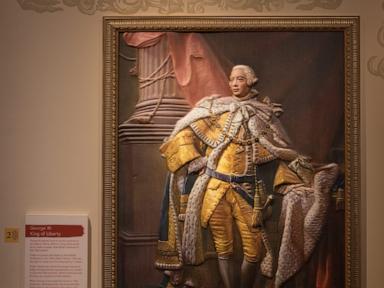
Walk into any American classroom, and the villain is always the same. He is a caricature of tyrannical madness, a man who allegedly talked to his oak trees, bled blue blood, and tore a continent apart because he couldn't bear the thought of losing a few pennies on tea. We know him as King George III. For two and a half centuries, his name has been shorthand for the dark, suffocating weight of monarchy—the perfect foil to the pristine, freedom-loving heroes who forged the United States.
But step inside the quiet, temperature-controlled reading rooms of the Royal Archives at Windsor Castle, and that cartoon villain evaporates.
The air in Windsor smells faintly of old calfskin and centuries of trapped dust. To turn the pages of George III’s personal correspondence is to feel an uncomfortable prickle of recognition. Here is a man who kept meticulous, almost obsessive ledgers of his family’s daily expenses. Here is a king who wrote essays on agriculture under a pen name because he genuinely cared about the crop yields of ordinary farmers. Here is a father agonizing over his children's illnesses.
We built an entire national identity on the idea that George III was a monster. What happens when we discover he was just a man?
As America approaches its 250th anniversary, a quiet revolution is happening among historians. Millions of pages of the Georgian Papers—previously locked away from public view—have been digitized. The portrait emerging from these ink-stained sheets isn't a manifesto of tyranny. It is a tragedy of a leader trapped in a system he didn't create, dealing with a crisis he couldn't possibly understand.
The Myth of the Mad Tyrant
Every great story requires a great antagonist. When Thomas Jefferson sat down in a humid Philadelphia boarding house in June 1776 to write the Declaration of Independence, he knew exactly what he was doing. He didn’t target the British Parliament, which was actually responsible for the taxation policies that enraged the colonies. Parliament was an abstract body of elected politicians. Abstract bodies don't make for good villains.
Instead, Jefferson pointed his pen directly at the Crown. He crafted a masterclass in political character assassination, listing twenty-seven specific grievances, pinning every single one of them on the man wearing the coronation robes.
George became the tyrant who had "plundered our seas, ravaged our coasts, burnt our towns, and destroyed the lives of our people."
It was brilliant propaganda. It was also a massive distortion of how the British government actually functioned.
By 1776, Britain was not an absolute monarchy. The King could not simply decree taxes or send armies on a whim. He was a constitutional monarch, bound by the decisions of Parliament. In reality, George III was often a stabilizing force, trying to navigate the chaotic factionalism of British politics. He didn't invent the Stamp Act or the Townshend Acts; he merely signed the legislation put forward by his prime ministers.
To understand the real George, look at his handwriting. In the early days of his reign, the script is elegant, measured, and precise. He was an Enlightenment prince. He funded the arts, built a massive library, and was the first British monarch to study science seriously. He commissioned the world's most advanced telescopes. This was not a man eager to crush human progress under a royal boot. He was a man obsessed with order, duty, and the rule of law.
Then the American crisis hit, and the ink began to smear.
A Communication Breakdown Across an Ocean
Imagine trying to run a global enterprise where every memo takes six weeks to cross the Atlantic on a wooden ship, tossed by storms and subject to piracy. That was the reality of the British Empire in the late eighteenth century.
Consider the sheer psychological distance between London and Boston. To the colonists, British troops were an occupying force, a visible symbol of oppression. To King George, those troops were a defensive shield. Britain had just spent a fortune defending those same colonies from the French during the Seven Years' War. The British national debt had skyrocketed. From the perspective of the royal ledger, asking the colonists to pay a small fraction of the cost for their own ongoing defense wasn't tyranny. It was basic fairness.
The letters from this period reveal a King who was profoundly out of touch, not out of malice, but out of structural isolation. He received reports from colonial governors who were terrified, incompetent, or both. They painted a picture of a small, radical mob terrorizing loyal British subjects in America.
George believed them. He viewed the unrest not as a legitimate movement for self-determination, but as a law-and-order crisis. It was a riot that needed to be quelled for the good of the empire.
There is a poignant moment in the archives, a draft of a speech George prepared but never delivered. In the margins, you can see his corrections, his frantic attempts to find words that would make his American subjects understand that he viewed them as his children. He genuinely believed that if he gave in to their demands, the entire empire would collapse into anarchy, destroying the prosperity of British citizens on both sides of the ocean.
He wasn't fighting to enslave America. He was fighting to preserve what he believed was the most perfect system of liberty the world had ever seen: the British Constitution.
The Breaking Point
The narrative of the mad king usually links his mental illness directly to his political failures. We’ve been told that his madness caused the war, or that losing America drove him insane. The timeline says otherwise.
The physical and mental collapse that defined George's later years—now widely believed by medical historians to have been porphyria, a genetic blood disorder, or perhaps severe bipolar disorder—did not hit its first major crisis until 1788. That was five years after the Treaty of Paris recognized American independence.
During the war itself, George was acutely sane, and that sanity made the defeat all the more agonizing.
When the news reached London in November 1781 that Lord Cornwallis had surrendered at Yorktown, the British political establishment collapsed. The Prime Minister, Lord North, reportedly took the news "as he would have taken a ball in the breast," pacing up and down his room, crying out, "Oh God! It is all over!"
But George refused to break. He insisted on continuing the fight. Not because he was bloodthirsty, but because he could not conceive of a world where his kingdom was fractured. He truly believed he had a divine and constitutional duty to pass the empire down to his heirs intact. To lose America was to fail God, country, and history.
When he finally realized that his parliament would no longer fund the war, George sat down at his desk and drafted an abdication speech.
The document still exists. The ink is heavy. The handwriting, usually so controlled, falters. He wrote that he was ready to step down from the throne and leave Britain forever, retiring to his ancestral lands in Germany, because he could not bear to preside over the dismemberment of his realm.
He never delivered the speech. His ministers talked him off the ledge. He stayed, swallowed his pride, and did the hardest thing a king can do: he accepted defeat.
The Grace of the Defeated
The true measure of George III’s character didn't happen during the war, but in its quiet aftermath.
In June 1785, John Adams arrived at St. James’s Palace. He was the first official ambassador from the newly independent United States of America. A few years prior, Adams had been a rebel with a price on his head; George had been the monarch who ordered his capture.
The room was small. The tension was suffocating. Adams was visibly nervous, his voice shaking slightly as he delivered his prepared remarks, expressing a desire for friendship between the two nations.
George listened intently. When Adams finished, the King spoke. His response should be required reading in every history classroom.
"I was the last to consent to the separation," George said, his voice steady but filled with emotion. "But the separation having been made and having become inevitable, I have always said, as I say now, that I would be the first to meet the friendship of the United States as an independent power."
It was a stunning act of political magnanimity. In that single moment, the "tyrant" of the Declaration of Independence showed more grace, dignity, and commitment to peaceful diplomacy than his American detractors had ever given him credit for. He accepted the new reality, not with bitterness, but with a profound sense of realism.
Why the Truth Matters Now
History is not a statue carved in marble; it is a living conversation. For two and a half centuries, Americans have needed George III to be a monster. We needed him to be cruel so that our rebellion could be righteous. We needed him to be mad so that our system could be sane.
But as we look across the current landscape of our own democracy, fractured by intense polarization and competing versions of the truth, that simplistic narrative feels less useful than it used to.
Nuance is not a betrayal of the American experiment. Acknowledging that George III was a decent man caught in an impossible historical vice doesn't diminish the achievement of Washington, Jefferson, or Adams. If anything, it makes their victory more compelling. They didn't defeat a comic-book villain; they defeated a global superpower led by a deeply dedicated, highly capable, and stubbornly principled sovereign.
When the celebrations for the 250th anniversary begin, there will be fireworks, reenactments, and speeches about liberty. That is as it should be. But perhaps, in a quiet moment, we can also remember the lonely man in Windsor Castle, staring at his maps, wondering how a people he thought were his children had grown up so fast, and so completely out of his reach.