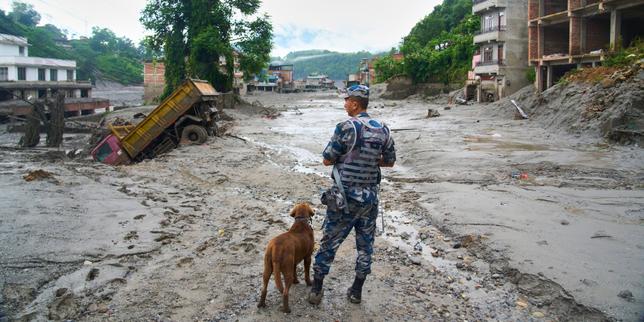
The monsoon does not negotiate. When torrential downpours battered the Himalayas, the resulting disaster bypassed standard diplomatic channels and administrative warning systems with brutal efficiency. Official tallies from the police in Nepal confirmed a rising death toll reaching 389 fatalities, while diplomatic wires from the United States State Department revealed an alarming secondary crisis involving ninety missing American citizens stranded or unaccounted for in remote Tibetan and Nepalese valleys.
Disaster reporting usually stops at the body count. It treats the deluge as an act of meteorological cruelty, a tragic roll of the dice dictated by erratic weather patterns and climate anomalies. That framing is a convenient fiction. What occurred across the roof of the world was an institutional failure years in the making. Infrastructure expansion outpaced environmental safety, early warning protocols broke down across international borders, and thousands of travelers walked straight into a valley-wide trap because regional authorities failed to share real-time hydrological data.
The Anatomy of a Himalayan Cascade
Water moves fast when gravity is your enemy. The geography of the region guarantees that heavy precipitation triggers immediate, violent runoff. Rivers swell into destructive torrents within hours, taking out bridges, roads, and communication lines before evacuation orders can be issued.
When the skies opened, the geography turned against the population. Steep mountain slopes stripped of vegetation by rapid commercial development offered zero resistance to the sheer volume of water. Landslides choked narrow river valleys, creating temporary natural dams. When those dams inevitably breached, downstream settlements faced walls of water and debris moving at terrifying speeds.
Yet, nature was only half the culprit. Human decisions amplified the catastrophe. Roads cut into unstable hillsides acted as makeshift chutes, channeling mud straight into villages and tourist outposts. Hydropower projects scattered across the region altered natural flow rates and trapped debris, worsening the impact of the sudden surge.
Blind Spots in Diplomatic Dispatches
The involvement of foreign governments added a stark geopolitical layer to the humanitarian emergency. When the United States State Department confirmed that nearly a hundred of its nationals were missing, it exposed a glaring vulnerability in modern adventure tourism.
Thousands of trekkers and backpackers flock to the Annapurna and Everest regions every autumn, chasing solitude and scenic majesty. They rely on local trekking agencies, satellite messengers, and sporadic cellular coverage. When regional telecommunications systems collapsed under the weight of the storm, these independent travelers vanished into a data blackout.
Local rescue infrastructure was instantly overwhelmed. Emergency services in Nepal operate on thin margins during the best of times. They rely on a patchwork of private helicopter companies, overworked military pilots, and volunteer ground crews. Facing hundreds of simultaneous distress calls across rugged terrain, rescue coordinators had to make impossible choices. Foreign nationals stranded in high-altitude tea houses found themselves competing with local villagers for scarce airlift capacity.
Diplomatic pressure from Washington and other foreign capitals forced an expedited allocation of search-and-rescue assets. This dynamic created friction on the ground. Wealthy tourists with insurance policies capable of funding private helicopter extractions occasionally bypassed official triage queues, diverting resources away from devastated rural communities where entire families remained buried under tons of rock and mud.
The Regional Data Void
You cannot fight a flood without knowing it is coming. The most damning aspect of this disaster is not the rain itself, but the complete absence of effective transboundary warning systems.
Weather systems do not respect national borders. Storms gathering over the Tibetan Plateau sweep down into the Nepalese river basins with total disregard for geopolitical demarcations. For years, hydrologists and disaster management experts have pushed for integrated data-sharing agreements between China, Nepal, and India.
Progress has been painfully slow. Bureaucratic inertia, territorial sensitivities, and a lack of mutual trust have kept crucial river-gauge data trapped behind political walls. If upstream sensors in Tibet detect a dangerous rise in water levels, that information must travel through diplomatic channels before reaching downstream communities in Nepal. By the time the bureaucratic machinery grinds into motion, the water has already arrived.
Independent experts have warned about this data gap for decades. Without automated, real-time sharing of hydrological metrics, early warning systems are little more than theoretical exercises on paper.
Re-Engineering Mountain Resilience
Fixing this vulnerability requires dismantling how we approach disaster risk reduction in high-altitude developing nations. Throwing emergency aid at a crisis after the fact is an expensive, inefficient band-aid.
Infrastructure standards must change. Building codes in the Himalayas need a radical overhaul to account for extreme weather events that were once considered hundred-year anomalies but now occur with alarming frequency. Roads must be engineered with proper drainage that does not destabilize surrounding slopes. Hydropower facilities must incorporate ecological flow models that account for sudden sediment loads.
Tourism models also require a reckoning. The unchecked promotion of remote trekking routes without mandatory registration, mandatory satellite tracking, and strict seasonal cutoffs invites disaster. Tour operators must be held to higher safety standards, with legal liability for failing to pull clients out of hazardous zones when early warnings flash red.
The dead cannot be brought back, and the missing will likely remain statistics of a broken system. Unless the nations sharing the Himalayan watershed bridge their political divides to build an integrated, automated flood alert network, the next monsoon will simply repeat the cycle on an even larger scale.


