The Mediterranean does not care about horsepower. From the cockpit of a Formula 1 car, the water is just a blinding flash of turquoise seen sideways through a visor at a hundred and sixty miles per hour. It blurs past the yachts, past the marble balconies, and past the Armco barriers that sit exactly three inches from your front tire.
Monaco is an anachronism. It is a geographic impossibility converted into a racetrack, a place where modern physics goes to suffer. To drive a contemporary Grand Prix car here is like trying to fly a fighter jet through a supermarket. Meanwhile, you can read related developments here: The Weight of the Horizon Below the Sahara.
Every driver knows the equation. The tarmac is polished, slick with the grease of everyday road traffic, and unforgivingly narrow. There are no run-off areas. No gravel traps to cushion a mistake. There is only the concrete, the steel, and the absolute certainty that a lapse in concentration lasting a fraction of a heartbeat will destroy a forty-million-dollar machine.
For years, Max Verstappen owned this tension. He thrived on it. The reigning world champion operates with a robotic, terrifying precision, turning the chaotic streets of the Principality into a personal laboratory of speed. When he goes out for a final qualifying lap, the garage holds its breath because everyone knows what happens next. He squeezes the life out of the stopwatch. He takes the pole position. It is what he does. To understand the bigger picture, we recommend the recent report by Yahoo Sports.
Until a teenager from Bologna decided that history was overrated.
The Weight of the Garage
To understand the sheer absurdity of what happened in Monte Carlo, you have to understand the silence of a garage before the final run of Q3.
The mechanics do not speak. They move with the synchronized, quiet urgency of trauma surgeons. The tires sit in their electric blankets, cooking at exactly eighty degrees Celsius. On the telemetry screens, lines of data cascade downward in a neon waterfall, mapping throttle inputs, brake pressures, and tire degradation.
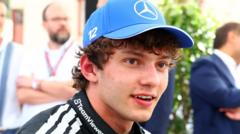
Kimi Antonelli sat in his car, surrounded by this pressurized quiet. He is nineteen years old. A rookie. A kid who, just a year ago, was racing in junior categories where the crowds were small enough to hear individual engine notes. Now, he was wearing the overalls of a legendary team, tasked with filling shoes that felt impossibly large.
The pressure on a young driver in Formula 1 is not abstract. It is physical. It is a tightening in the chest, a dryness in the mouth, and the knowledge that fifty million people are watching your steering wheel inputs in high definition. Every mistake is meme-fied. Every slow lap is dissected by pundits who were winning championships before you were born.
Across the pit lane sat Verstappen. Calm. Imposing. A three-time champion whose Red Bull car looked less like a mechanical vehicle and more like an extension of his own nervous system. Verstappen had already set a time that looked unassailable. It was a lap built on brute force and flawless geometry, a benchmark that screamed to the rest of the grid: Don't bother.
Antonelli looked at the screens. He was down. Not by much, but in Monaco, a tenth of a second is an eternity. It is the distance between glory and the second row of the grid, which, on a track where overtaking is practically illegal, means the difference between a trophy and disappointment.
The Chemistry of Risk
What goes through a human brain when it decides to bypass the survival instinct?
As a driver approaches the Swimming Pool chicane—a blind, high-speed S-bend flanked by solid curbs and iron rails—every nerve ending screams to lift off the throttle. The human body evolved to run, to climb, to hunt. It did not evolve to travel sideways at triple-digit speeds toward a swimming pool built for billionaires.
Consider the mechanics of a "magic lap." It is a driver's term for a performance that defies the engineering simulations. The engineers run thousands of computer models before the weekend. They know precisely how fast the car can theoretically go based on downforce, grip, and atmospheric pressure. They print out a number.
A magic lap happens when a driver looks at that theoretical limit, smiles, and steps over it.
Antonelli left the pit lane for his final attempt with less than two minutes on the clock. The track was at its absolute peak. The sticky rubber from twenty cars had baked into the asphalt, creating a narrow strip of high-traction black gold. But the air temperature was dropping as the sun dipped behind the Monégasque hills, throwing long, deceptive shadows across the entry to the turns.
Through Saint Devote, the first corner, the Italian rookie was aggressive. The car danced. A Formula 1 car is designed to be stable, but to extract the final drop of performance, you must set it up on a knife-edge. It wants to spin. It wants to swap ends. Antonelli caught the slide with a microscopic correction—a twitch of the wrists so fast it looked like an electric shock.
He carried the speed up the hill toward the Casino. This is where Monaco punishes the hesitant. The road crowns in the middle, meaning the car becomes light, almost airborne, just as you need to throw it into a blind left-hander.
The Ghosts of Sainte Devote
Every sport has its sacred ground, but Monaco is a graveyard of reputations.
Senna crashed here while leading by fifty seconds because he lost focus for a single corner. Schumacher parked his car at Rascasse in a desperate, dark-arts attempt to block his rivals. The walls are stained with the paint of a thousand broken suspension arms.
As Antonelli flew past the grandstands, the telemetry in the Mercedes garage showed something strange. He wasn't braking where the simulator said he should. He was holding the throttle open for five, ten, fifteen meters longer than anyone else dared.
It looked like madness. To the casual observer, it looked like a young driver overdriving, letting adrenaline override intellect. But if you looked closer, at the onboard camera, his inputs were eerily smooth. There was no sawing at the wheel. No panicked stabs at the pedal. He was operating in that rare, terrifying state of flow where the speed of the world slows down to match the speed of the mind.
Verstappen was already on his cool-down lap, watching the big screens around the circuit. He saw the purple mini-sectors lighting up next to the number 12.
The Dutchman’s lap had been a masterpiece of control. But Antonelli was producing a masterpiece of violence.
Through the tunnel, the loudest section of the track, the V6 turbo hybrid engine howled against the concrete walls. The noise is deafening, a physical pressure that rattles the ribcage. Drivers exit the darkness of the tunnel into the blinding glare of the harbor side, their pupils struggling to dilate fast enough to catch the braking point for the Nouvelle Chicane.
Antonelli didn't blink. He clipped the barrier on the inside of the chicane. Not hard enough to break the carbon fiber, but close enough to leave a microscopic smear of Pirelli rubber on the steel.
The Final Twelve Hundredths
The final sector of Monaco is a claustrophobic nightmare. Rascasse and Anthony Noghes—two corners that require the driver to hook the car around tight, low-speed apexes while the rear tires try to break traction and send the vehicle into the pit wall.
This is where championships are lost. The tires are boiling by this point in the lap. The surface scale temperature can reach over a hundred and twenty degrees, turning the grippy compound into something resembling warm chewing gum. The car slides. The driver must treat the throttle like a trigger on a landmine.
Antonelli threw the car into Rascasse with an audacity that made his team principal flinch on the pit wall. The rear end broke away. For a fraction of a second, the lap was over. The car was heading for the barrier.
Instead of slamming on the brakes—the human response—Antonelli kept his foot pinned. He used the wheel to guide the slide, using the momentum to rotate the car around the apex faster than the physics textbook allowed. It was a gamble that required absolute trust in his own hands.
He crossed the line.
The digital clock on the gantry flashed. The numbers settled.
One minute, ten point one-six-six.
A mere twelve hundredths of a second faster than Max Verstappen.
The Mercedes garage erupted. It wasn't the polite, measured clapping of corporate executives; it was the raw, shouting relief of mechanics who had just witnessed someone walk a tightrope across a canyon without a net.
The View from the Top
In the pit lane, Antonelli climbed out of the cockpit. He stood on the nose of his car, his hands raised, looking slightly dazed by the noise. The Monégasque crowd, usually a cynical bunch wrapped in linen shirts and designer sunglasses, was on its feet.
A few feet away, Verstappen walked over. The champion looked at the young Italian, nodded, and offered a brief, respectful handshake. There was no anger in the Dutchman's eyes, only the grim acknowledgment of a predator recognizing another predator. Verstappen knew better than anyone what that lap had required. He had checked the telemetry. He knew where those twelve hundredths had been found—in the places where the walls are closest and the risks are highest.
The paddock will spend the evening analyzing the data. They will talk about tire preparation, track evolution, and aerodynamic efficiency. They will try to turn an act of pure, human defiance into a series of neat spreadsheets.
But the telemetry cannot capture the feeling in the cockpit. It cannot measure the heartbeat that spikes to one hundred and ninety beats per minute, or the cold sweat that pools at the small of a driver's back when they realize they are traveling too fast to survive a mistake.
Tomorrow is the race. Seventy-eight laps of monotonous, grueling tension where the walls do not move and the pressure never stops. The points are scored on Sunday, and pole position is merely an invitation to the hardest afternoon of a driver’s life.
But for one Saturday afternoon in May, the hierarchy of the sport shifted. A kid from Italy looked at the most formidable driver of a generation, looked at the most dangerous circuit on earth, and decided that the simulator was wrong.
As the sun finally dropped behind the casino, casting the paddock into shadow, the Mercedes mechanics were still wiping down the car. On the right front wheel rim, there was a thin, bright silver scrape where the paint had been shaved off by the steel barrier at Rascasse. It was less than a millimeter deep. The exact width of a miracle.


