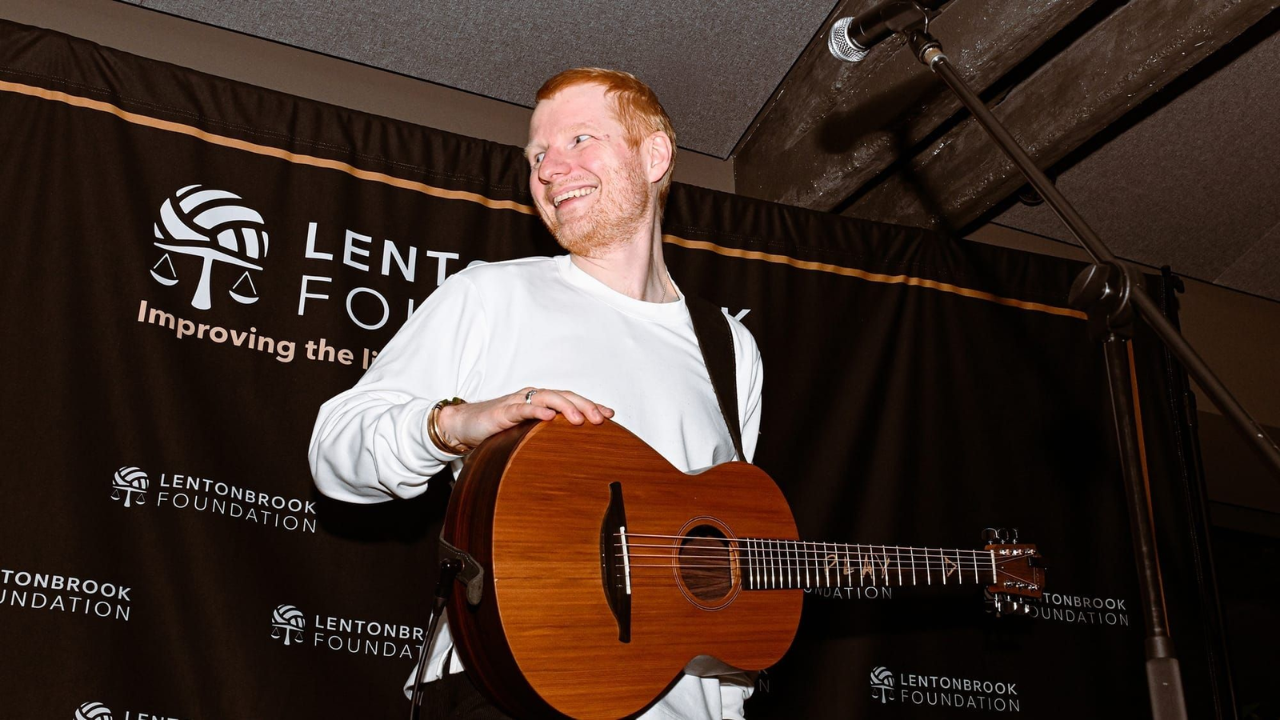
The bassline in a Manhattan ballroom hits differently when you know what a heating bill feels like in February.
Picture a room in New York City—not the neon chaos of Times Square, nor the sterile glass canyons of Midtown, but one of those hushed, mahogany-paneled spaces where the air smells faintly of expensive Pinot Noir and laundered linen. In these rooms, money moves quietly. A nod from a corner table buys a table for ten; a raised paddle covers a year’s tuition at a boarding school. Into this rarefied oxygen steps Ed Sheeran, carrying nothing heavier than a battered acoustic guitar and the kind of unassuming posture that makes him look less like a billionaire stadium-filler and more like a bloke who just wandered in from the rain to fix the radiator. You might also find this related story interesting: The Heavy Silence Across the Pacific and the Unraveling of the Markle Name.
He plays. The room listens. By the time the last chord of "Thinking Out Loud" dissolves into the polite clatter of dessert forks, the tally hits $1 million.
If you read the standard wire reports—the ones churned out in thirty seconds by tired desks between stock tickers and red-carpet roundups—the story ends right there. Pop star plays charity gig. Rich people open wallets. Big round number achieved. It reads like a press release, neat and bloodless. As discussed in recent articles by Reuters, the results are widespread.
It also misses the entire point.
To understand why that million dollars matters, you have to leave the island of Manhattan, cross three thousand miles of gray Atlantic water, and step off a slow train onto a windswept platform in Suffolk, England.
The Postcode Lottery Nobody Talks About
Most Americans who know Suffolk at all know it through a soft-focus lens. They picture Constable paintings—lush green water meadows, sleepy thatched cottages, hay wains creaking down dirt lanes under towering cumulus clouds. Or they know it as the playground of London’s weekenders, who drive up the A12 on Friday afternoons to eat oysters in Aldeburgh and walk their Labradors along the shingle beaches of Southwold.
That Suffolk exists. I have walked those beaches, felt the North Sea wind turn my ears to ice, and watched the light hit the flint walls of medieval churches in a way that makes you understand why painters never wanted to leave.
There is another Suffolk, though. You find it ten miles inland, or tucked behind the shuttered arcades of coastal towns like Lowestoft and Jaywick just down the coast, where the seasonal tourism dries up every October like a receding tide, leaving behind damp council flats, zero-hour contracts, and bus routes that stop running at six in the evening.
Poverty in a big city is loud and visible; it crowds the subway grates and shouts on street corners. Rural poverty is quiet. It hides behind drawn curtains in villages where the local post office closed a decade ago and the nearest youth club is a forty-minute ride away—if you have the three pounds fifty for the bus fare.
Consider a hypothetical teenager—let’s call him Leo—growing up in a terraced house on the outskirts of Ipswich. Leo isn't starving in the way television charity appeals show you. He has a roof over his head and a secondhand phone with a cracked screen. What Leo lacks is oxygen—the invisible kind that comes from opportunity. When his school’s music department cuts its budget because the roof needs patching, Leo doesn't get to try a trumpet or learn how a loop pedal works. When his mum has to choose between topping up the prepayment electric meter and paying for his football boots, Leo quits the team. Slowly, almost imperceptibly, the walls of Leo’s world inch inward until the horizon shrinks to the end of his street.
According to data from the End Child Poverty coalition and local Suffolk community trusts, tens of thousands of children across the county live below the poverty line after housing costs. In some pockets of Ipswich and coastal Waveney, more than a third of kids are growing up in households where a single broken washing machine triggers a financial crisis.
This is the invisible ledger behind a New York gala.
Why a Guitar in Manhattan Changes a Classroom in Framlingham
You might wonder why an English singer had to fly across an ocean to raise money for kids in his own backyard. Fair question. At first glance, the geography seems absurd. Why not play a benefit at Ipswich Town’s Portman Road stadium—the very club Sheeran sponsors and loves with the obsessive devotion of a lifelong supporter—and pass the bucket around East Anglia?
The answer comes down to simple, brutal economics—the kind every charity director learns during their first winter on the job.
Think of fundraising like fishing. You can cast a net in a pond where everyone already knows your name, or you can take your boat out to the deep water where the whales swim. Local generosity in Suffolk is fierce; neighbors bake cakes, run half-marathons in the drizzle, and drop pound coins into tins at the pub bar. That community grit keeps food banks stocked and hospice nurses on the road. Yet you cannot squeeze a million pounds in a single evening out of a region where median wages lag behind the national average and public services are already stretched thin.
New York, by contrast, is the global capital of concentrated capital. In a single Manhattan dining room, you can assemble two hundred people whose collective net worth rivals the GDP of a small nation. For many of them, a $25,000 table is a rounding error on a quarterly tax estimate.
Sheeran understands this asymmetry intuitively. He has spent fifteen years turning himself from a teenager sleeping on friends' sofas in London into one of the most bankable live acts on earth, and he has never once pretended to forget where he came from. He grew up in Framlingham, a market town in Suffolk where the castle ruins sit quietly above a mere of reeds and ducks, and where his parents—an art lecturer and a jewelry designer—taught him that community isn't an abstract civic virtue; it’s the people who live three doors down.
When Sheeran walks into a New York fundraiser, he isn't selling luxury. He is acting as a human currency converter. He takes his global fame—minted in stadiums from Melbourne to Mexico City—and trades it for American philanthropy, routing the proceeds straight back into the soil that raised him.
The Anatomy of a Million Dollars
Numbers that big tend to go numb in our heads. A million dollars sounds like a movie ransom or a lottery jackpot—something shiny and abstract. Break it down into the currency of a disadvantaged child’s Tuesday afternoon, however, and the abstraction sharpens into focus.
In the UK, once converted to pounds and distributed through grassroots children’s charities and youth foundations—like the Suffolk Community Foundation and local arts, sports, and mental health initiatives Sheeran has quietly backed for years—that sum doesn't disappear into glossy administrative brochures. Grassroots organizations in East Anglia run on shoestring budgets. A single full-time youth worker costs roughly £30,000 to £35,000 a year. A community music program offering free studio access and instruments to eighty kids in a deprived ward might cost £15,000 for twelve months.
Do the math.
One night in New York pays for:
- Twenty-five years’ worth of dedicated youth mentorship in neighborhoods where adult role models are scarce.
- Thousands of hot meals served during school holidays, when free school lunches vanish and family pantries go bare.
- Hundreds of musical instruments, sports kits, and mental health counseling sessions for teenagers sitting on eighteen-month NHS waiting lists.
That is the hidden alchemy of the event. A song written in a bedroom in Suffolk travels around the world, gets sung to strangers in Manhattan tuxedos, and returns home as a warm coat, a violin bow, or a safe room with a light on after dark.
The Quiet Rebellion Against Celebrity Cynicism
We live in an era deeply suspicious of celebrity charity, and frankly, we have earned our cynicism. We have seen too many A-listers lecture the public from private jets, too many vanity foundations that spend seventy cents of every dollar on gala centerpieces and executive salaries, too many tearful Instagram videos filmed from marble bathrooms.
It is easy—almost fashionable—to lump every star-studded benefit into the same bucket of performative PR. I used to feel that reflex myself every time a glossy photo hit my feed showing celebrities clinking champagne glasses "for the children." There is an undeniable dissonance in watching people eat three-course meals to fight hunger.
Yet dismissing every fundraiser on aesthetic grounds is a luxury that hungry kids cannot afford. The test of charity isn't whether the room looks humble; it’s whether the money arrives clean, fast, and without strings attached.
Look at Sheeran’s track record in Suffolk over the last decade, and a very different pattern emerges. He didn't slap his face on a billboard campaign or launch a self-branded global empire. Instead, he funded a music hub at his old school, Thomas Mills High, so students could access recording equipment and instruments regardless of their parents' income. He donated hundreds of thousands of pounds to East Anglia’s Children’s Hospices. During the pandemic, when local hospital wards and youth charities were hemorrhaging cash, his donations landed quietly in bank accounts before the press even knew a check had been written.
There is no ego in how he moves at home. Visitors to Framlingham still spot him queuing at the local chip shop or drinking a pint at the Station Hotel without a phalanx of bodyguards. When you remain woven into the daily fabric of a small town, poverty isn't a statistic you read in a briefing binder. It’s the kid whose mum works the checkout at the Co-op. It’s the empty shopfront on the high street that used to be a bakery.
What Happens When the Spotlight Moves On
The danger with any headline-grabbing donation is the illusion of "problem solved." Readers see the million-dollar figure, feel a brief, pleasant glow of vicarious generosity, and scroll on to the next story. Meanwhile, the structural engines creating child poverty in Britain—stagnant wages, crumbling local council budgets, soaring housing costs—keep grinding away the next morning.
A million dollars will not fix the British welfare state. It won't rebuild rural bus networks or reverse fifteen years of austerity in English local government. Anyone pretending otherwise is selling fairy tales.
What it does do is buy time and dignity for the kids caught in the gears right now. Childhood doesn't wait for parliamentary committees or five-year economic recovery plans. A ten-year-old who misses out on music, sport, or emotional support today doesn't get a do-over at twenty-five. The window opens once, stays open for a few brief, messy years, and then shuts.
Consider our hypothetical teenager Leo in Ipswich again. Nobody is handing him a mansion or a record deal. Maybe all that Manhattan money buys him is a Tuesday evening session at a community studio, a working amplifier, and a youth worker who notices when he shows up angry and asks him what’s wrong instead of kicking him out. Maybe Leo never writes a hit song. Maybe he becomes an electrician, a nurse, or a dad who knows how to listen to his own kids because someone once listened to him.
You cannot put that return on investment onto a gala balance sheet. It doesn't fit neatly into a wire-service headline.
The ballroom in New York is empty now. The waiters have cleared the glasses, the donors have gone back to their brownstones and penthouses, and Ed Sheeran has packed his battered guitar back into its case. Three thousand miles east, across a dark ocean, a coastal wind is rattling the windows of a row of terraced houses in Suffolk—and somewhere inside, a light stays on a little longer than it did yesterday.