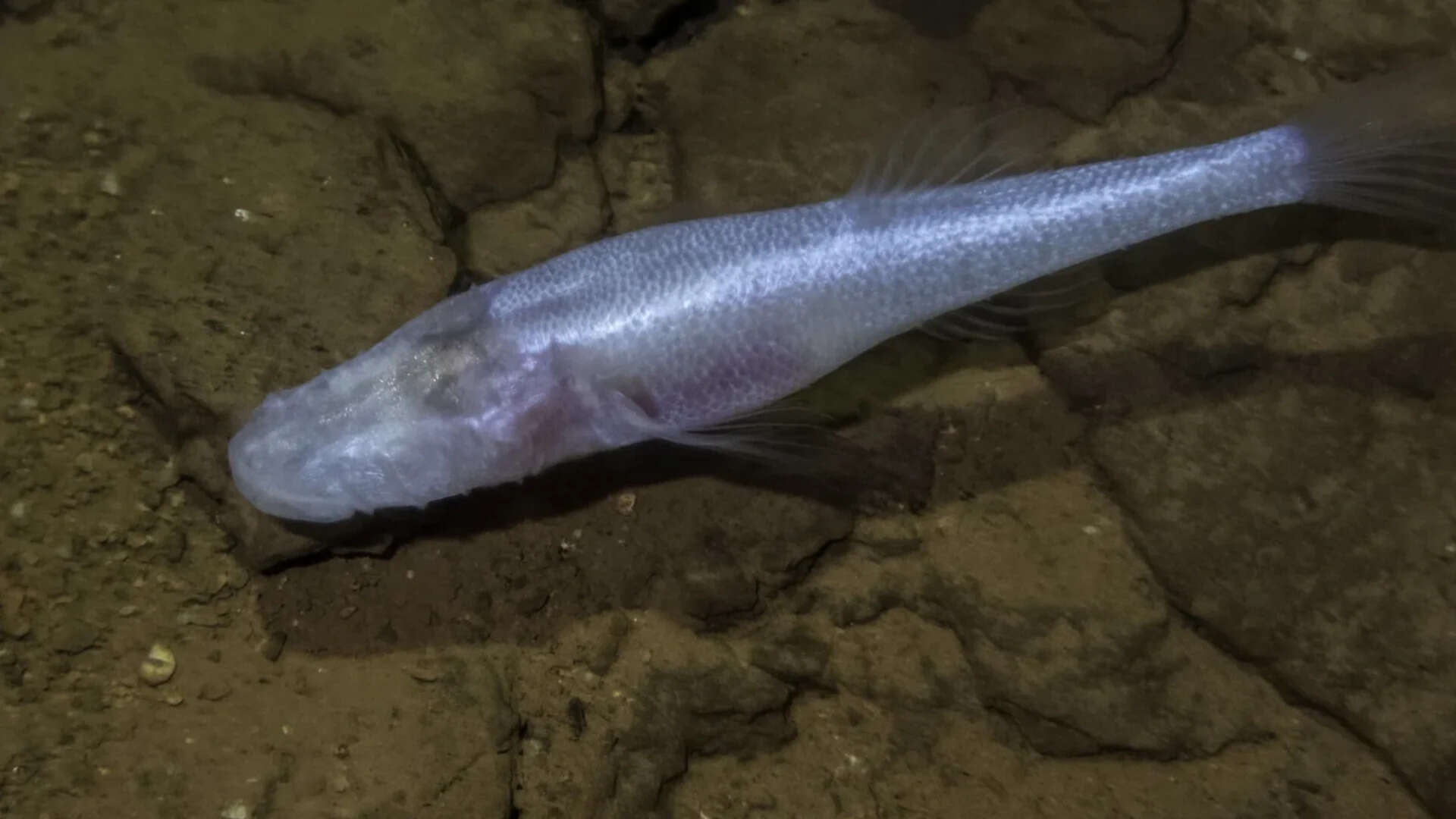
Deep beneath the concrete runways and high-security fences of America’s southern military installations lies a world of perpetual darkness, holding secrets that the Pentagon would often prefer to leave undisturbed. When researchers slipped into the subterranean water systems beneath these bases, they did not just find a strange, translucent creature known as the demon cavefish. They uncovered a brewing crisis where national security, unregulated groundwater pumping, and the survival of ancient ecosystems are locked in a silent, high-stakes collision. This is not a simple story of a quirky biological discovery, but a warning about the rapidly depleting water systems that support both military readiness and millions of civilian lives.
The discovery of these blind, pale organisms—surviving in deep artesian wells hundreds of feet below the surface—presents a stark reality. These creatures are the ultimate biological indicators of aquifer health. If they are pushed to extinction by the military's massive hydrological footprint, it means the very water supply keeping these bases operational is on the verge of collapse.
The Deep Descent Under the Runway
Military installations are notoriously difficult to access for civilian scientists. For decades, the vast underground aquifers beneath bases like Joint Base San Antonio in Texas have remained a black box. Hydrologists and biologists knew that these deep limestone cavities held water, but they did not grasp the complexity of the life teeming within them.
Accessing these deep wells requires navigating a labyrinth of security clearances, armed escorts, and physical danger. Scientists must lower specialized traps and monitoring equipment through narrow, deep-bore wells that plunge straight through the limestone.
The water is pitch black.
In this subterranean pressure cooker, evolution took a radical turn. Over millions of years, species like the widemouth blindcat—the infamous "demon cavefish" known scientifically as Satan eurystomus—shed their eyes and pigmentation entirely. They do not need them. Instead, they rely on highly sensitive lateral lines and chemical receptors to hunt in an environment where food is incredibly scarce.
But these creatures are not just evolutionary oddities. They are highly specialized apex predators of an incredibly fragile underground food web. Because they sit at the very top of their isolated ecological system, any change in water chemistry, pressure, or volume reverberates through them instantly. When scientists pull up traps containing dead or dying specimens, it is a sign that the structural integrity of the aquifer itself is failing.
The Hydrological Conflict of Interest
To understand why this is a crisis, one must look at the sheer scale of water consumption required to run a modern military installation. A base is essentially a self-contained city, complete with housing, industrial maintenance facilities, runways that require constant washing, and weapons-testing facilities that consume millions of gallons of water daily.
This creates a profound conflict of interest. On one hand, the Department of Defense is legally bound to comply with certain environmental regulations, including the Endangered Species Act. On the other hand, national security priorities almost always override local conservation efforts.
The legal battles over these water resources are quietly intense. Under the federal reserve water rights doctrine, the military can claim a right to as much water as it needs to fulfill its primary mission. This often leaves local groundwater conservation districts powerless to regulate the amount of water being pumped from beneath military property.
Sovereign Immunity and Secret Water
Local authorities often find themselves completely shut out of the conversation. When a municipal water district attempts to audit water usage or enforce pumping limits during a drought, military attorneys can invoke sovereign immunity.
This legal shield allows bases to pump water without disclosing the exact quantities to local regulators. The justification is simple. Disclosing exact water consumption figures could theoretically allow foreign adversaries to calculate the operational capacity, troop strength, and readiness levels of a specific base.
While this argument holds weight from a tactical standpoint, it creates a hydrological nightmare. Aquifers do not respect property lines or military borders. When a base pumps millions of gallons of water to cool data centers or maintain massive training fields, the water table drops for everyone in the surrounding region.
Why the Demon Fish Matters to Millions of Civilians
It is easy for critics to dismiss the plight of a tiny, blind fish living in a dark cave. Why should taxpayers care about an animal they will never see, especially if protecting it might interfere with national defense?
The answer lies in the concept of aquifer compaction.
When water is pumped out of a limestone aquifer faster than it can rain back down and recharge, the structural integrity of the underground stone begins to fail. Empty caverns collapse under the weight of the earth above them. Once these underground chambers collapse, they can never hold water again.
[Healthy Aquifer] --------> [Over-Pumping] --------> [Compaction & Collapse]
Water fills limestone       Water is removed         Caverns collapse
caverns; supports life.     leaving empty voids.     Storage capacity lost forever.
The demon cavefish is the first to feel this pressure. As water levels drop, their habitat shrinks, and the concentration of surface-level pollutants—like industrial runoff, heavy metals, and per- and polyfluoroalkyl substances (PFAS) commonly used in military firefighting foams—becomes deadly.
If the water becomes too toxic or too scarce for these highly resilient survivors, it is already unsafe for human consumption. The cities surrounding these bases, which rely on the exact same aquifers for their municipal drinking water, are drinking from the same poisoned, dying well.
The Silent Drain
The reliance on outdated geological surveys compounds the issue. Many of the water management plans currently used by military planners are based on models developed decades ago, before the onset of extreme weather patterns and prolonged droughts that have severely reduced aquifer recharge rates.
The recharge zones for these aquifers—the areas of land where rainwater actually sinks into the ground rather than running off into rivers—are being paved over by rapid urban sprawl surrounding military bases.
With less water entering the system and more water being pumped out, the pressure in the deep artesian zones is falling rapidly. This pressure drop does not just threaten the cavefish; it threatens the entire physical infrastructure of the region. Land subsidence, where the ground literally sinks, is already damaging runways, highways, and residential foundations near major installations in the South and Southwest.
The Path to Hard Accountability
Solving this crisis requires a fundamental shift in how the military views its natural resources. The era of treating groundwater as an infinite, invisible resource is over.
First, military installations must transition to closed-loop water recycling systems for industrial processes, such as aircraft washing and equipment cooling. These processes do not require pristine groundwater, yet they currently consume millions of gallons of it every year.
Second, the Pentagon must allow independent, third-party hydrological monitoring on military land. While national security must be maintained, the data regarding groundwater levels and species health can be shared securely with state and local authorities without compromising sensitive operational details.
Finally, federal funding must be directed toward protecting the recharge zones that lie outside military borders. By preserving the open land where rainwater enters the aquifer, we can ensure that the subterranean rivers beneath these bases remain flowing and stable.
The demon cavefish is a survivor of a prehistoric world, having outlasted ice ages and cataclysms by adapting to the harshest environment imaginable. But it cannot adapt to a dry well. If we allow the systems beneath our feet to be pumped dry in the name of short-term security, we will find ourselves facing a far more immediate threat: a nation with the most advanced military in the world, but no water left to drink.