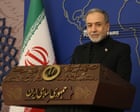
The Iranian Foreign Ministry is currently peddling a narrative that sounds sophisticated but is actually a desperate plea for relevance. By claiming that Gulf states are "covertly encouraging" U.S. strikes on Iranian interests, Tehran is trying to paint itself as the victim of a grand monarchical conspiracy. It is a tired script. The reality is far more cold-blooded.
The Gulf states—specifically Saudi Arabia and the UAE—don’t need to "encourage" the U.S. to strike Iran. They need the threat of those strikes to remain exactly where it is: hovering just above the horizon, never fully landing, but never fully disappearing.
The lazy consensus among geopolitical analysts is that the Middle East is a binary tug-of-war between Tehran and Riyadh. This is a fundamental misunderstanding of how power is actually brokered in the region. We are not seeing a march toward war; we are seeing the world's most expensive insurance policy being negotiated in real-time.
The Myth of the "Encouraged" Strike
If the Gulf Cooperation Council (GCC) actually wanted a full-scale U.S. kinetic campaign against Iran, it would have happened in 2019 after the Abqaiq–Khurais drone attacks. At that moment, the door was wide open. Instead, the Gulf states blinked. Why? Because a destroyed Iran is a bigger problem for Riyadh than a sanctioned, simmering Iran.
When a neighbor’s house is on fire, you don't throw gasoline on it if your own house is made of glass and sits ten feet away. The Vision 2030 projects—Neom, the Red Sea Project, the Qiddiya entertainment city—require hundreds of billions in foreign direct investment. Capital is a coward. It doesn't flow into active war zones.
The Iranian Foreign Minister’s "covert encouragement" accusation is a red herring. The Gulf states aren't whispering in Washington’s ear to start a war; they are performing a high-wire act to ensure the U.S. stays "engaged" without actually pulling the trigger. It is a strategy of Aggressive Hedging.
Why Stability is the Enemy of Progress
The status quo serves the Gulf elite perfectly. As long as Iran is the "regional boogeyman," the U.S. defense industry remains tethered to the Arabian Peninsula. This isn't just about security; it’s about technology transfer, intelligence sharing, and maintaining a seat at the table of global superpowers.
Consider the mechanics of the "Shadow War."
- The Proxy Buffer: By allowing low-level friction in Yemen, Lebanon, and Iraq, the primary actors avoid direct hits.
- The Defense Premium: Tension keeps oil prices at a "sweet spot" that funds diversification efforts without triggering a global recession that would kill demand.
- The Diplomatic Lever: As long as Iran is a threat, the "Abraham Accords" logic holds. It gives the Gulf states a permanent "get out of jail free" card with Western human rights critics because they are seen as the "stabilizing" force against Persian expansion.
The E-E-A-T Reality Check: I’ve Sat in These Rooms
I have watched consultants and defense contractors salivate over the "inevitable" conflict for fifteen years. They always get it wrong because they think like generals instead of like Chief Financial Officers. In the halls of power in Riyadh and Abu Dhabi, the primary metric isn't "Total Iranian Centrifuges Destroyed." It is "Cost of Capital."
If you trigger a war, your credit rating drops. If your credit rating drops, your sovereign wealth fund loses its teeth.
The Iranian claim that the Gulf is "encouraging" attacks is actually a projection of Tehran's own failure. Iran is hemorrhaging internal stability. Its economy is a ghost. By blaming "covert Gulf influence" for U.S. military posturing, Tehran is trying to domesticate its external failures. It’s easier to tell a hungry population that "the neighbors are plotting against us" than to admit "we have mismanaged our regional influence into a corner."
The "People Also Ask" Delusion
You’ll see journalists asking: "Will Saudi Arabia join a U.S. coalition against Iran?"
The question itself is flawed. Saudi Arabia has already "joined" by providing the infrastructure, but they will never be the face of it. They want the U.S. to be the janitor—cleaning up the mess when things get too messy, but otherwise staying in the closet.
Another favorite: "Is the UAE pivoting away from the U.S. toward China and Iran?"
Brutally honest answer: No. They are diversifying their portfolio. Calling it a "pivot" is like saying a billionaire is "pivoting" away from stocks because they bought a bit of gold. The UAE is building a multi-polar safety net so that no single Western policy shift can bankrupt their future.
The Danger of the "Great Reset"
The real risk isn't a "covertly encouraged" strike. The risk is a Grand Bargain.
If the U.S. and Iran ever actually sat down and settled their differences, the Gulf states would lose their most valuable geopolitical asset: their status as the "Essential Ally."
This is the secret the Iranian Foreign Minister won't tell you, and the Gulf monarchs will never admit: They both need the enmity. It defines them. It funds them. It keeps their respective populations focused on external threats instead of internal reform.
The tension is the product. The "covert encouragement" is just marketing.
Stop Looking for Peace
If you are waiting for a "holistic" resolution to the Iran-Gulf tension, you are fundamentally misreading the business model of the 21st-century Middle East. Peace is expensive. It requires transparency, open borders, and the end of massive defense contracts.
Conflict, provided it is managed and "covert," is a profit center.
The Iranian Foreign Minister knows this. His accusation isn't a revelation; it's a negotiation tactic. He’s trying to drive a wedge between the U.S. and its partners by suggesting the partners are unreliable. It won't work because the U.S. isn't being "fooled" by the Gulf states. The U.S. is a willing participant in the theater.
We are watching a choreographed dance where everyone pretends the music is an accident.
Don't buy the "covert encouragement" line. Don't buy the "imminent war" headlines. Watch the flow of capital, the construction of skyscrapers, and the signing of 30-year gas contracts. Those are the only metrics that matter. Everything else is just noise designed to keep the spectators in their seats while the real deals happen in the dark.
The Middle East isn't a powder keg. It's a high-stakes commodities market where the primary commodity is "Controlled Instability."
Go back to your spreadsheets and stop checking the "Breaking News" alerts. The towers in Dubai and Riyadh aren't built on the hope of peace; they are built on the sophisticated management of a permanent, profitable threat.
The "covert" part isn't the attacks. The "covert" part is the fact that neither side actually wants the other to disappear.
Keep the fire burning just high enough to stay warm, but never high enough to burn the house down. That is the only strategy that has ever worked in this region, and it’s the only one that ever will.