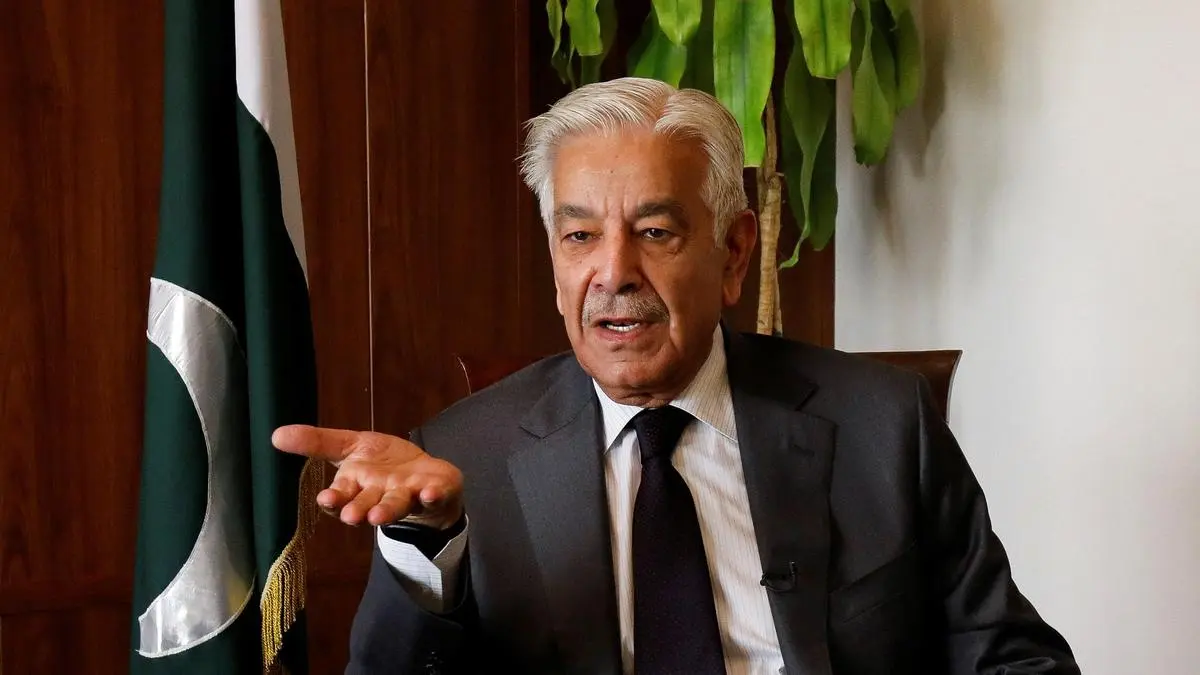
The air in Islamabad during April is often heavy, a thick curtain of heat that signals the coming monsoon. But inside the corridors of power, the atmosphere has little to do with the weather. It is defined by the weight of silence. Pakistan’s Defense Minister, Khawaja Asif, recently broke that silence with a revelation that carries the scent of a storm: a new round of negotiations between Tehran and Washington is looming on the horizon.
To the casual observer, this is a headline about diplomacy. To those living in the shadow of these two giants, it is a matter of survival.
Think of a small shopkeeper in a border town like Taftan. Let’s call him Hamid. Hamid doesn’t care about the intricacies of the Joint Comprehensive Plan of Action or the specific percentages of uranium enrichment. He cares about the price of cooking oil. He cares about whether the electricity, often piped in from across the Iranian border, stays on long enough to keep his milk from curdling. When the United States and Iran stop talking, Hamid’s world shrinks. Sanctions tighten like a garrote. Trade dries up. The "shadow economy" becomes the only economy, and the risks of doing business become deadly.
Minister Asif’s announcement isn't just a political update. It is a signal to the Hamids of the region that the pressure might—just might—ease.
The Geography of Anxiety
Pakistan occupies a precarious seat at this table. It is the neighbor that hears the shouting through the walls. When tensions between Iran and the West escalate, Pakistan finds itself in an impossible squeeze. On one side lies a historical, cultural, and energy-rich neighbor in Iran. On the other, a vital security and financial partner in the United States.
The minister’s confirmation of upcoming talks suggests a shift in the tectonic plates. For years, the relationship between Washington and Tehran has been a series of "frozen conflicts" and "maximum pressure" campaigns. But pressure without a vent eventually leads to an explosion.
Pakistan is currently desperate for that vent. The country is grappling with an energy crisis that threatens to derail its industrial base. The Iran-Pakistan gas pipeline, a project that has lived in a state of perpetual limbo for decades, sits as a rusting monument to geopolitical friction. Iran has finished its side. Pakistan has stalled, paralyzed by the fear of American sanctions that would follow any move to connect the pipes.
Asif’s words carry a hidden subtext: if the U.S. and Iran can find a way to sit in a room together, Pakistan might finally be able to turn the valves.
The Ghost at the Table
Negotiation is a deceptive word. It implies a sense of balance, two parties meeting in the middle. In reality, these talks are a high-stakes poker game played with the lives of millions.
The "core facts" are easy to find. We know that the 2015 nuclear deal is a skeleton of its former self. We know that regional proxies continue to clash from the Levant to the Red Sea. But the human element is found in the uncertainty.
Consider the Iranian student who wants to study abroad, or the American family waiting for a detained relative to come home. These are the "human chips" on the table. When Khawaja Asif speaks of "negotiations expected soon," he is talking about the possibility of humanizing a conflict that has become dangerously abstract.
The rhetoric from Tehran often paints the U.S. as an existential threat. The rhetoric from Washington often paints Iran as a rogue state beyond the reach of logic. But when the doors close and the cameras go away, the language changes. It has to. You cannot negotiate with a monster; you can only negotiate with a person who has interests, fears, and a constituency back home that needs a win.
The Pakistani Tightrope
Why is it the Pakistani Defense Minister delivering this news?
It highlights Islamabad's unique, and often thankless, role as a regional bridge. Pakistan has a vested interest in seeing these two powers find a detente. A conflict between the U.S. and Iran would not stay within their borders. It would spill over, sending waves of refugees, skyrocketing oil prices, and extremist volatility into a South Asia that is already brittle.
Asif is playing the role of the town crier, but he is also a stakeholder. By announcing the talks, he is signaling to the international community that Pakistan is not just a bystander. It is a facilitator. It is a nation that understands the nuances of the Persian mind and the demands of the American machine.
However, this role comes with a cost. Being the middleman means you are often the first to be blamed when things go wrong and the last to be thanked when they go right.
The Language of the Unspoken
What will these talks look like? They won't be grand summits with flags and handshakes. They will likely be "proximity talks"—the diplomatic equivalent of passing notes in class. One delegation sits in a room, a mediator walks across the hall to the other room, and the slow, agonizing process of building a bridge begins.
They will talk about sanctions relief. They will talk about regional stability. They will talk about the red lines that neither side is willing to cross.
But the real conversation is about trust. Or, more accurately, the management of mistrust.
Imagine two people standing on opposite sides of a canyon, trying to build a bridge by throwing stones. Most of the stones fall into the abyss. But every once in a while, a stone hits the other side. You keep throwing until you have enough of a pile to step on.
Asif is telling us that the stone-throwing is about to begin again.
The Invisible Stakes
The stakes are not just about nuclear centrifuges. They are about the stability of the global oil market. They are about the safety of shipping lanes in the Strait of Hormuz. They are about whether a generation of young Iranians will grow up in isolation or integrated into the world.
For the United States, a successful negotiation means one less fire to put out in a world that is currently ablaze with conflicts in Europe and the Pacific. For Iran, it means an end to the economic strangulation that has fueled domestic unrest.
For Khawaja Asif and the people of Pakistan, it means a chance to breathe.
We often treat international relations like a game of chess, where pieces are sacrificed for a greater strategy. But in the real world, the pieces bleed. The "facts" of a diplomatic meeting are the dry husks of a story that is actually about bread, heat, medicine, and the basic human right to live without the constant threat of a falling sky.
As the heat in Islamabad rises, the world watches the calendar. "Expected soon" is a vague timeline, but in the world of high diplomacy, it is a heartbeat. It is a pulse. It is the sound of a door being unlocked, even if no one has walked through it yet.
The shopkeeper in Taftan waits. The student in Tehran waits. The policymaker in D.C. waits. They are all linked by a thread of hope that is as thin as a diplomat’s promise and as heavy as the history of two nations that have forgotten how to speak the same language.
The room is being prepared. The chairs are being set. Somewhere, a light is being turned on in a room that has been dark for far too long.