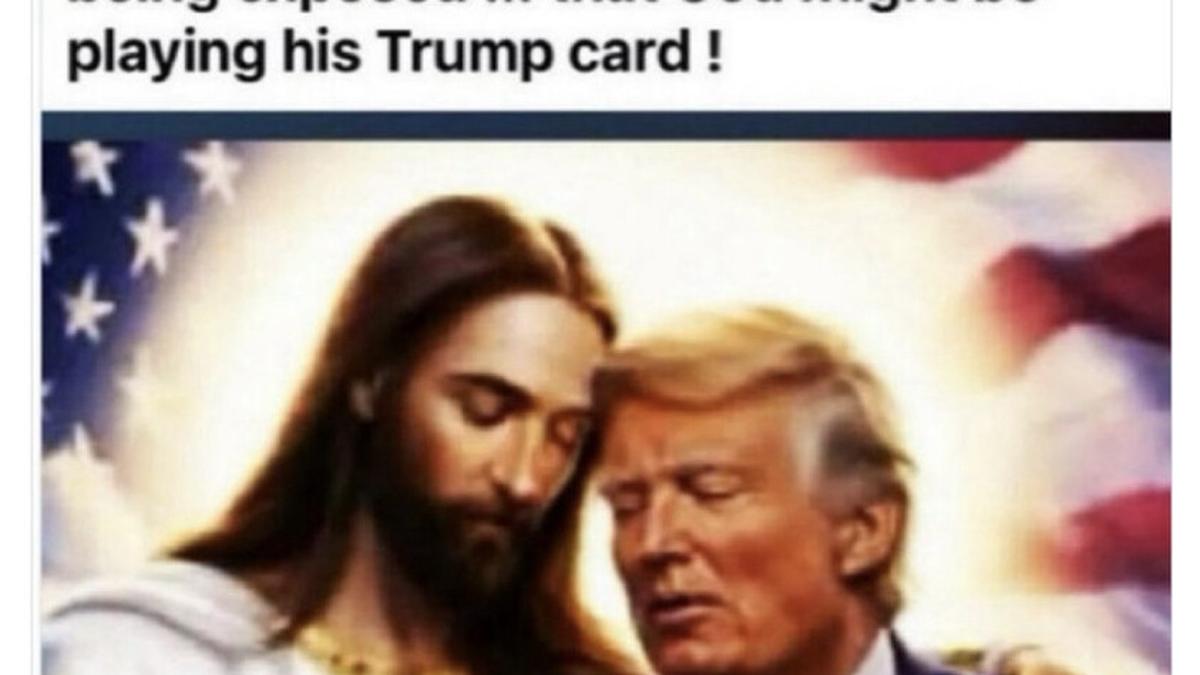
The utilization of religious iconography in modern political communication serves as a high-leverage tool for consolidating constituent identity while simultaneously creating a deliberate friction point with institutional religious authority. When Donald Trump distributes imagery depicting a proximity to Jesus Christ, the action is not a theological claim but a strategic deployment of Sacred Association. This mechanism operates by bypassing traditional denominational gatekeepers—such as the Vatican or established church hierarchies—to forge a direct, unmediated link between a political figure and a divine mandate. The resulting conflict with the Holy See is a predictable byproduct of a competition for moral signaling authority.
The Structural Architecture of Sacred Association
The efficacy of religious political imagery relies on three distinct psychological and sociological pillars. Understanding these explains why such posts resonate with a specific base while drawing sharp rebukes from clerical bodies.
- Identity Fusion: The imagery forces a cognitive merge between a supporter’s religious identity and their political affiliation. By placing the candidate in the same visual plane as a deity, the "sacred" status of the deity is transferred to the candidate’s policy platform. This makes opposition to the candidate feel like an opposition to the faith itself.
- Disruption of Mediation: Historically, religious institutions acted as the "arbiters of the sacred." They decided what was blasphemous or pious. Digital dissemination allows a political actor to seize the "means of sanctification," communicating directly with the laity and rendering the Pope’s criticisms irrelevant to the target audience.
- Signal Boosting via Contradiction: Conflict with the Vatican serves as a proof point for the candidate’s "outsider" status. For a populist base that views global institutions with skepticism, a critique from the Pope is not a moral failing but evidence that the candidate is successfully challenging the "globalist" status quo.
Institutional Friction The Cost Function of Moral Authority
The tension between the Trump administration’s rhetoric and the Vatican’s social doctrine creates a volatile marketplace for moral authority. This friction is best understood through the lens of The Hierarchy of Compliance. The Catholic Church operates on a global, multi-generational timeline, prioritizing doctrine and institutional stability. In contrast, a political administration operates on a four-year cycle, prioritizing immediate electoral mobilization.
When the administration or its surrogates criticize the Pope, they are executing a Targeted De-legitimization. By framing the Pope’s comments on migration or climate as "political" rather than "pastoral," the administration provides its Catholic supporters with the cognitive tools to ignore papal authority without abandoning their faith. This creates a schism between "Cultural Catholicism" and "Institutional Catholicism."
The cost of this strategy is the erosion of soft power in international diplomacy. The Holy See maintains one of the world's most extensive diplomatic networks. By alienating the Vatican, an administration loses a critical back-channel for mediation in regions where the Church holds significant sway, such as Latin America and parts of Sub-Saharan Africa.
Quantifying the Visual Impact
While sentiment analysis of social media provides some insight, the real metric of success for religious imagery is Engagement-to-Polarization Ratio.
- Positive Engagement: High-velocity sharing within evangelical and traditionalist Catholic digital ecosystems strengthens the "in-group" bond.
- Negative Engagement: Secular or liberal outrage provides the necessary "out-group" friction that confirms the imagery’s power.
The image does not need to be "believed" in a literal sense to be effective. It functions as a Tribal Guidon. Just as a flag identifies a unit on a battlefield, the Jesus-Trump imagery identifies a digital territory. The inaccuracy or "cringe" factor cited by critics is a feature, not a bug; it acts as a filter that separates true believers from those who are merely "politically aligned."
The Displacement of Traditional Clergy
The rise of the "Digital Pastor" or the "Political Prophet" has effectively outsourced the role of the local priest or bishop to social media influencers and political figures. This displacement creates a power vacuum. When the Vatican issues a statement of concern regarding the "politicization of the faith," it is reacting to its own diminishing market share of the believer’s attention.
The administration’s strategy exploits a specific vulnerability in modern religious life: the preference for Aesthetic Orthodoxy over Doctrinal Orthodoxy. A supporter may not know the specifics of the Catechism of the Catholic Church, but they recognize the visual language of holiness. By colonizing that visual language, the political actor gains the benefits of religious devotion without the requirements of religious obedience.
Logical Failures in Institutional Responses
The Vatican and other religious critics often fail in their counter-messaging because they address the content rather than the context.
- The Literalism Trap: Clergy often point out the theological inaccuracy of the imagery. This is ineffective because the audience is not consuming the image as a theological text, but as an emotional signal.
- The Authority Fallacy: Appealing to the "office of the Pope" assumes that the audience still accepts that office as the final word on morality. In a fragmented media environment, authority is "opt-in."
To regain influence, religious institutions would have to offer a competing visual and emotional narrative that is as high-velocity as the political one—a task for which ancient, slow-moving bureaucracies are ill-equipped.
The Strategic Trajectory of Sacralized Politics
The current trajectory suggests that the boundary between political branding and religious devotion will continue to dissolve. This is not a localized American phenomenon but a global shift toward Identity-First Governance.
The immediate tactical move for the administration is to double down on the "Persecuted Prophet" narrative. Every criticism from the Pope or the "liberal" religious establishment will be reframed as a spiritual attack. This creates a feedback loop where the candidate's survival is viewed as a divine necessity.
Religious institutions must choose between two suboptimal paths:
- Aggressive Excommunication: Formally distancing themselves from the political actors, which risks losing a massive percentage of their active base.
- Quietism: Withdrawing from the political sphere to focus on pure doctrine, which risks becoming culturally irrelevant.
The political actor, meanwhile, has no such dilemma. They will continue to harvest the symbolic capital of the Church until the asset is depreciated or until the base finds a more potent symbol. The final play is the conversion of the political party into a de facto church, where policy papers are replaced by icons and voting is rebranded as a test of faith.